
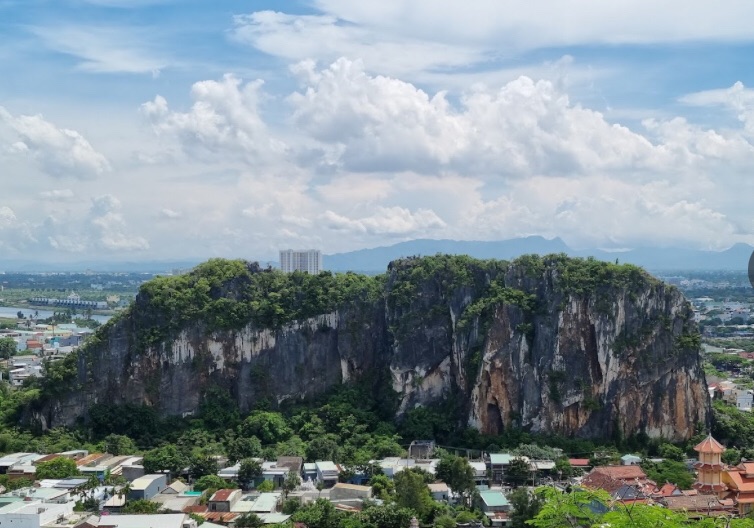
Marble Mountains is a group of five limestone peaks situated seven kilometres from downtown Da Nang. The five karsts (called Ngu Hanh Son in Vietnamese) are named after the five elements: Kim (metal), Thuỷ (water), Mộc (wood), Hoả (fire) and Thổ (earth). Over centuries, Marble Mountains has held special significance for the people of Central Vietnam. The ancient Cham revered the karsts as a spiritual site, and Vietnamese emperors from Hue and legendary generals passing through paid visits to the peaks, adding to their store of legends.
Marble Mountains is home to a network of caves, tunnels, towers, and pagodas built by Mahayana Buddhists and the Nguyen Dynasty Kings.
There are half a dozen large caves hidden away in the Marble Mountains, and many other small ones that are rarely visited. All the caves in Marble Mountains have unique features, and some have fascinating stories of being discovered and used as hideaways over the centuries.
On Water Mountain, Hoa Nghiem Cave is watched over by a beautiful 400-year-old stone statue of Lady Buddha’ and on Metal Mountain, Tang Chon Cave is worth a wander for the marble statues of chess players and mandarins placed inside the cave’s warrens.
This tour is about the Tang Chon Cave (Dong Tong Chon) which means “contains all truths of the universe”.
Cham people used to live and worship the gods here in the 12th century. During the reign of Le Canh Hung (1740-1786), they left and started living in Phan Rang which is 95 kms south of Nha Trang. Vietnamese rediscovered the caves, settled in the area and worshiped Buddha.
King Minh Mang (1791-1841) who was the second emperor of Nguyen dynasty of Vietnam named it Tang Chon cave meaning treasure or “the place where the treasure is stored”.
There are five caves inside Tang Chon are:
- Thien Long Coc Cave: – The shrine has three compartments with image in each section. In the center is Lao Tu altar, the right compartment of which is to worship Linh Son Thanh Mau, and the left to worship Bat Bo Kim Cuong.
- Ban Co Tien Cave: – On the left side of shrine is a semi-circular cave with two marble figures in white. They sit with a chess board between them. According to the legend, gods came down to play chess and talk.
- On the right side of central shrine, stairs lead to a cave of Di Da Buddha or Amitabha cave.
- Chiem Thanh cave also called the Cham Pa cave is next to the Di Da cave. The entrance to cave is very narrow.
- Tam Thanh cave:
Outside these caves is the Xa Loi Tower. This 28-metre structure houses 200 statues of Buddha, and offers breathtaking views of the landscape below.
 Prabhu's Ponder