Ha Long Bay Cruise – Day 2 – Vietnam Travel Diary – 6

The Karsts

Hạ Long Bay, in northeast Vietnam, is known for its emerald waters and thousands of towering limestone islands topped by rainforests. 

The limestone in this bay has gone through 500 million years of formation in different conditions and environments. The evolution of the karst in this bay has taken 20 million years under the impact of the tropical wet climate.
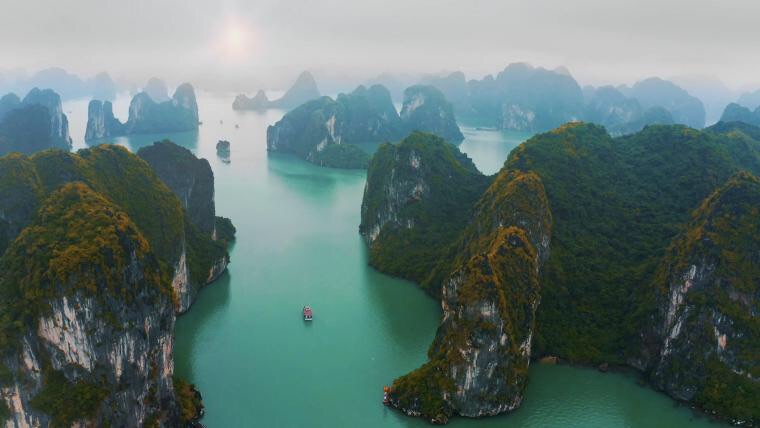
Ha Long Karst

Karst is a type of landscape formed by the dissolution of soluble rocks like limestone, resulting in features such as sinkholes, caves, underground rivers, and springs. This process is caused by slightly acidic water, typically rainwater, seeping into cracks and dissolving the bedrock over millions of years. The term “karst” originates from the Karst Plateau in Slovenia and the surrounding region, and these landscapes are found globally, covering about 10-11% of the Earth’s surface. 

Among the 1,969 sunken limestone towers submerged in the indigo waters of Ha Long Bay are a series of ancient caves and grottoes – many of which remained unexplored. To date, there are 59 caves listed on the official registry (this includes the most recent discovery of 23 ‘new’ caves), all of which have a special belonging in Ha Long Bay’s distinctive ecosystem. Undoubtedly the most famous of them all is Sung Sot Cave, which has rightfully earned its near-legendary status among visitors to the world-famous bay.

    Day 2, commences with Tai Chi lessons at 0630 on the top deck of the cruise boat. Weather permitting, sun rise visuals are pleasing. After a sip of coffee/tea with cookies, we proceed on a smaller boat to Sung Sốt cave.

      Sung Sốt cave

      Sung Sốt cave is an old phreatic cave. It means “Grotte des Surprises”, or Surprising Cave, because of its ‘surprising’ beauty. It is on Bo Hon Island. From its truncated entrance chambers on a ledge high on the cliff, a passage of more than 10m high and wide descends to the south. It takes an hour to walk through the cave.

      Sung Sot cave is the largest, perhaps the most renowned, and likely the most visited of all. 

      There’s a small dock at the bottom of Bo Hon Island, where you’ll dismount your boat and begin the climb up 100 or so steps to the mouth of Sung Sot Cave. The cave covers a staggering 10,000 square meters (that’s twice the size of the White House if that’s anything to go by).

       The interior is separated into 2 caverns, the first of which is a small amphitheater type of space connected by a small passageway to the larger cavern next door, which is big enough to hold 1,000 people or more. The entire cave is bestrewn with stalactites and stalagmites, which serve as endless material for the legend and ‘lore of the area.

      After the visit, it is time to pack up, checkout and loiter around the boat till it docks back.  

      Here is my video.
      Ha Long Bay Cruise – Day 1 – Vietnam Travel Diary – 5

      TiTop Island

      Ha Long Bay

      Hạ Long Bay, in northeast Vietnam, is known for its emerald waters and thousands of towering limestone islands topped by rainforests. 

      The name Hạ Long means “descending dragon”. Hạ Long Bay has an area of around 1,553 km2 (600 sq mi), including 1,969 islets, most of which are limestone. The core of the bay has an area of 334 km2 (129 sq mi) with a high density of 775 islets.

      The Cruise along the Ha Long Bay starts on a sleek, modern vessel that fuses contemporary styling with Vietnamese design concepts. Paradise Elegance is a luxury cruising on Ha Long. Boasting a piano bar, day spa, butler service and the full range of dining options, cruise on the Elegance is an experience exquisite, the journey flawless.

      The day (literally noon, after a long drive from Hanoi) starts with a briefing, a welcome song followed by Lunch. There were excellent Indian vegetarian options on board with an Indian Chef dishing out delicacies to our taste buds.

      TiTop Island

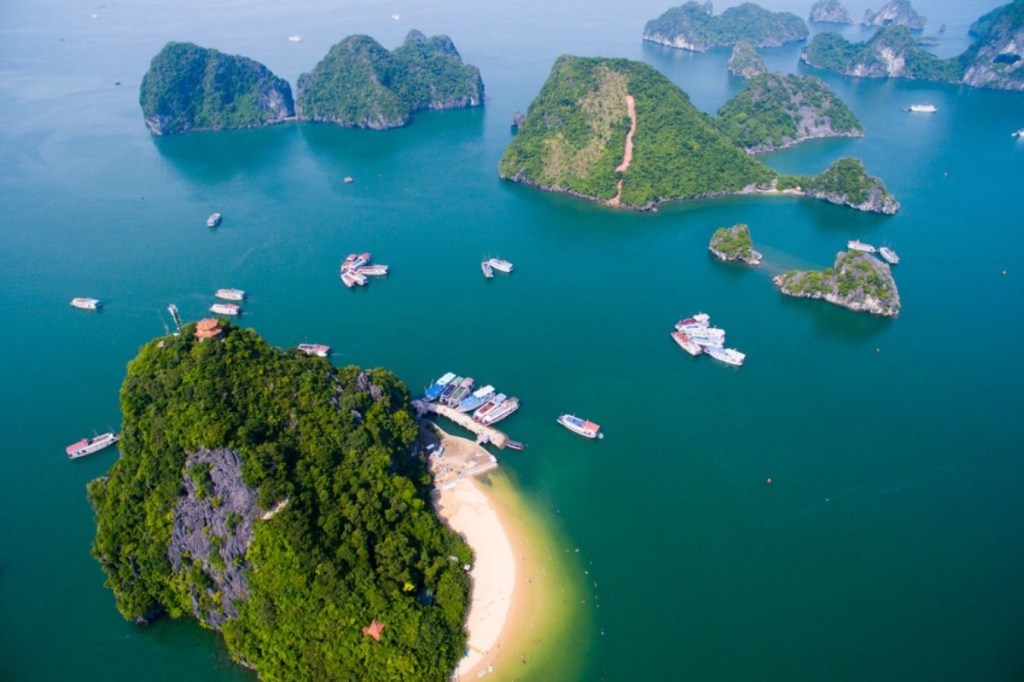
      After lunch and of course after a siesta in the comfortable cabin, we head to TiTop Island sits at the heart of Ha Long Bay. It is relatively small (a total area of 3.7 hectares); yet it’s regarded as one of the most picturesque islands in the bay and is a crowd favorite among Halong tourists.

      Formerly called Cat Nang Island, it is now named after Russian cosmonaut Gherman Titov, who in 1961 boarded the spaceship Vostok 2 and became the second man to orbit the Earth (after fellow Russian Yuri Gagarin who beat him by just a few months).

      A year later, he visited Halong Bay and toured the area with Vietnam’s revered leader – Ho Chi Minh. He consulted with the locals and, in a gesture of friendship between Vietnam and Russia, renamed the island ‘Titov’ in honor of the valiant cosmonaut.

      Titop offers breathtaking landscapes that can be viewed from a vantage point high up in the center of the island. The climb up the hill is a test of the strength of your knees as the steps are steep, winding and very often without side supports with only ropes to hold on and people forming ant line for climbing up and coming down. This island has a crescent-shaped beach, Vang Trang beach – It is now known as TiTop Beach. The beach is known for its tranquility, powdery white sand, and azure blue waters. 

      Luon Cave

      A trip to TiTop hills, ensures that the gourmet lunch you had is well digested. It is now time for a Cuppa at the Elegance. A lecture demonstration of making Spring Rolls is followed by Tea. After tea, we use a smaller boat to enter the Luon Cave. If you are an ardent kayaker, you can do that. 

      Luon Cave is a natural water tunnel in Vietnam’s Halong Bay that leads to an enclosed, scenic lagoon. Located on Bo Hon Island,  it is only accessible by small boats or kayaks due to its low ceiling and is popular for kayaking and exploring its unique ecosystem, which includes monkeys and ancient fossils. The cave itself is about 60 meters long. After passing through the cave, you enter a peaceful, enclosed lagoon surrounded by towering limestone formations and filled with lush plant life like ferns and orchids. The area is home to playful monkeys that can often be seen on the cliffs. You can also see evidence of ancient marine life, like fossilized shells, on the cave’s walls.

      The day’s activities come to an end with a retreat back to Elegance. Dinner is followed by Live Music from the Piano Bar.

      Here is my video