
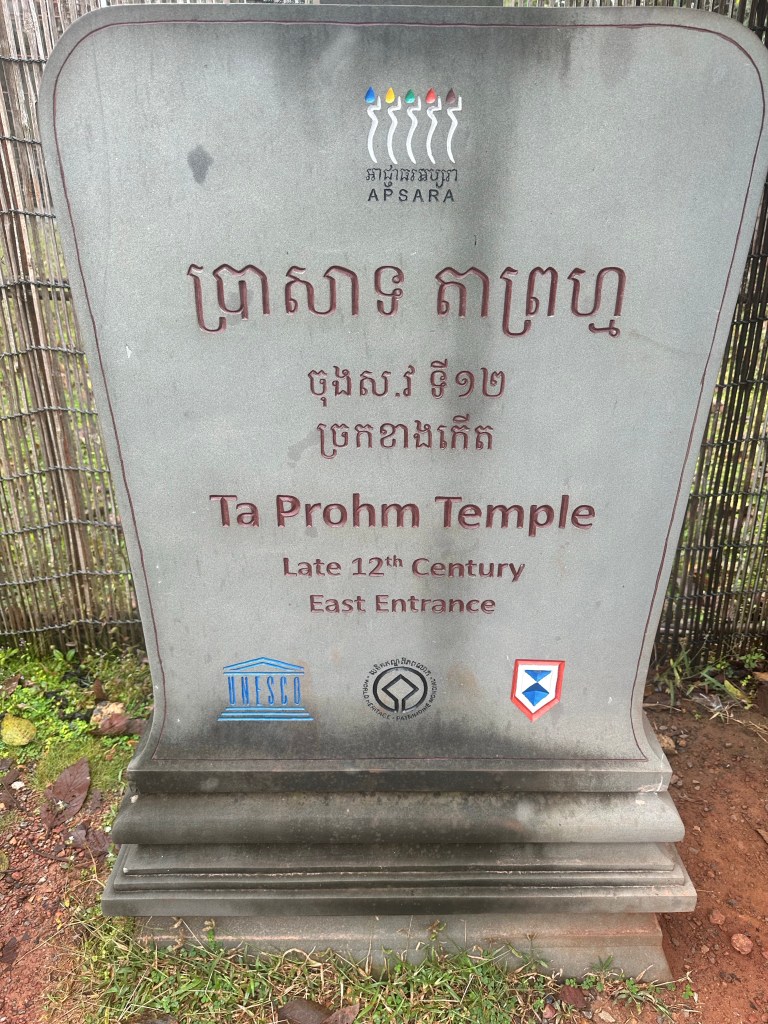
In 1186 A.D., King Jayavarman 7, embarked on a massive program of construction and public works. Rajavihara (“monastery of the king”), today known as Ta Prohm (“ancestor Brahma”), was one of the first temples founded pursuant to that program.
Jayavarman VII constructed Rajavihara in honour of his family. The temple’s main image, representing the personification of wisdom, was modelled on the king’s mother.
The site was home to more than 12,500 people (including 18 high priests and 615 dancers), with an additional 80,000 inhabitants in the surrounding villages working to provide services and supplies.
After the fall of the Khmer Empire in the 15th century, the temple of Ta Prohm was abandoned and neglected for centuries.
In 1992, UNESCO inscribing Ta Prohm on the World Heritage List, initiated the conservation and restoration of Ta Prohm as a partnership project of the Archaeological Survey of India (ASI) and the Authority for the Protection and Management of Angkor and the Region of Siem Reap (APSARA).
By 2013, the ASI restored most parts of the temple complex, some of which were constructed from scratch. Wooden walkways, platforms, and roped railings were put in place around the site to protect the monument from further damages from tourists.
It is emotionally draining to see “one of the most imposing [temples] built for personification of wisdom and was dedicated to a mother, best merging with the jungle, to the point of becoming a part of it”.
Nothing but a soulful “Subha Pantuvarali” , (a raga that stirs one’s soul, evokes grief and sorrow in the heart and focusses one towards the inner consciousness) can describe the feeling one goes through on visiting this place.
I am no exception to that when I visited this place recently.
Here is my YouTube video . Pl subscribe to my channel
https://youtu.be/3u8-Wjk0V2Q?si=mv3u8udLpgQqCDIw
 Prabhu's Ponder