Temple of Literature – Vietnam Travel Diary – 7

Temple of Literature – Hanoi

Văn Miếu, literally translated as Temple of Literature, is a temple in Hanoi, northern Vietnam, dedicated to Confucius, the Chinese Scholar. The temple was founded and first built in 1070 at the time of Emperor Lý Thánh Tông. 

Over the next 6 years, his son established a new complex called the Imperial Academy, which educated royal members, such as nobles, princes, and bureaucrats. They would learn the doctrines of Confucius, as well as other Confucianism-relating theories.

The core belief of Confucianism is to focus on rigorously educating the rules of political, social, and ethical conduct. It is believed to bring wonderful values, encouraging each individual’s development in society.

In 1253, the Hanoi Confucius Temple first opened its doors to excellent commoners coming to study for 3 – 7 years. At that time, the official curriculum was under the strong impact of Imperial China, including the study of Chinese penmanship, literature, and poetry. Despite that, the values of Confucianism have been preserved to this day.

The First Courtyard (Dai Trung Mon)

After coming across the Great Middle Gate, visitors will be impressed by the green and fresh ambiance of Dai Trung Mon. On the right and left side, you can see two special-designed gates called Talent Gate and Virtua Gate respectively. Both gates expressed the expectation of the Vietnamese royalty towards the best achievements in the national educational system.

On the top of the gates, there is a symbol of a fish, which relates to a Vietnamese tradition in the past. Legend has it that the King or God organized a competition to find the strongest fish, which was compared to the way to seek the talents of a nation. Once they overcome all of the challenges, brilliant individuals represented by the symbol Dragon at the academy .

The Second Courtyard (Khue Van Cac)

Khue Van Cac (Pavilion of Constellation) is known as a symbol of the Temple of Literature Hanoi, which is a familiar image to most travelers. It is simply because when you exchange currency for a Vietnam dong, you can easily catch sight of Khue Van Cac on the 100,000 VND banknote.

The Third Courtyard (Thien Quang Well)

Thien Quang Well was constructed in a square shape, representing the earth, together with the circle on the top of the pavilion – meaning the sky. All of these things mean a wish for harmony between the earth and sky, bringing prosperous development to one country.

In this Courtyard of Temple Hanoi, visitors will also see stone turtles with large stelae, as a strong respect for the beliefs of Confucianism and the national Doctors. Although there are only 83 remaining stelae today, this site is one of the impressive royal styles, which is great for visitors to discover more about Vietnamese culture.

The Forth Courtyard (Dai Thanh Mon)

“Dai Thanh Mon” means “the great success” in Vietnamese, boasting the sanctuary to Confucius and the magnificent House of Ceremonies. In the center of the sanctuary, tourists can see an altar – decorated in Vietnamese tradition, with 5 basic elements, including Fire, Metal, Water, Wood, and Earth. Additionally, the altar is always filled with offerings and incense, expressing strong honors to the ancestors of the Vietnamese people. This also makes Dai Thanh Mon one of the most sacred areas in Van Mieu Hanoi.

The Fifth Courtyard (The Grounds of Imperial Academy)

The last courtyard in the Temple of Literature Hanoi is the Grounds of the Imperial Academy. It is the sole place belonging to this temple to be designed on 2 floors. When visiting the ground floor, you will see a statue of the famous Vietnamese teacher Chu Van An. Besides that, visitors also have a chance to discover more about Confucian education of Vietnamese Feudal Dynasties through some pictures and artifacts.

The second floor is the area to worship the three Kings who played important roles in developing Van Mieu Hanoi, including Ly Thanh Tong, Ly Nhan Tong, and Le Thanh Tong. With their contributions, the Vietnamese educational system has been preserved and maintained for thousands of years.

Here is my video

Hanoi – The old and new – Vietnam Travel Diary 8

Cyclo Tour of Old District 

By sitting on a cyclo, slowly going through each street and alley to admire the cultural features and daily life activities of the people, international tourists have interesting experiences when visiting Hanoi. For Hanoians, the image of cyclos has long been an important part of the city’s typical cultural picture. The image of cyclo drivers leisurely pedaling on the old streets, with the characteristic curved glass bell, has become a symbol of peace and tranquility in urban life. It is a special highlight in the landscape of Hanoi, contributing to the diversity and richness of the capital’s culture.

Ho Chi Minh Mausoleum

The President Ho Chi Minh Mausoleum is a mausoleum which serves as the resting place of Vietnamese revolutionary leader and President Ho Chi Minh in Hanoi, Vietnam, is one of Vietnam’s most revered landmarks and stands as a powerful symbol of the nation’s history and independence.

The Ho Chi Minh Mausoleum is centrally located in Ba Dinh Square, Hanoi, an area of immense historical and political significance. It is surrounded by other key landmarks such as the Presidential Palace, One Pillar Pagoda, and the Ho Chi Minh Museum, making it a crucial stop in any Hanoi itinerary.

Water Puppet Show

Every year during the annual rice harvest, farmers in Vietnam’s Red River Delta region would gather for folk singing and dancing at village festivals. About one thousand years ago, water puppets were added to the list of performances at these festivals. The first shows were hosted in the harvested rice fields, which could be filled with water to create a watery stage.

Water puppetry as a folk art form evolved from serving everyday people to a show for royalty.  Under the reign of the Lý Dynasty in the 12th century, the country’s best water puppet troupes were chosen to entertain the king and guests, marking a new high for the art’s social status. Many centuries later, water puppetry (múa rối nước) still fascinates audiences, and is a cherished intangible cultural heritage of Vietnam.

Múa rối nước is a physically demanding craft. Puppeteers stand in water throughout the show, and use the movement of the water to create drama, perfect the illusion, and tell a story. The puppeteers’ secret lies in the material of the puppets themselves, which are made of buoyant fig wood and painted with lacquer. The puppeteers skillfully maneuver the puppet’s arms using bamboo sticks and strings. It takes decades to become a master water puppeteer.

Today in Vietnam, water puppet shows are not presented in flooded rice paddies but in pools of water. These pools are decorated with red tiered roofs, flags, and parasols to resemble an altar inside Vietnamese communal houses. On both sides of the stage sit the musical ensemble who bring the stories to life using their voices and traditional instruments.

A traditional show always starts with an introduction to Tễu, the comedic host. Tễu is an iconic character, a whimsical storyteller who will lead you through different scenes and stories as they unfold on stage. The brightly coloured puppets recreate daily life in Vietnam’s northern villages, including duck herding, fishing, rice planting, boat rowing, and royal parades. Some shows include depictions of Vietnamese folktales, which always carry a moral.

The show we saw was at Thang Long Water Puppet Theatre.

Here is the video of our Hanoi Tour

Ha Long Bay Cruise – Day 1 – Vietnam Travel Diary – 5

TiTop Island

Ha Long Bay

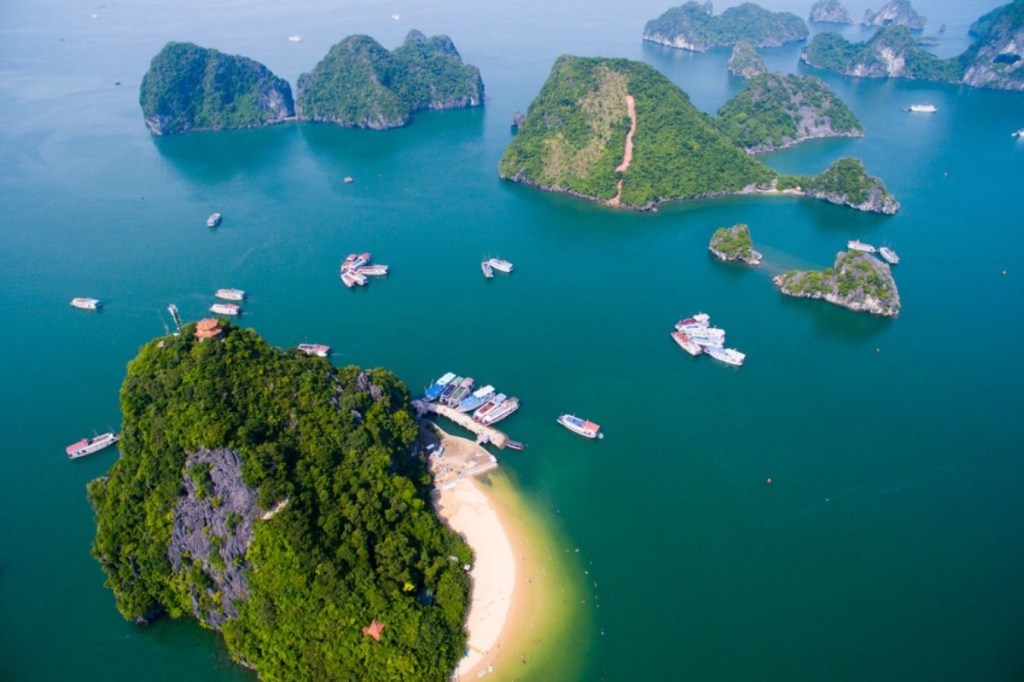
Hạ Long Bay, in northeast Vietnam, is known for its emerald waters and thousands of towering limestone islands topped by rainforests. 

The name Hạ Long means “descending dragon”. Hạ Long Bay has an area of around 1,553 km2 (600 sq mi), including 1,969 islets, most of which are limestone. The core of the bay has an area of 334 km2 (129 sq mi) with a high density of 775 islets.

The Cruise along the Ha Long Bay starts on a sleek, modern vessel that fuses contemporary styling with Vietnamese design concepts. Paradise Elegance is a luxury cruising on Ha Long. Boasting a piano bar, day spa, butler service and the full range of dining options, cruise on the Elegance is an experience exquisite, the journey flawless.

The day (literally noon, after a long drive from Hanoi) starts with a briefing, a welcome song followed by Lunch. There were excellent Indian vegetarian options on board with an Indian Chef dishing out delicacies to our taste buds.

TiTop Island

After lunch and of course after a siesta in the comfortable cabin, we head to TiTop Island sits at the heart of Ha Long Bay. It is relatively small (a total area of 3.7 hectares); yet it’s regarded as one of the most picturesque islands in the bay and is a crowd favorite among Halong tourists.

Formerly called Cat Nang Island, it is now named after Russian cosmonaut Gherman Titov, who in 1961 boarded the spaceship Vostok 2 and became the second man to orbit the Earth (after fellow Russian Yuri Gagarin who beat him by just a few months).

A year later, he visited Halong Bay and toured the area with Vietnam’s revered leader – Ho Chi Minh. He consulted with the locals and, in a gesture of friendship between Vietnam and Russia, renamed the island ‘Titov’ in honor of the valiant cosmonaut.

Titop offers breathtaking landscapes that can be viewed from a vantage point high up in the center of the island. The climb up the hill is a test of the strength of your knees as the steps are steep, winding and very often without side supports with only ropes to hold on and people forming ant line for climbing up and coming down. This island has a crescent-shaped beach, Vang Trang beach – It is now known as TiTop Beach. The beach is known for its tranquility, powdery white sand, and azure blue waters. 

Luon Cave

A trip to TiTop hills, ensures that the gourmet lunch you had is well digested. It is now time for a Cuppa at the Elegance. A lecture demonstration of making Spring Rolls is followed by Tea. After tea, we use a smaller boat to enter the Luon Cave. If you are an ardent kayaker, you can do that. 

Luon Cave is a natural water tunnel in Vietnam’s Halong Bay that leads to an enclosed, scenic lagoon. Located on Bo Hon Island,  it is only accessible by small boats or kayaks due to its low ceiling and is popular for kayaking and exploring its unique ecosystem, which includes monkeys and ancient fossils. The cave itself is about 60 meters long. After passing through the cave, you enter a peaceful, enclosed lagoon surrounded by towering limestone formations and filled with lush plant life like ferns and orchids. The area is home to playful monkeys that can often be seen on the cliffs. You can also see evidence of ancient marine life, like fossilized shells, on the cave’s walls.

The day’s activities come to an end with a retreat back to Elegance. Dinner is followed by Live Music from the Piano Bar.

Here is my video

Ba Na Hills – Vietnam Travel Diary – 3

Sun World Ba Na Hills − the European-themed recreational complex is in the Trường Sơn Mountains, about 30km from Da Nang.

The only way up to Ba Na Hills is via the cable-cars. This infrastructure is among the 10 most impressive cable-car systems in the world. There are various cable lines and stations, depending on where you want to reach. We started at the famous Golden Bridge by taking the Hoi An (05) ground station. We were rewarded with a picturesque ride boasting incredible, 360-degree views.

Golden Bridge, a 150-metre-long bridge, has two giant hands holding the walkway.  This attracts huge crowds every day.

At the top, the French Village has everything one would expect from a medieval village – a town square, cute cafes, a cathedral and fountain. It looks realistic  as you walk the cobbled streets.

At the Linh Ung Pagoda one of the biggest Buddha statues in the land, which sits serenely on a five-metre wide circular base, and is 27 metres tall can’t be missed. Unfortunately the day we were there it was nearly covered by dense mist.

Another attraction that we visited is a 4D theatre where we had to wear glasses. The story was fun and the animation was good.

Outside of Luna Castle  is Lava Castle, which is bright pink. One end is ‘held’ up by an Atlas statue, so make sure you stop and see that!

Rather than walking back to the main area, in the depths of Luna Castle  there is a 400 year old funicular railway that takes 2 minutes to reach a building back in the main plaza.

Here is our video

The Marble Mountains – Vietnam Travel Diary – 2

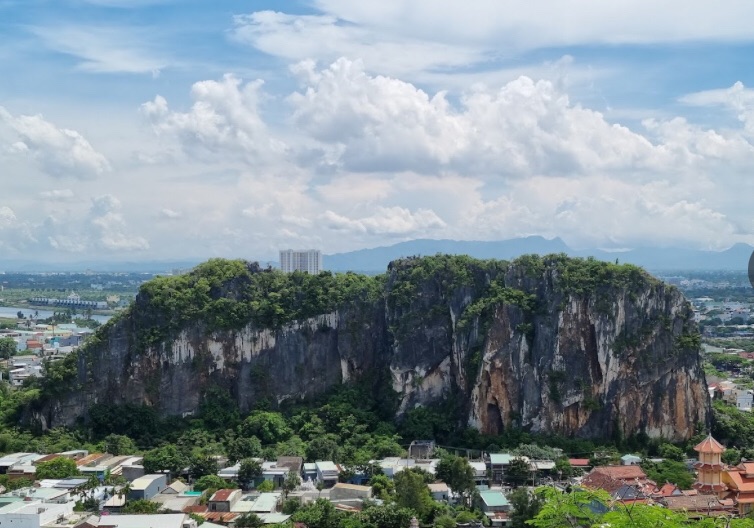
Marble Mountains is a group of five limestone peaks situated seven kilometres from downtown Da Nang. The five karsts (called Ngu Hanh Son in Vietnamese) are named after the five elements: Kim (metal), Thuỷ (water), Mộc (wood), Hoả (fire) and Thổ (earth). Over centuries, Marble Mountains has held special significance for the people of Central Vietnam. The ancient Cham revered the karsts as a spiritual site, and Vietnamese emperors from Hue and legendary generals passing through paid visits to the peaks, adding to their store of legends. 

Marble Mountains is home to a network of caves, tunnels, towers, and pagodas built by Mahayana Buddhists and the Nguyen Dynasty Kings.

There are half a dozen large caves hidden away in the Marble Mountains, and many other small ones that are rarely visited. All the caves in Marble Mountains have unique features, and some have fascinating stories of being discovered and used as hideaways over the centuries. 

On Water Mountain, Hoa Nghiem Cave is watched over by a beautiful 400-year-old stone statue of Lady Buddha’ and on Metal Mountain, Tang Chon Cave is worth a wander for the marble statues of chess players and mandarins placed inside the cave’s warrens.

This tour is about the Tang Chon Cave (Dong Tong Chon) which means “contains all truths of the universe”.

Cham people used to live and worship the gods here in the 12th century. During the reign of Le Canh Hung (1740-1786), they left and started living in Phan Rang which is 95 kms south of Nha Trang. Vietnamese rediscovered the caves, settled in the area and worshiped Buddha.

King Minh Mang (1791-1841) who was the second emperor of Nguyen dynasty of Vietnam named it Tang Chon cave meaning treasure or “the place where the treasure is stored”.

There are five caves inside Tang Chon are:

  1. Thien Long Coc Cave: –  The shrine has three compartments with image in each section. In the center is Lao Tu altar, the right compartment of which is to worship Linh Son Thanh Mau, and the left to worship Bat Bo Kim Cuong. 
  2. Ban Co Tien Cave: – On the left side of shrine is a semi-circular cave with two marble figures in white. They sit with a chess board between them. According to the legend, gods came down to play chess and talk.
  3. On the right side of central shrine, stairs lead to a cave of Di Da Buddha or Amitabha cave.
  4. Chiem Thanh cave also called the Cham Pa cave is next to the Di Da cave. The entrance to cave is very narrow.
  5. Tam Thanh cave: 

Outside these caves is the Xa Loi Tower. This 28-metre structure houses 200 statues of Buddha, and offers breathtaking views of the landscape below.

Da Nang – Vibrant Beach City – Vietnam Travel Diary – 1

Da Nang is the largest city in Vietnam by geographical area. It lies on the coast of the Western Pacific Ocean of Vietnam at the mouth of the Han River and is one of Vietnam’s most important port cities.

With broad beaches, fantastic street food, the fabled Hai Van Pass, and a growing collection of cafes, restaurants, and bars, it’s no wonder it is the vibrant beach city in the country. The warm sands of My Khe Beach sweep south from the mountainous Son Tra Peninsula. Da Nang’s much of the beach still belongs to the people who make it their playground, gym, and source of livelihood.

Here is a video that captures the spirit of Da Nang City