
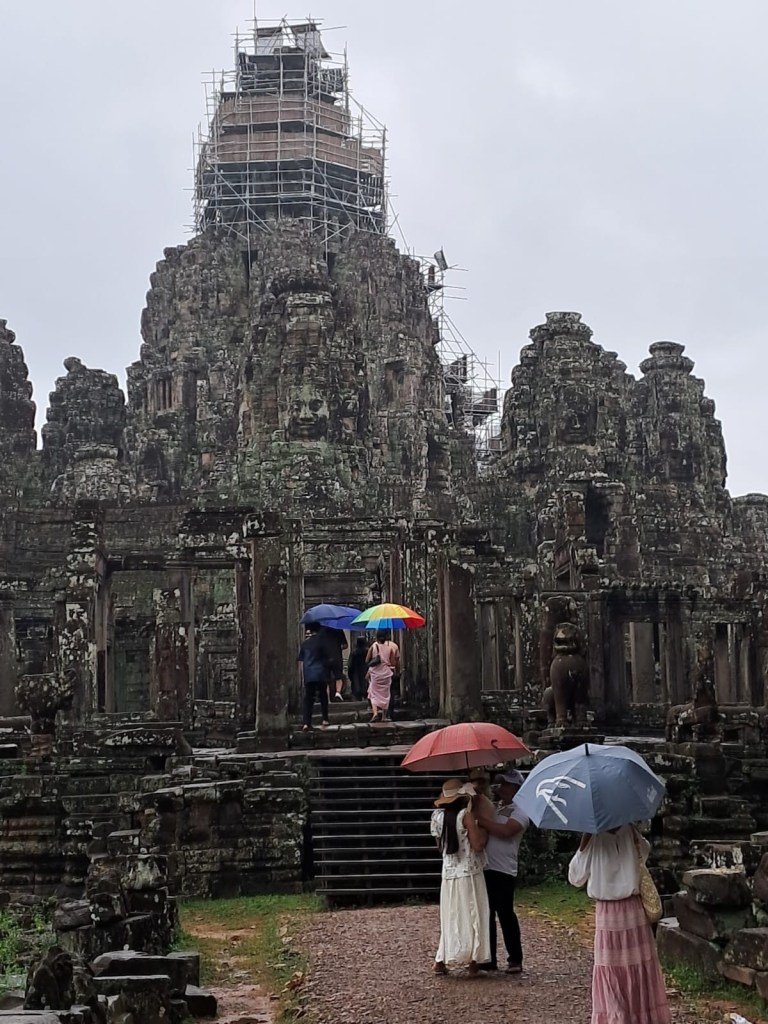
Angkor Thom was the last and most enduring capital city of the Khmer Empire, established in the late 12th century by King Jayavarman VII in what is now Cambodia. Angkor Thom served as the final capital of this powerful empire, which ruled much of Southeast Asia from the 9th to the 15th centuries.
It is not a single temple, but a massive walled royal city containing temples, a Royal Palace, and impressive bas-reliefs, with the Bayon temple and its famous smiling faces being a central feature. The site is located in the Angkor Archaeological Park, a UNESCO World Heritage site, and is a popular tourist destination.
Key features of the city includes the Bayon temple, the Terrace of the Elephants and a Royal Palace, all within a large, walled and moated area. It is known for its architectural genius and intricate bas-reliefs that depict both mythical and historical scenes from Khmer life and battles.
”Angkor Thom is a ruined citadel several kilometers north of Angkor Wat. Angkor Thom encloses a rectangular area of nine square kilometers, and at its peak may have held a population of over 100,000, living in tiled or thatched houses. The building of the citadel dates to around the year 1200. Angkor Thom enclosed the Royal Palace (now vanished) and a handful of major temples; the complex was bounded by walls and a moat (now mostly dry) and pierced by five gates. The city was surrounded with rice fields, which provided food; these were irrigated with reservoirs, which also supplied drinking water.
Michael Buckley
While Angkor Wat is Hindu in inspiration, Angkor Thom resonates with sculpted images expressing the Mahayana Buddhist ideal of Lokesvara (compassion), Prajnaparamita (wisdom), and the Buddha (enlightenment). Although still incorporating Hindu elements, Angkor Thom is a three-dimensional representation of Buddhist cosmology. Temple ground plans reveal a mandala-like base, with radiating symmetrical forms. At the exact center of Angkor Thom lies the Bayon Temple.
What at first appears to be of masonry actually consists of massive stones shaped into fluid sculptures, without apparent use of cement or mortar.
On the top terrace of the Bayon, you come face-to-face with myriad of these giant stone heads topped with lotus crowns. There are dozens of them, originally 54 towers with four heads each of which 37 towers remain. The enormous heads, ranging in size from ten to fifteen feet, features eyes downcast under lowered lids.
Disorder in the construction of the Bayon is reflected in the numerous architectural changes. It seems that after the Cham sacked Angkor in 1177, Jayavarman VII decided the Hindu deities had failed, so he switched allegiance to Mahayana Buddhism. However, he made no attempt to alter existing Hindu elements. The Bayon was caught in the middle — the foundations are Hindu, but the superstructure is Buddhist. It is estimated that the Bayon took 20 years to build. Jayavarman VII’s son and grandson reverted the use of the temple to Hindu (Shivaist) worship, with Brahmans from India gaining great influence over the Angkor court. Heads and faces on statues were destroyed and replaced with Hindu gods.”

 Prabhu's Ponder