Travel Video
https://youtu.be/IEnz-4ocsfs?si=I-S64SuHiNnWCi4r
The Old Faithful
Located in the Yellowstone National Park, Old Faithful is the world’s most famous geyser. It erupts roughly every 90 minutes, with intervals ranging between 35 and 120 minutes. Eruptions last 1.5 to 5 minutes, shooting 3,700 to 8,400 gallons of boiling water 106 to 180+ feet into the air. In 1870, this was named for its consistent performance. The time between Old Faithful eruptions has not remained constant over the years. In the 1870s, explorers noted that the time between eruptions was 60-70 minutes. This remained the case through the 1950s, but then began to lengthen to the average today, which is 94 +/- 10 minutes between eruptions. Although its average interval has lengthened, Old Faithful is as spectacular as it was a century ago.
Geysers of Yellowstone – The Vision – Summary
Yellowstone is home to more than half of the world’s geysers. Though each has its own personality and rhythm, all arise from the same unseen geothermal source beneath the earth.
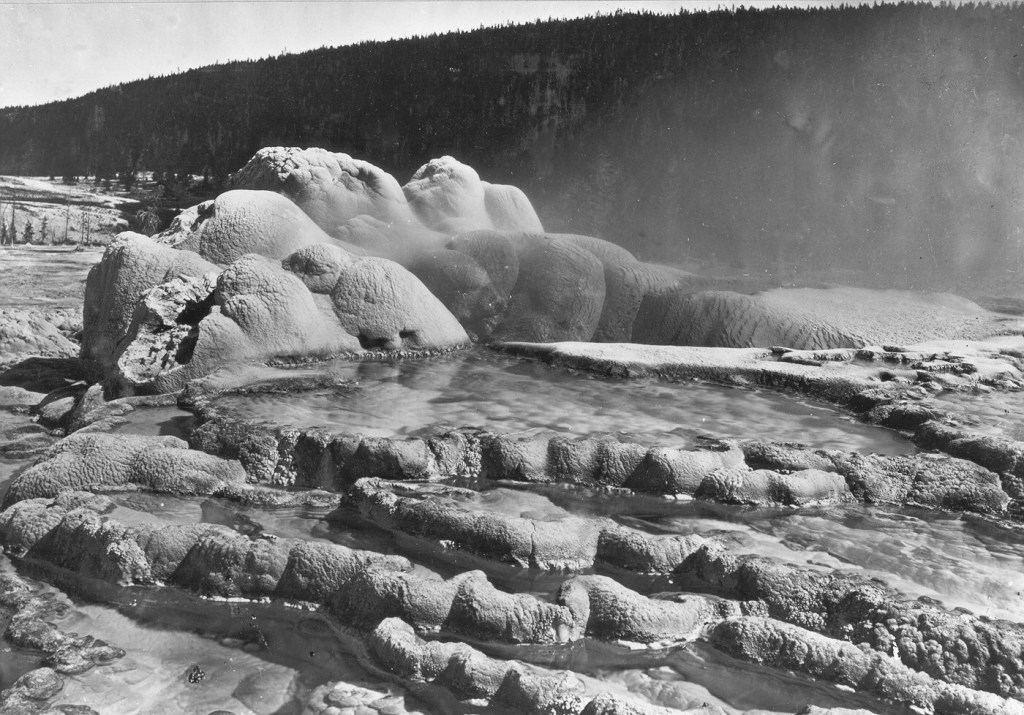
1. The first lesson a Vedāntin sees is that diversity at the surface conceals unity at the source. Old Faithful erupts with remarkable regularity, Grand Geyser produces the tallest predictable eruptions, Castle Geyser resembles an ancient fortress, Riverside Geyser arches gracefully over the Firehole River, and Daisy Geyser erupts at an angle like a giant flower opening to the sky. Their appearances, intervals, durations, and expressions differ widely. Yet the heat energizing them originates from the same underlying volcanic system.
This immediately recalls the famous declaration of the Chāndogya Upaniṣad:
“सदेव सोम्य इदमग्र आसीदेकमेवाद्वितीयम्”
(sad eva somya idam agra āsīd ekam eva advitīyam)
— “O gentle one, Existence alone was this in the beginning, one without a second.”
(Chāndogya Upaniṣad 6.2.1)
2. The many geysers correspond to the countless names and forms (nāma-rūpa) of the world, while the underlying geothermal energy corresponds to the one Existence-Consciousness that manifests as all phenomena. Just as a tourist may become fascinated by the differences among geysers while overlooking their common source, humanity becomes captivated by the multiplicity of beings while forgetting the one Brahman that appears as all.
The Bhagavad Gītā echoes this truth:
“मत्तः परतरं नान्यत्किञ्चिदस्ति धनञ्जय”
(mattaḥ parataraṃ nānyat kiñcid asti dhanañjaya)
— “There is nothing whatsoever higher than Me.”
(Gītā 7.7)
The geysers are therefore reminders that the many are never truly separate from the One.
3. To the Vedāntin, Old Faithful is a striking manifestation of Īśvara’s order (Īśvara-sṛṣṭi). The eruption appears spontaneous, yet it follows precise laws governing heat transfer, pressure, geology, and water movement. There is no chaos here.
The Bhagavad Gītā declares:
“मयाध्यक्षेण प्रकृतिः सूयते सचराचरम्”
(mayādhyakṣeṇa prakṛtiḥ sūyate sacarācaram)
— “Under My supervision, Prakṛti produces the moving and the unmoving.”
(Gītā 9.10)
The regularity of Old Faithful reminds us that the universe is not an accident but an expression of cosmic intelligence. Every planetary orbit, every heartbeat, every geyser eruption reveals an underlying order.
4. Adi Śaṅkara repeatedly points out that the astonishing harmony of the universe points to the existence of an intelligent principle governing apparent multiplicity. Old Faithful becomes a natural sermon proclaiming the presence of that intelligence.
5. Every eruption of every geyser indicates the relationship between the unmanifest (avyakta) and the manifest (vyakta)
The Bhagavad Gītā teaches:
“अव्यक्तादीनि भूतानि व्यक्तमध्यानि भारत”
(avyaktādīni bhūtāni vyakta-madhyāni bhārata)
— “Beings are unmanifest in their beginning, manifest in their middle state.”
(Gītā 2.28)
The hidden energy beneath Grand Geyser is analogous to the unmanifest causal condition from which visible phenomena emerge. The eruption symbolizes manifestation itself.
6. When you see the Riverside geyser, The river and geyser appear different, yet both are only water in different conditions. Likewise, individual beings and the world appear different, yet both are manifestations of the same Brahman.
The Bṛhadāraṇyaka Upaniṣad teaches:
“नेह नानास्ति किञ्चन”
(neha nānāsti kiñcana)
— “There is no multiplicity here whatsoever.”
(Bṛhadāraṇyaka Upaniṣad 4.4.19)
7. Every geyser depends upon a hidden subterranean network of channels and chambers. The observer sees only the eruption; the real mechanism remains concealed beneath the earth. This hidden system provides an excellent metaphor for Māyā.
The highest Advaitic vision transcends even these contemplations. The geysers, the earth beneath them, the steam rising into the sky, the observer watching them, and the very act of observation are all appearances in the one non-dual Consciousness.
The Muṇḍaka Upaniṣad declares:
“ब्रह्मैवेदममृतं पुरस्ताद्ब्रह्म पश्चाद्ब्रह्म दक्षिणतश्चोत्तरेण”
(brahmaivedam amṛtaṃ purastād brahma paścād brahma dakṣiṇataś cottareṇa)
— “Brahman alone is this immortal reality before, behind, to the right, and to the left.”
(Muṇḍaka Upaniṣad 2.2.11)
Standing before Old Faithful or Grand Geyser, the mature Vedāntin does not merely admire nature. He recognizes the truth proclaimed by the Upaniṣads. The water is Brahman. The steam is Brahman. The subterranean fire is Brahman. The observer is Brahman. The wonder that arises in the mind is Brahman. There is, in reality, no second thing.
In that recognition, Yellowstone ceases to be merely a geological wonder and becomes a vast open-air Upaniṣad, silently teaching the timeless truth:
“तत्त्वमसि” — “That Thou Art.”
(Chāndogya Upaniṣad 6.8.7)
This completes the tour of Yellowstone. The background music for the video appropriately addresses the Ultimate Reality behind all these wonderful manifestations as “that which is beyond the human knowledge and perception”.
We will now proceed South and reach the Grand Teton. Our travelogue will resume in October.
GOD BLESS


Leave a comment