The Sight
Sheepeater Cliff
A small side road on the highway between Mammoth Hot Springs and Norris Junction leads to Sheepeater Cliff, a spectacular example of columnar jointing in a lava flow. Sheepeater Cliffs is part of a basaltic lava flow that erupted north and outside of Yellowstone Caldera about 500,000 years ago. These sorts of lava flows, which are similar to those erupted in Hawaiʻi, are common around the edge of the caldera, but they can’t erupt in the caldera because the denser lavas from the basaltic magma chamber are blocked from rising to the surface by the overlying chamber of viscous rhyolite magma.
The name of the cliffs comes from a band of Shoshone Native Americans who frequented the Yellowstone area and were known as the Tukudeka, or “Sheepeaters,” because of the bighorn sheep they hunted. The cliff is made up of a series of adjoining vertical columns. When viewed from the top, each column is hexagonal in shape, and all are of very similar size—so much so that it almost looks artificial! Columnar jointing forms upon slow cooling of a volcanic or shallow intrusive deposit. As the lava or ash cools, it shrinks, like most materials (except water, which expands when it freezes!). In the vertical dimension, adjusting to this shrinking is easy—the lava or ash flow simply subsides, or sinks. But in a horizontal direction, the contraction is much harder to accommodate, and so the rock fractures. If the cooling happens quickly, the rock breaks in random patterns. When the cooling happens over a long period of time, however, the fracturing is not random, but rather results in the formation of generally hexagonal columns. The hexagonal shape is favored because it does a good job of relieving the thermal stress created as rock cools; however, columnar joints may have as few as 3 sides and as many as 8.
Gardner River
The Gardner River is a 25-mile-long tributary of the Yellowstone River located entirely within Yellowstone National Park. Originating in the Gallatin Range, it flows past Indian Creek and Mammoth Hot Springs before merging with the Yellowstone River near the North Entrance in Gardiner, Montana.
The river starts as a tiny, icy trickle almost 10,000 feet up. By the time it reaches the northwest corner of Gardner’s Hole it has been joined by several other icy small streams but it is not yet fish worthy. In Gardner’s Hole, which it traverses the full length in a northwest-southeast direction, it is joined by Fawn, Panther, Indian and Obsidian creeks, as lovely a quartet of trout stream names as one will find, and the streams are just as lovely.
All are small, winding, willow lined, clear and cold, and all host numbers of brook and rainbow trout. These four streams, and the river here, are the only ones in the Park that may be fished with worms-but only by children twelve years and under. This is a family fishing area, with an excellent campground located near where Panther, Indian and Obsidian creeks join the main river.
Obsidian Cliff
Obsidian Cliff is located about six miles north of Norris Geyser Basin along Highway 89 to Mammoth Hot Springs. Because it can be chipped into very sharp edges, obsidian is an excellent rock for making stone tools and arrowheads. Obsidian Cliff was an important prehistoric source of obsidian for indigenous tribes of the Midwest and Great Plains. The columnar jointing of the two different lava flows is preserved in the cliff. The lower obsidian-bearing cliff is an early Quaternary lava flow (called the Obsidian Creek Member of the Plateau Rhyolite). The upper unit in the cliff is the Roaring Mountain Member
Obsidian Cliff is a towering 200-foot-high volcanic glass formation in Yellowstone National Park, located about 13 miles south of Mammoth Hot Springs along the Grand Loop Road. Designated as a National Historic Landmark, it was a vital source of material for prehistoric tools. The cliff is the result of a thick, silica-rich rhyolite lava flow that erupted roughly 105,000 to 180,000 years ago. Because the lava cooled extremely rapidly without retaining dissolved water, it solidified into natural black glass rather than forming crystals. The deep black color is due to microscopic iron inclusions in the quartz-rich glass. On sunny afternoons, the cliff face catches the light and gleams brightly
Travel Video
https://youtu.be/mdyaAZIbJfM?si=MMYV1f_5FTdXAhLu
The Vision
Viewing your Yellowstone video through Advaita Vedanta glasses, I do not merely see cliffs, rivers, volcanic rocks, and obsidian. I see every time a silent Upaniṣadic teaching unfolding in stone, water, and time.
- The basalt columns of the Sheepeater Cliff were once molten lava. Today they appear as rigid stone. The form has changed completely, yet the underlying existence (sat) has never disappeared. This is precisely the Upaniṣadic vision: वाचारम्भणं विकारो नामधेयं मृत्तिकेत्येव सत्यम् – “The modification is merely a name arising from speech; the reality alone is true.” — (Chandogya Upaniṣad 6.1.4). The lava became rock. The rock weathers into gravel. The gravel becomes sediment. Names and forms continuously change. But the underlying existence remains. Looking at Sheepeater Cliff, I see an enormous natural illustration of nāma-rūpa (name and form) superimposed upon sat, pure existence.
- The Gardner river reminds me of Bhagavad Gita 2.16: – नासतो विद्यते भावो नाभावो विद्यते सतः – “The unreal has no existence; the Real never ceases to be.” Everything observable is flowing. Everything observable is becoming. Therefore none of it can be the Absolute. The river silently teaches impermanence.
- The Obsidian Cliff signboard mentions roughly 500,000 years. To the human mind this seems unimaginably vast. Yet from the standpoint of Vedanta, even half a million years belongs to time (kāla). And time itself belongs to Maya. Whether it is one second, one lifetime, one civilization or five hundred thousand years,all are equally objects of awareness. Awareness itself does not age. The Katha Upaniṣad says: न जायते म्रियते वा विपश्चित् – “The Knower is neither born nor does It die.” The cliff appears ancient only relative to a human life. To Consciousness, both the cliff and the observer arise together in awareness.
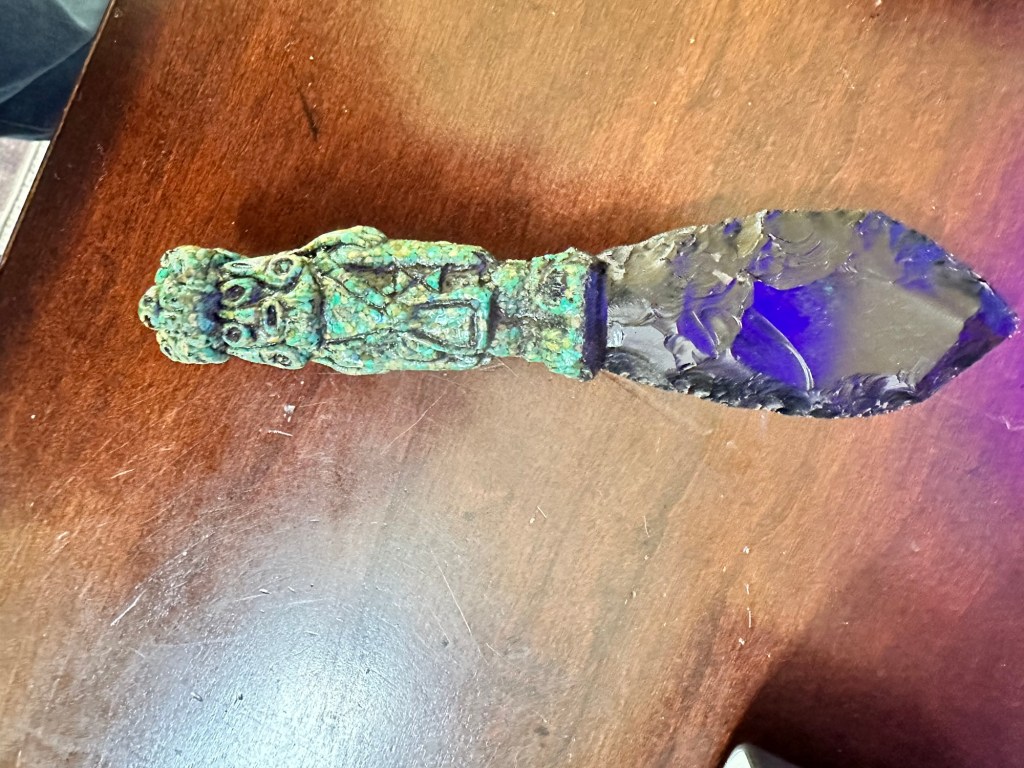
- One of the most striking moments is the obsidian knife. The same volcanic material exists first as molten magma, then as volcanic glass, then as a tool, and finally perhaps as an artifact in a museum. The substance remains. The uses change. Likewise Brahman appears as matter, life, intellect, civilization and culture. The forms differ. The substratum does not. The knife therefore reminds me of the famous gold-ornament analogy of Vedanta. Bracelet, ring, necklace—different names. Gold alone is real. Knife, rock, shard, artifact—different names. The underlying existence alone persists.
- Yellowstone is often presented as a place of tremendous violence such as volcanic eruptions, lava flows, earthquakes and tectonic forces. Yet after all the upheaval, what strikes me most is the silence. The volcanic drama is over. The river quietly flows. Trees grow. Animals wander. Nature rests.This resembles the spiritual journey. At first there is desire, struggle, seeking, questioning. Then comes knowledge.After knowledge, the mind settles. What remains is not excitement.What remains is peace. The cliff itself appears like a sage seated in meditation.
I see Yellowstone as a gigantic natural commentary on the Chandogya Upaniṣad. The basalt cliff declares: “Forms arise and perish.” The river declares “Everything flows.” The Obsidian declares “One substance appears as many.” The immense age of the rocks declares “Time consumes all forms.” And the silent awareness declares that Yellowstone ceases to be merely a geological wonder. It becomes a living Upaniṣad, teaching the difference between the changing appearance and the changeless Reality that illumines it.
Next week
Next week, we will go to the Roaring Mountains and see what it has to offer to us.
God Bless
 Prabhu's Ponder
Leave a comment