Travel Video
https://youtu.be/LtP7GKvNR7w?si=8WjJmUg6xCC5id0b
The Sight
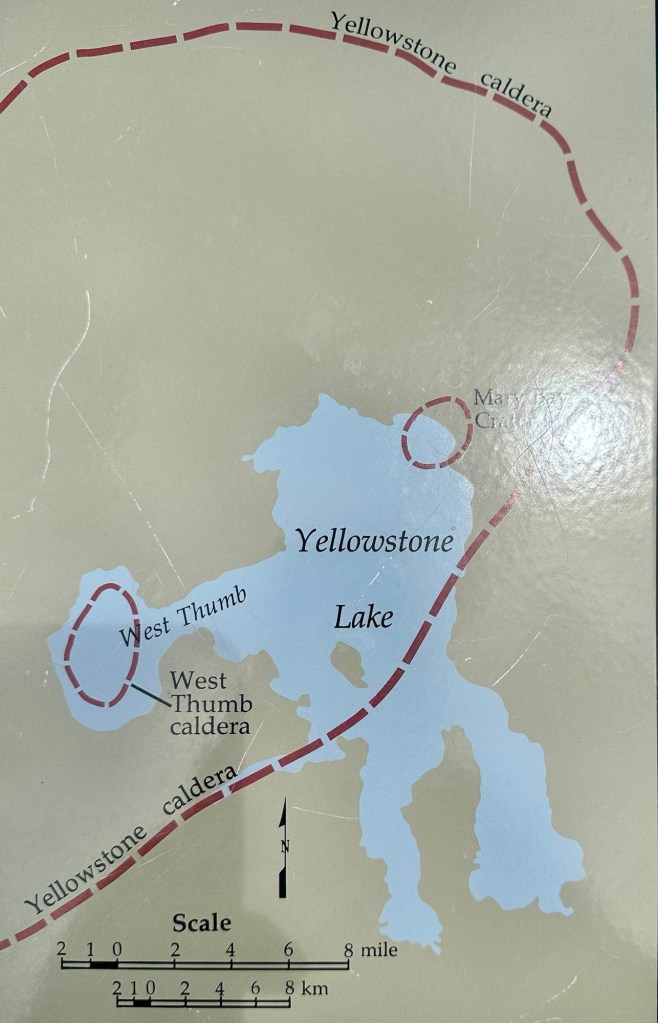
Located at the Southern Yellowstone at the junction of the Grand Loop Road and West Thumb Basin, roughly 22 miles north of the South Entrance, the West Thumb Geyser Basin in Yellowstone National Park is celebrated for its stunning placement directly along the shores of Yellowstone Lake. It features highly colorful, steaming thermal features and underwater vents that empty directly into the lake’s cold waters. The thermal springs are Iridescent, an optical phenomenon where a surface exhibits lustrous, shifting colors that change depending on the angle of the light and the angle of the observer. Several Pools are attractive. Some of them are:
- Abyss Pool: One of the deepest hot springs in the park, plunging to 53 feet and displaying a striking deep blue color.
- Black Pool: Once a cooler pool with dark bacteria, a 1991 temperature shift killed the bacteria and turned the pool into an intensely vibrant, transparent blue.
- Fishing Cone: A thermal cone protruding directly from the lake. Early explorers popularized the “hook and cook” method here, where an angler could catch a trout and immediately boil it in the hot spring, though this practice is strictly prohibited today.
- Thermophiles: The orange, yellow, and green colors seen in the runoff channels and pools are created by heat-loving microorganisms.
The Vision
Standing on the boardwalks of the West Thumb Geyser Basin, where the boiling, iridescent thermal springs sit right on the edge of the vast, cold expanse of Yellowstone Lake, one is presented with a vivid, living metaphor for the core truths of Advaita Vedanta.
Nature here does not hide its secrets; it lays bare the play of Maya (the cosmic illusion/manifestation) and the underlying reality of Brahman (the unchanging, absolute consciousness).
In the Upanishads, the material universe is understood as a modification of the Pancha Mahabhutas—the five great elements. Nowhere is their dynamic play more dramatic than at West Thumb:
- Prithvi (Earth): The solid volcanic caldera, holding the entire landscape.
- Apas (Water): The crystal-clear, deep pools and the freezing lake right beside them.
- Agni (Fire): The immense subterranean magma heat driving the entire system.
- Vayu (Air): The rising columns of sulfurous steam drifting across the sky.
- Akasha (Space): The vast, open sky reflecting perfectly in the deep, still waters of pools like Black Pool or Abyss Pool.
In the Taittiriya Upanishad, we learn that these elements emerge sequentially from Brahman. At West Thumb, they do not just coexist; they beautifully interact. The subtle intermixing of elements creates the tangible world we experience.
If you look at springs like the Abyss Pool, Black Pool, or the underwater Fishing Cone, they appear entirely distinct. They have different shapes, different temperatures, and breathtakingly different colors—ranging from deep turquoise to rust-orange, caused by different species of thermophilic (heat-loving) bacteria.
“As from a blazing fire sparks of like form issue forth by the thousands, so do various degrees of beings issue forth from the Immutable and return to It.”
— Mundaka Upanishad (II.i.1)
To the casual observer, the pools are separate entities defined by their Nama (name) and Rupa (form). But Vedantic vision looks deeper to the Adhistana—the underlying substratum. Every single hot spring, bubbling mud pot, and geyser shares the exact same source: the unseen, subterranean heat of the caldera and the same meteoric water. The differences in color and activity are merely accidental attributes (Upadhis). In reality, there is only one geothermal field expressing itself as many.
The most striking feature of West Thumb is its geography. You have boiling hot springs separated by mere inches of rock from the massive, icy waters of Yellowstone Lake. This mirrors the apparent relationship between the Jiva (the individual soul) and Isvara (the cosmic lord):
- The hot spring seems small, localized, bound by its rocky rim, and intensely active—much like the Jiva bound by the ego and body-mind complex.
- The lake is vast, cool, calm, and seemingly infinite—resembling Isvara, the ruler of the manifest universe.
Yet, hydrologically, they are not separate. The water in the geysers eventually flows into the lake; the water from the lake seeps into the ground to be heated into geysers. They are of the very same nature (Jalatvam — “water-ness”). The apparent boundary between the boiling spring and the freezing lake is thin and porous.
To appreciate West Thumb from a Vedantic perspective is to step back and adopt the role of the Sakshi—the unattached Witness. The geysers erupt in flashes of energy, the mud pots bubble and dissolve, the weather shifts from bright sunlight to sweeping storms across the lake, and the colors change with the angle of the sun.
Everything in the basin is in a state of constant, fluid flux (Samsara). Yet, the awareness that observes this breathtaking display remains completely untouched, silent, and still—just like the deep bedrock beneath the volcano, quietly holding space for the entire magnificent dance.
West Thumb is therefore one of Yellowstone’s most contemplative locations: the stillness of Yellowstone Lake and the restlessness of the geothermal basin together illustrate the Advaitic relationship between the changeless substratum and the changing appearances superimposed upon it.
From next week, we will, as a tourist, complete our tour of the Upper Geyser Basin. After we complete the visual tour of all the five active geysers, we will put on our Vedanta Glasses and consolidate our vision.
God Bless


Leave a Reply