The Sight
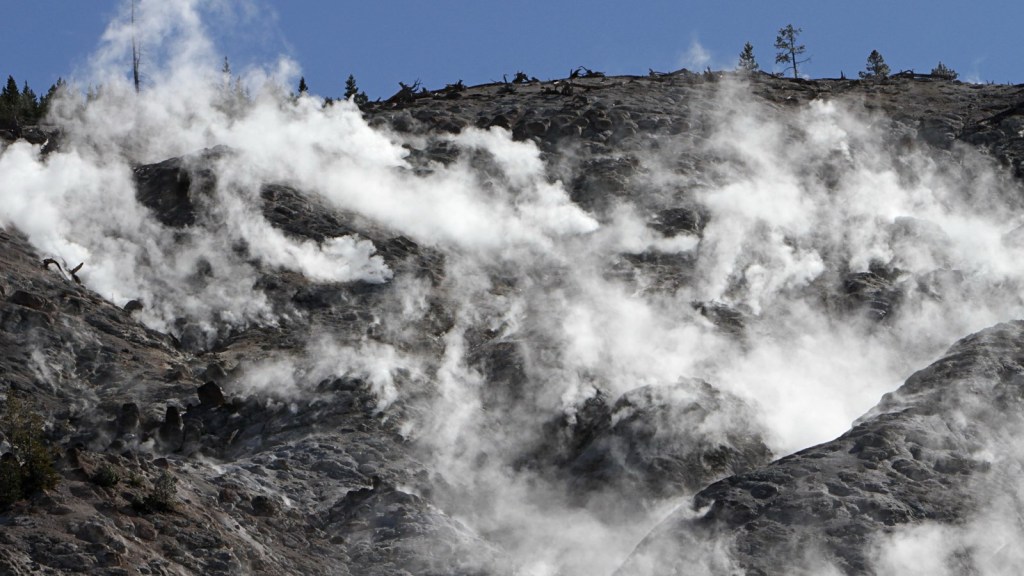
Between Norris Geyser Basin and Mammoth Hot Springs is an interesting thermal area known as Roaring Mountain. These days, it is quieter than it used to be, but that sense of calm might not last forever. Roaring Mountain is a large, acidic thermal area (solfatara) that contains many steam vents (fumaroles). In the late 1800s and early 1900s, the number, size, and power of the fumaroles was much greater than today. Roaring Mountain was named for the numerous fumaroles on the western slope of the peak which during the early 1900s were loud enough to be heard for several miles.
Roaring Mountain is a classic example of an acid-sulfate thermal area. No geysers are present on Roaring Mountain; rather, the surface is dotted with numerous steam and gas vents. The gases that are emitted are at or above boiling temperatures for that elevation, and their acidic nature has caused much of the rock in the area, which is densely welded ash erupted during the caldera-forming event that created Yellowstone caldera, to become altered into clay minerals, especially kaolinite and smectite. That alteration gives the thermal area its chalky, soft appearance. The area of intensely hot ground—easily viewable from space!—makes Roaring Mountain one of the most intense thermal areas in the park despite its overall small size, with more than 100 megawatts of geothermal radiative power output.
Although most thermal areas in Yellowstone are found within or along the perimeter of the Yellowstone Caldera, Roaring Mountain is outside and north of the caldera along an important north-trending lineation that is tectonically and thermally active. The area between Norris Geyser Basin and Mammoth Hot Springs, informally called the Norris-Mammoth Corridor, hosts abundant thermal and tectonic activity and is an area of fluid transport, allowing water heated by the Yellowstone magmatic system to migrate out of the caldera to the north.
The Vision
Among Yellowstone’s many spectacular hydrothermal features, Roaring Mountain is not the most colorful, nor the most dramatic. It has no towering geyser eruptions like Old Faithful, no vast terraces like Mammoth, and no canyon grandeur like the Grand Canyon of the Yellowstone. Yet, for a student of Advaita Vedānta, Roaring Mountain carries a profound spiritual symbolism.
The Seen and the Unseen
What we observe is merely steam emerging from cracks in the earth. What we do not see is:
- the immense magma chamber below,
- the geothermal heat,
- the underground water pathways,
- the pressure systems that sustain the entire phenomenon.
The visible steam is only the final expression of a vast invisible process. Likewise What we perceive as the world is merely the visible expression of an unseen Reality. Just as steam points to hidden geothermal energy, the universe points to Brahman.
The Kaṭha Upaniṣad teaches: यदिदं किं च जगत्सर्वं प्राण एजति निःसृतम् । – Whatever exists in this universe moves because of That. (Kaṭha Upaniṣad 2.3.2)
The Silent Source and the Noisy Manifestation
Roaring Mountain appears noisy. The source beneath is silent. The noise belongs to the escaping steam, not to the geothermal energy itself. Similarly, all activities belong to body, mind, senses, prāṇa, thoughts and emotions. The Self remains untouched.
Lord Krishna says in Bhagavad Gītā (5.8–9) “I do nothing at all”—thus thinks the knower of Truth. Actions roar; The Self remains silent. Thoughts roar; Consciousness remains silent. The world roars; Brahman remains changeless.
The Mountain as the Human Personality
Roaring Mountain may be viewed as a symbol of the human being. The mountain represents the body-mind complex.mThe steam vents represent desires, fears, ambitions, attachments, anxieties. Every vent in our body mind comp,ex hisses “I want this.” , “I fear that.”, “I need recognition.”, “I need security.” The ordinary person identifies with these hissing vents. The learned (sage) asks “What is the source from which all these emerge?” Vedānta redirects attention from the steam to the heat beneath, and ultimately from the heat to the Consciousness in whose presence all experiences arise.
The Teaching of the Fumaroles
Notice an interesting fact. The steam emerges only because there are openings in the rock. Without openings, the hidden heat would not become manifest, the way it has. Similarly the one Consciousness manifests through countless bodies and minds.
Each being is like a fumarole. The steam differs from vent to vent. Some vents are large. Some small. Some noisy. Some quiet. Yet the underlying geothermal source is one. Likewise, The bodies differ. The minds differ. The personalities differ. But Consciousness is one.
The Chāndogya Upaniṣad declares सर्वं खल्विदं ब्रह्म – “All this indeed is Brahman.” (Chāndogya Upaniṣad 3.14.1)
The Disappearing Roar
One of the most beautiful lessons of Roaring Mountain is historical. The roar that once gave the mountain its name has largely disappeared. The mountain itself remains. The geothermal source remains. Only the outward expression has changed.
Likewise Childhood thoughts disappeared. Youthful ambitions disappeared. Old fears disappeared. Countless mental states came and went. Yet something remained throughout. That unchanging witness is the Ātman.
The Bṛhadāraṇyaka Upaniṣad talks about:
The Seer of seeing,
the Hearer of hearing,
the Thinker of thinking.
(Bṛhadāraṇyaka Upaniṣad 3.4.2)
The roar changes. The Witness remains.
Roaring Mountain and Māyā
The mountain seems to be the source of the steam. But in reality, the source lies far beneath. Similarly, we assume the body acts, the mind thinks and the senses perceive. Vedānta reveals that these are only instruments. The real basis is Consciousness. The appearance distracts us from the Reality behind it. This is Māyā—not a separate power creating another reality, but the tendency to mistake the appearance for the underlying truth.
Roaring Mountain is a magnificent symbol of Vedāntic truth. Standing before Roaring Mountain, the Advaitin is reminded of the great declaration of the Kaṭha Upaniṣad:
अशब्दम् अस्पर्शम् अरूपम् अव्ययम् – “Soundless, touchless, formless, undecaying…” (Kaṭha Upaniṣad 1.3.15)
The mountain roars. The steam hisses. Nature speaks loudly. Yet the Truth to which it points is eternally silent. And that silent Reality is none other than your own Self — Ātman, the non-dual Brahman.
Travel Video
https://youtu.be/CI7vPS4noAY?si=cO_FCefxShoS0aVx
Next week, we will travel to the Norris Geyser Basin.
God Bless


 Prabhu's Ponder
Leave a comment