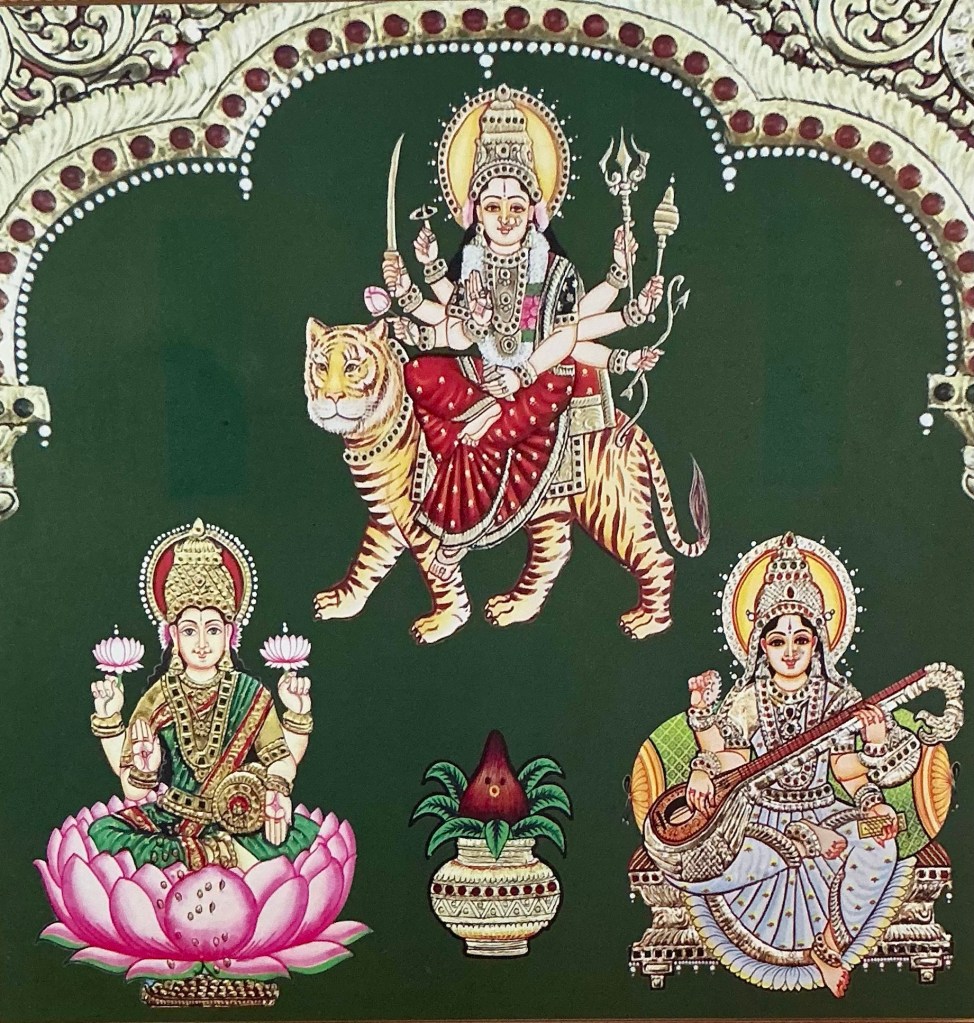
Wishing all our readers a very happy and Divine Navarathri celebrations.
For me, what better way is there to celebrate these ten days, than to try and understand what Jagat Guru Ādi Śaṅkarācārya’s beautiful hymn to the Divine Mother, traditionally known as Ānanda Laharī.
With reverence to the sacred feet of Ādi Śaṅkarācārya, we will begin our study of Ānanda Laharī.
On Each day of Navarathri, commencing from October 11th, we will study two Slokas and on Vijaya Dasami day (October 20th) we will complete the last Sloka 20.
Audio Link
https://drive.google.com/file/d/1I-fuQmWzsWts88a_y9HrOzIOpR4899cw/view?usp=drivesdk
Introduction
The name Ānanda Laharī means “The Wave of Bliss.” The title itself beautifully captures the spirit of the work. As the devotee contemplates the glory, beauty, compassion and divine presence of the Mother, waves of devotion and bliss arise within the heart.
The Divine Mother appears in these verses in many beautiful forms. She is seen as the Supreme Śakti, as the consort of Śiva, as the compassionate Mother, and as the very embodiment of beauty and grace. The poet draws upon the beauty of nature—flowers, lotuses, fragrance, moonlight, swans, bees, gentle breezes, mountains and waters—to create vivid images through which the Divine is contemplated.
Yet this is not merely poetry in praise of physical beauty. Behind the imagery lies a profound devotional vision. Remembrance of the Mother removes suffering; contemplation of Her brings peace to the mind; and surrender at Her feet becomes a means of spiritual elevation. Thus devotion, meditation and poetic beauty are woven together throughout the hymn. In approaching these ślokas, it is therefore useful not merely to ask what each word means, but also to observe the picture, feeling, devotional mood and deeper suggestion conveyed by the verse.
Accordingly, each śloka is considered here in four stages:
- Word-by-word meaning — to understand the individual Sanskrit words and expressions.
- Literal translation — to remain as close as possible to the structure and meaning of the original.
- Essence of the śloka — to appreciate its deeper devotional and contemplative significance.
- A Tamil poetic rendering — not as a literal translation, but as an attempt to recreate in Tamil the beauty, imagery and emotional flavour of the original.
The intention is not to present a critical edition or undertake an exhaustive textual study. It is simply an attempt to approach these verses with attention and reverence, allowing the Sanskrit words, their imagery and their devotional sentiment to unfold naturally.
In this way, each śloka becomes more than a collection of words to be translated. It becomes a vision to be contemplated, a feeling to be experienced, and a prayer to be lived.
And as the verses unfold, the beauty that the poet sees in the Divine Mother gradually becomes an inner experience of the devotee. That is the spirit of Ānanda Laharī — the Wave of Bliss.
God Bless


Leave a Reply