

Word of Caution:

This write up below is definitely not an exhaustive description of what our scriptures talk about Pralaya. It is my very limited understanding of the vast literature available in public domain. The objective is to get a broad idea of the principles involved so that when we take up the study of our scriptures and Sanskrit Slokas, we will have a better comprehension of what they say.

Reader is strongly advised to strictly learn these under the guidance of a Guru, if one wants a deep dive in this subject.
Introduction
The concept of Pralaya or dissolution is intimately related with the concept of creation. Our scriptures say that the chain of creation and dissolution continues without break. After each creation, there is dissolution and after dissolution there is again new creation.Following the dissolution, there is a period of rest or interval, known as Pralaya. It's a period of non-existence where the universe remains dormant before the next cycle begins.

Each creation i.e., anything that has an “existence” goes through the dissolution process. The dissolution process is the reverse of the creation process. This means that all the creations at the gross level dissolves into the subtle level and the subtle into causal levels.

Therefore, in addition to the “kaala” or time and its breakdown which we saw in the earlier part, we should also understand what is getting dissolved, where is it getting dissolved and how often do they get dissolved. In other words, we should understand

1. The different forms of existence
2. the realms of existence
3. The cycles of dissolution
Forms of existence
In this universe, (universe included) there are sentient and insentient things that exist.

Leaving the near infinite number of insentient and inert materials and their different forms aside, the Padma Purana discusses the number of different types of life-forms in the universe. According to the Padma Purana, there are 8,400,000 life-form species, 900,000 of which are aquatic ones; 2,000,000 are trees and plants; 1,100,000 are small living insects species; 1,000,000 are birds; 3,000,000 are beasts and reptiles; and 400,000 are mammal species.

Creation (srishti) and destruction (pralaya) is about all these forms of existence.
Realms of existence
Apart from the infinite time element, as one of the common causes for cosmic evolution, infinite space is to be understood in proper perspective. This is known as “loka” in our scriptures. The most common cosmological conception of lokas in the Veda was that of the trailokya or triple world: three worlds consisting of earth, atmosphere or sky, and heaven, making up the universe.

Hindu mythology defines fourteen worlds (not to be confused with planets) – seven higher worlds (heavens) and seven lower ones (underworlds). (The earth is considered the lowest of the seven higher worlds.) The higher worlds are the seven Vyahrtis (Heavens or Upper worlds) and seven Patalas (Hells or lower worlds).

The 14 Lokas are: (1) Satya (2) Tapa (2) Jana (4) Mahar (5) Svar (6) Bhuvar (7) Bhu (8) Atala (9) Vitala (10) Sutala (11) Talatala (12) Mahatala (13) Rasatala (14) Patala.
Time Cycles and kinds of Pralaya
Visnu Purana describes, four kinds of pralaya viz.,

Naimittika (occasional),
Prakrtika (elemental),
Atyantika (absolute) and
Nitya (perpetual)
All these are directly related to the life of Brahma, the God assigned the responsibility of creation.
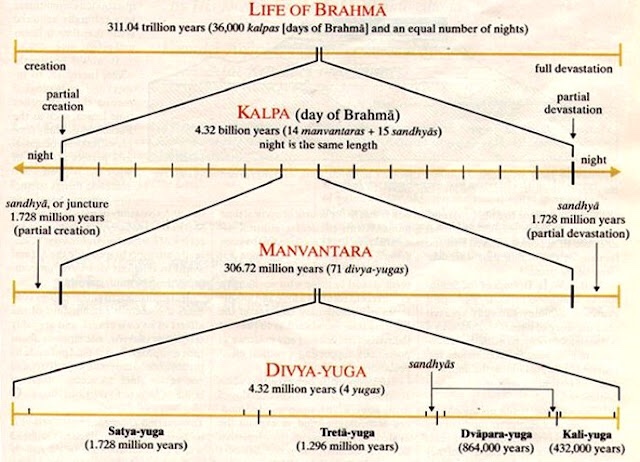
(Readers may refer https://en.wikipedia.org/wiki/Hindu_units_of_time for a better understanding of the concept of time, life and life span as per Hinduism)
Naimittika Pralaya:

This Pralaya is also termed as the Brahma Pralaya. This Pralaya at the end of a kalpa or at the end of a day of Brahmas life - 4.32 Billion human calendar years);. After a kalpa, Naimittika pralaya occurs. It is also indicated in the Visnu Purana that this dissolution occurs only in the three lokas, i.e., Bhu, Bhuva and Sva.The Visnu Purana also gives a very fearful description of this dissolution.
Prakrtika Pralaya:

This Pralaya occurs when the whole Brahmanda dissolves in Prakrti. This pralaya occurs at the end of the life span of Brahma (100 years as per his calendar) , viz., at the end of Maha Kalpa - 311.04 Trillion years in human calendar (comprising of two paraardhaas of 155.52 Trillion years each).

At that time all the things of the world return to their causes. This dissolution takes place in the opposite order of their creation. Thus, the seven forms of Prakrti from Mahat to earth enter successively into their causes. The Egg of Brahma is dissolved in the waters that surround it with its seven lokas, seven oceans, seven islands and the mountains. Water is drunk up by fire; that of air absorbs the stratum of fire. Air is merged in ether and Bhutadi or Ahamkara devours the ether. Mahat again takes up Ahamkara. Then Prakrti absorbs Mahat and all these. Prakrti and Purusa also are dissolved into the Supreme Spirit. This is Prakrta Pralaya.
Atyantika Pralaya :

Absolute or final dissolution is attained by the knowledge of the Supreme. It is said that all beings are afflicted by three kinds of worldly pains, viz., adhyatmika, adhibhautika and adhidaivika. The Visnu Purana also describes these three types of pains. Adhyatmika is of two types - bodily and mental. That kind of evil, which is inflicted upon men by beasts, birds etc. are called Adhyatmika. Adhidaivika pain is the work of cold, heat, wind, rain, lightning and other atmospherical phenomena. These three types of afflictions are described in the Samkhya system also in the similar vein.

Only true knowledge about one self (atma vidya, brahma jnanam) can rescue men from these three kinds of affliction. When a man attains true, knowledge & detachment from human afflictions, he obtains final dissolution. In this pralaya, the yogis are merged in the Supreme Spirit.
Nitya Pralaya:

It is said that Nitya or perpetual dissolution is the constant disappearance of all living beings. Experts interpret this as the death of the living beings, which occurs constantly - “Nitya is the extinction of life, like the extinction of a lamp, in sleep at night”. Some Vedantists describe Nitya Pralaya as Susupti or deep sleep.
Conclusion
We have through a five part study tried to have an overview of the cosmic evolution as per the modern and Indian perspectives. This study was essential to appreciate Narayaneeyam Dasakam 5.
From the next blog we will start our study the Slokas of Dasakam 5.
God Bless
 Prabhu's Ponder