एवं देव in this manner O Lord! चतुर्दश-आत्मक-जगत्-रूपेण in the form of the fourteen worlds जात: पुन: – manifesting (Thyself) again तस्य-ऊर्ध्वं खलु at the head (peak) of that (the worlds) सत्य-लोक-निलये in the abode of Satyaloka जात: -असि धाता स्वयं manifested as Brahma (the Creator) Thyself यं शंसन्ति whom (Brahma) (the Srutis) describe हिरण्यगर्भम्- (as) Hiranyagarbh अखिल-त्रैलोक्य-जीवात्मकं of all the beings in the three worlds as the collective soul य: -अभूत् who became स्फीत-रज:-विकार-विकसन्- because of the upsurge of Rajoguna नाना-सिसृक्षा-रस:- became desirous of creating various beings.
Meaning in English:
The fourteen worlds are also known as trilokyam (3 worlds). The 7 worlds together below the earth are taken as one, called Patala. The Earth is taken as Bhuloka as second and the six worlds above the earth are taken as third as Upper world.
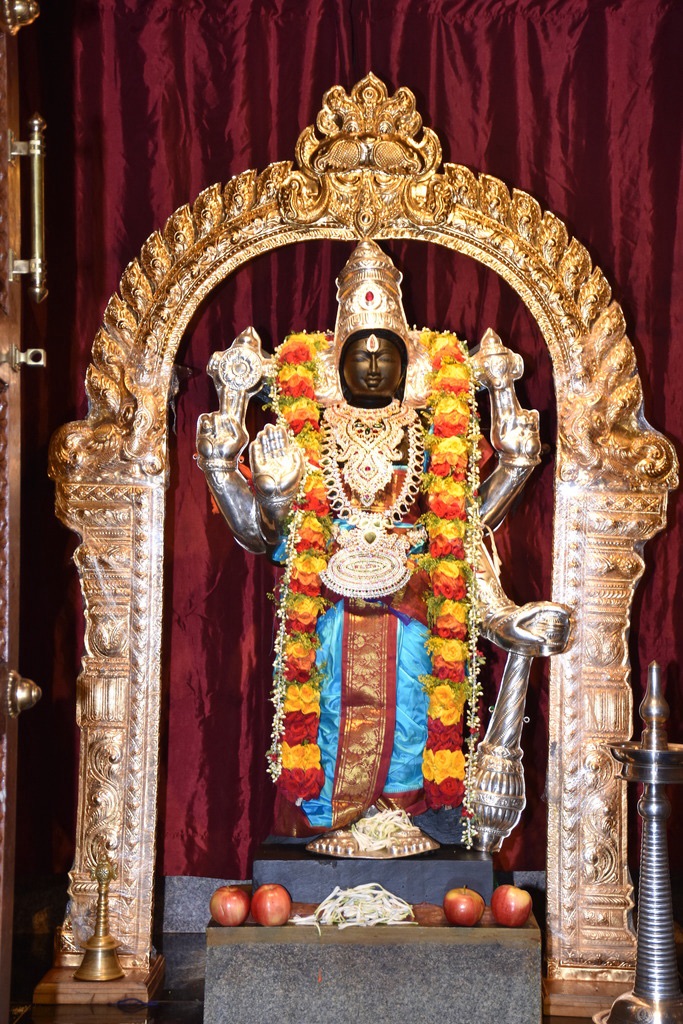
Thus O Lord! Thou who manifested in the form of the fourteen worlds, again by Thy own will, manifested as Brahma, in Satyaloka, which is the highest and loftiest of all the worlds.This Brahma is known as Hiranya Garbh (the golden egg) the cosmic intelligence of all the beings of the three worlds. With the upsurge of Rajoguna, Thou as this Hiranya Garbha became desirous of creating various beings.
Narayaneeyam Dasaka 7 is about the Lord Brahma, who is also known as Pitamah, Hiranyagarba, Abjayoni, Prajapati, Vishwasru, Vidatha, Vidhi, Kamalodbhava, Virinji, Andaja, etc. Before we try to understand the verses of this Dasaka, we need an overview of Lord Brahma. Whatever I have understood , I present it as a preface to the Dasaka
A Vedāntic Perspective
In the pāramārthika (absolute) plane, Parabrahman exists as nirguṇa (devoid of attributes). When reflected through māyā, it appears as saguṇa Brahman, conditioned by upādhis (limitations such as the knower-known distinction, space, time, etc.) and endowed with manifest qualities. This saguṇa Brahman associated with māyā is referred to as Īśvara in His unmanifest (kāraṇa) form. In His manifested (kārya) state, He is called Hiraṇyagarbha or Brahmā (the four-faced deity), who is the kārya Brahman.
The Vedas declare Hiraṇyagarbha to be the first manifest creation. Just as a tree, though initially a mere seed, later branches out into roots, trunk, branches, leaves, flowers, fruits, and seeds again, so too does Hiraṇyagarbha, the saguṇa manifestation of Brahman, emerge through the vikṣepa śakti (projecting power) of māyā.
The term hiraṇya means “gold” or “radiance.” Since both consciousness and gold are luminous, hiraṇya metaphorically refers to consciousness here (Śaṅkara’s bhāṣya on Ṛgveda 10.121 and on the Muṇḍaka Upaniṣad 2.1.1).Garbha means “womb” or “that which is within.” Therefore, Hiraṇyagarbha means “the golden womb,” or more accurately, “the luminous consciousness contained within.” It is the repository of limitless knowledge—the cosmic intelligence or subtle matrix containing within itself the seed-form of all beings, objects, and even the entire cosmos. Because it encompasses the subtle state of all things before their gross manifestation, it is also called Prathama-ja (the First Born) or Sambhūti in technical Sanskrit.
This is the classic adhyāropa–apavāda model. Hiraṇyagarbha is the first manifestation (prathamaja) as the total subtle body (sūkṣma śarīra-samasṭi). As per Advaita:
Suppose you meet an old schoolmate after 50 years at a gathering. How would you respond?
Would you say, “Ah! My 5th-grade classmate! The same features—I haven’t forgotten him in all these years. That’s Damodaran!”
Or would you say, “Due to uninterrupted neural excitation, countless photons struck my retina, producing electromagnetic waves that traveled through my optic nerves to the thalamus and occipital cortex, where they were processed as visual representations. These patterns matched stored memory structures in my prefrontal cortex, thereby enabling me to recognize Damodaran, my schoolmate.”?
Both are valid. The first is subjective and experiential; the second is science based and neurologically objective.
Generally, what we call “mind” refers to a collective of thoughts, emotions, memories, and beliefs. The mind is not made of matter, yet it exerts immense influence. Scientists typically assume that the brain—a three-pound gelatinous organ inside the skull—is the physical substrate of what we experience as mind. Thoughts and feelings, they argue, arise from electrical impulses in neurons and associated neurochemical activity. Most neuroscientists reject the notion of the mind as a separate entity. Rather, they treat it as a by-product of the brain’s computational architecture—a dependent function, not an independent agent.
Thus, cognitive neuroscience attempts to uncover the biological foundations of mental functions—how the mind arises from the brain’s internal information processing structures.
But can we truly understand the mind only by examining the brain in isolation? Can we study an individual’s consciousness from outside social context from where we derive our ideas, opinions etc and a meaning is constructed in our brain based on these inputs?
Our everyday experiences—interacting with the world, society, norms, values, and shared aesthetics—cannot be fully understood by a reductionist view of the brain. In research led by Aaron Barbee of the University of Illinois, it was found that:
“Cognitive neuroscience often assumes that one’s intelligence is individually housed in the brain and can be accessed using tools like MRI or CT scans. However, our research challenges this view. When multiple people engaged simultaneously in a shared cognitive task, their brain scans showed synchronized patterns across similar regions. This suggests that knowledge and cognition extend beyond the individual, and understanding the mind demands looking at interpersonal and collective domains as well.”
This leads us to the notion of Collective Consciousness. The eminent psychologist Carl Jung believed that humans are connected not just with each other, but also with their ancestors, through a shared repository of archetypes and inherited experiences—what he called the collective unconscious. It contains not just our personal memories but also the cumulative experience of the human race.
This collective mind bridges the dualities of part-whole, individual-society, permanence-change, and rationality-creativity. It comprehends individual mental states while simultaneously contributing to a shared group psyche. Extensive scientific research is now underway globally to understand this phenomenon.
While the scientific endeavours are not Advaitic per se, it is fully acceptable as vyāvahārika-level support. Śaṅkara does not reject empirical data; he just prioritizes adhyātma-jñāna. Advaita doesn’t negate empirical sciences, only their claims to ultimate reality.
Understanding the Vedāntic position that mind is not the brain, and that consciousness is not a product of matter is essential.
Hiraṇyagarbha: A Metaphysical Vision
We have thus far viewed mind, brain, and cognition from a material perspective. Let us now move into a higher metaphysical framework, where the universe, galaxies, and all realms (lokas) are examined from a cosmic standpoint.
Look at the night sky. So many stars, constellations, galaxies. Amidst such grandeur, we live on a tiny, seemingly insignificant planet orbiting an ordinary star.
Do we perceive an inherent order—a ṛta, a cosmic dharma—that sustains the unfolding of creation, sustenance, and dissolution?
Regardless of how we answer these questions, one thing becomes evident: there is a pervasive order, and we intuitively accept that it arises from something beyond. That “beyond” may be termed collective intelligence or consciousness, which orchestrates the cosmic processes.
I am deliberately not using the term “collective brain.”Carl Jung’s “collective unconscious” is a useful bridge but is not strictly Advaitic. In Advaita, samasṭi mind (collective mind) is not a Jungian archetypal storehouse, but the total antahkaraṇan associated with Hiraṇyagarbha, which is still mithyā, not satya.
It is still under māyā and hence subject to negation through apavāda.
To the best of my limited understanding, this collective intelligence, or samāṣṭi chaitanyam, is what the Vedas call Hiraṇyagarbha—the first born, the total mind that contains within it all subtle seeds of future manifestation.
Because this total mind includes both intelligence (buddhi) and collective experience, it is beyond the range of sense perception. It cannot be known through any organ of perception. However, due to the projecting power of māyā, this subtle causal state appears as a gross world of objects and entities. It is not only projected but also mistakenly perceived as real and independent.
Sambhūti Upāsanā
Meditation on Hiraṇyagarbha is termed Sambhūti Upāsanā. Narayaneeyam Daskam 7 focusses on this subject.
As Swami Paramārthānanda explains:
“If Hiraṇyagarbha is beyond the reach of the sense organs, how can one meditate upon Him? The method is to use an ālambana (symbol). The individual mind (vyashti manas) becomes the symbol for the total mind (samashti manas). Thus, turning one’s attention inward upon one’s own mind becomes a way of meditating on Hiraṇyagarbha.”
But where is this mind located?
Vedāntic scriptures clarify that mind is not the brain. The brain is a physical organ that can be studied empirically; the mind is a subtle instrument, inaccessible to the senses. Upon death, the brain perishes with the body, but the mind survives and seeks another body—a concept not accepted by modern science.
The Śāstras speak of sense organs (indriyas) and their instrumental counterparts (golakas). For example, the eye is the instrument; sight is the faculty. A blind person may possess eyes (golaka) but lack the power of vision (indriya).
Similarly, the golaka of the mind is said to be the heart (hṛdaya). In waking state, the mind operates through the body. In deep sleep, it withdraws and returns to its base in the heart. Hiraṇyagarbha is that omniscient, omnipresent cosmic mind.
Fruits of Sambhūti Upāsanā
The core practice in this mode of worship is dhyāna (meditation). The upāsaka contemplates Hiraṇyagarbha as the embodiment of all creation—recognizing the essential oneness of creation, nature, and themselves. Yet, in this devotion lies an implicit duality: the upāsaka (devotee) and īśvara (Lord) are seen as distinct.
As a result, such meditators, though attaining relative immortality (through identification with the cosmos), do not gain mokṣa (liberation) immediately. Instead, they attain Krama Mukti—a gradual path leading to Brahma-loka, the divine realm.
The Vedas state that upon death, the subtle and causal bodies of such a meditator exit the physical body through the suṣumnā nāḍī, ascend through the solar path (śukla gati), and finally reach Brahma-loka via the brahma-randhra at the crown of the head. From there, final liberation is attained after gaining Self-knowledge in Brahma-loka.
Though such aspirants may acquire the eightfold supernatural powers (aṣṭa-siddhis), the Vedas clearly state that even those are impermanent.


 Prabhu's Ponder