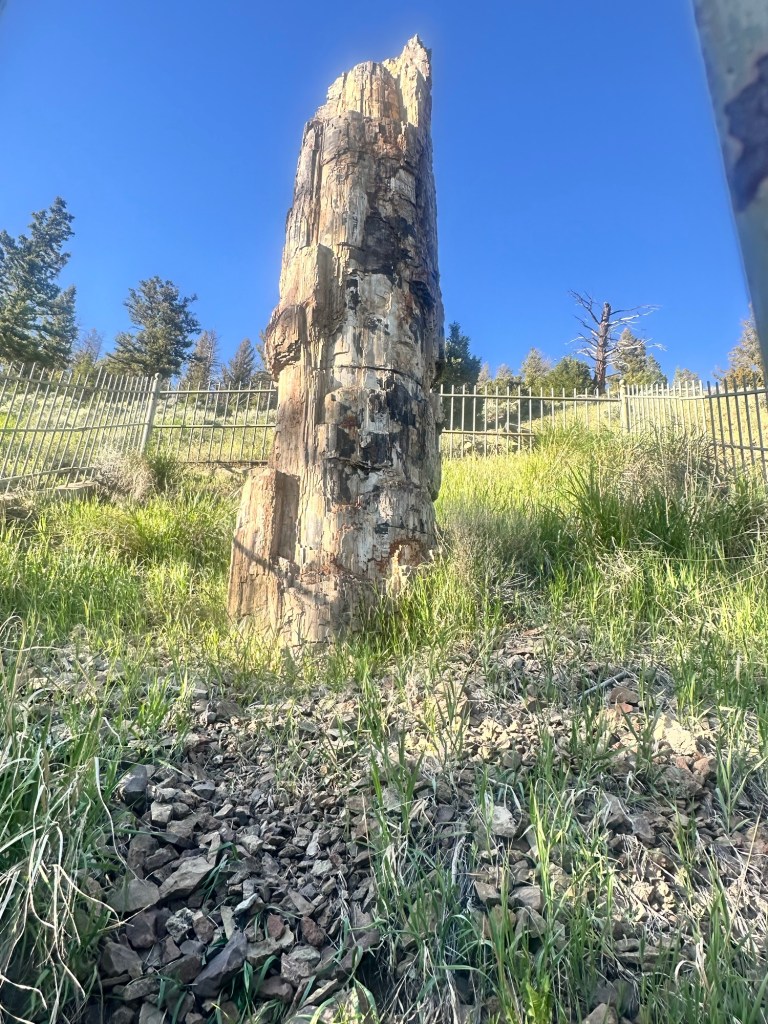
Approximately 50 million years old Petrified Tree
The Sight
The Undine Falls
Undine Falls, a scenic 60-foot, three-tiered waterfall where the water cascades over a series of distinct volcanic basalt cliffs is located in the northern region of Yellowstone National Park along Lava Creek, just 4 miles east of Mammoth Hot Springs along the Grand Loop Road (heading toward Tower Junction). It was named in 1885 by geologist Arnold Hague after “undines”—mythological German water spirits or nymphs known to live around waterfalls.
The Petrified Tree
Yellowstone’s petrified tree is an ancient relic preserved by volcanic ash and mudflows some 50 million years ago. The famous standing specimen is located along the paved Petrified Tree Trail, located just off the Grand Loop Road, 1.5 miles west of Tower Junction. It is encased in a metal fence to protect it from early souvenir hunters who chipped away at the other two trees that were originally there.
Fifty million years ago, the Absaroka volcanoes that follow the park’s eastern and northern boundaries were active separately from the Yellowstone hot spot. Their heat melted snow on the peaks, and sent the resulting mudslide rushing downslope in a lahar: a jumble of slush, debris, ash, and volcanic rock. These lahars covered the landscape of the northern range of Yellowstone, including the plants and trees that were living at the time. The petrification process here is unique because it has preserved the organic matter and actual cells of the wood within the minerals. In other famous fossil forests, such as in Arizona, the minerals actually replaced the cells. Here, trees were covered by debris, and then groundwater rich in silica and calcite from volcanic ash seeped in to clog the hollow tubes that trees use to transport water.
Travel Video
Please click the link below
https://youtu.be/Wk13fXKB6aQ?si=m4nWUBBucouCU3ws
The Vision
Undine Falls
The continuous cascade of Undine Falls perfectly mirrors the concept of Samsara—the endless, cyclical flow of worldly existence and change.
When you look at a waterfall, it appears to be a single, solid entity (“Undine Falls”). In reality, the water molecules are constantly changing every millisecond. Vedanta uses this to explain Maya (illusion): we mistake a rapidly changing stream of experiences for a permanent, static reality.
The Falls were named after “undines” (water spirits). In Vedanta, the universe is nothing but Nama (name) and Rupa (form) superimposed on the absolute truth. Water takes the form of a creek, a waterfall, and a river, receiving different names along the way, yet its essential nature remains unchanged as water.
The Chāndogya Upaniṣad teaches:
वाचारम्भणं विकारो नामधेयं मृत्तिकेत्येव सत्यम्
“All modifications are merely names arising from speech; the underlying reality alone is true.”
(Chāndogya Upaniṣad 6.1.4)
Petrified Tree
The story of the 50-million-year-old redwood tree turned to stone is a literal demonstration of the impermanence of the physical world (Anitya).
The Kaṭha Upaniṣad reminds us:
अनित्यं असुखं लोकम्
This world is impermanent and incapable of providing lasting fulfillment.
Everything in the realm of names and forms (nāma-rūpa) is subject to change. The petrified tree silently proclaims:
“That which appears permanent today was once changing; that which appears changing today will one day disappear.”
The living tree became stone. The mountain that buried it is eroding away. The observer who beholds it is also changing moment by moment. Thus the tree becomes a monument to anityatva—the impermanence of all objects.
“What is the common factor between the living tree and the petrified tree?” The answer is Existence (Sat). The tree existed then. The petrified tree exists now. Existence remains while names and forms undergo transformation.
The Petrified Tree of Yellowstone is more than an ancient fossil. It is a natural scripture written in stone.
It teaches:
- Impermanence (anityatva)
- The changing nature of nāma-rūpa
- The power of Time
- The mystery of continuity amidst change
- The need to look beyond appearances
- The order of Īśvara
- The distinction between the Seer and the seen
In that recognition, the petrified tree ceases to be merely a relic of the past and becomes a Dakshinamurthy, the silent guru pointing toward the eternal Brahman.
Next week
Next week, join me to visit the famous Mammoth Springs
God Bless


Leave a Reply