The Sight
The Grand Canyon
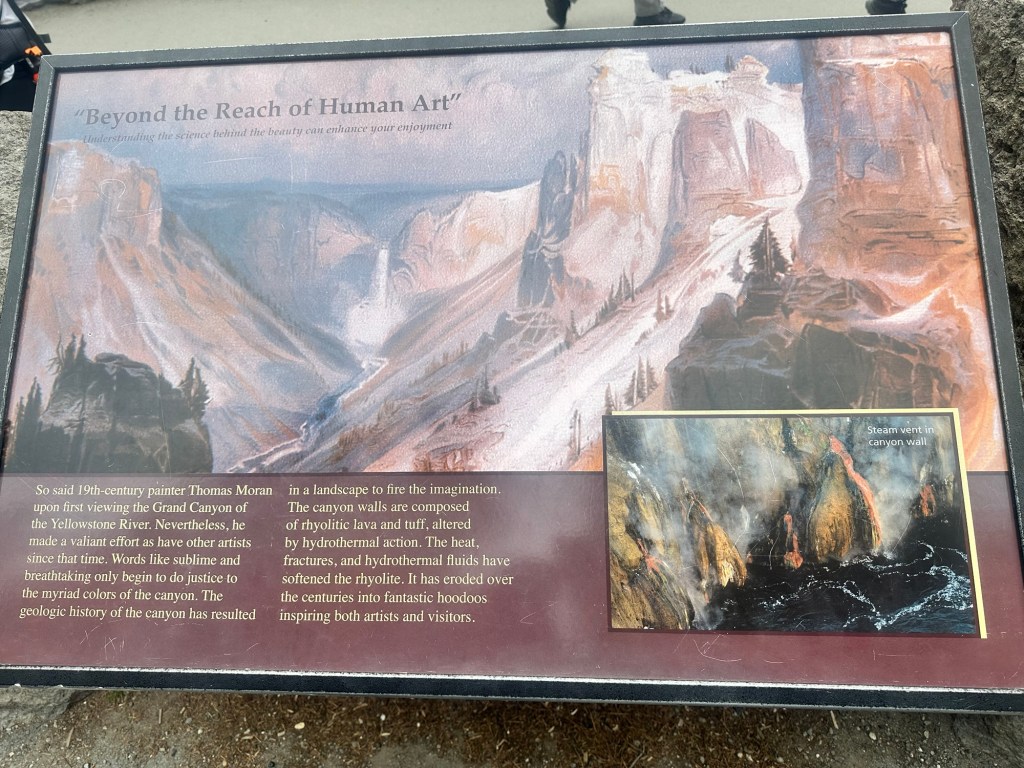
The Grand Canyon of the Yellowstone is relatively young (around 140,000 to 160,000 years old). It was carved by the Yellowstone River as it cut through subterranean rock weakened by constant geothermal and hydrothermal activity. Well, this statement appears to be a simple one; but behind this is the geological story of the birth of this Grand Canyon. Let us sum up these activities.
- About 631,000 years ago, massive explosions, uplift and faulting of the ground,
- About 480,000 years ago, thick lava flows,
- About 150,000 years ago, the area was the site of a vigorous acid-sulfate thermal area with abundant hydrothermal activity
- By 22,000 years ago, a thick ice cap covered Yellowstone as part of the Pinedale glaciation
- As the glaciers retreated, the Pinedale ice dam could have failed and reformed repeatedly between 18,000 and 14,000 years ago, releasing torrents of water that caused rapid erosion of the canyon. It was flooding by water, and not erosion by glaciers, that created the canyon because of the feature’s V-like shape (glacial canyons have U-like shapes).
Stretching from the Lower Falls to the Tower Falls area, the Grand Canyon of the Yellowstone is about 28 km (17 miles) long, 250–350 meters (820-1150 feet) deep, and 450–1200 meters (1500-4000 feet) across.
The canyon eventually extends through and passes just beyond the Tower Fall area, which is located about 17 miles north of the canyon’s starting point. The river’s erosion creates both the canyon walls and these famous drops.
Calcite Springs marks the downstream end of the Grand Canyon of the Yellowstone River. The geothermally altered rhyolite inspired the artist Thomas Moran. His paintings of this scene were among those presented to Congress in 1872, leading to the establishment of the park. The steep, columnar basalt cliffs on the opposite side of the river from the overlook are remnants of an ancient lava flow, providing a window into the past volcanic forces that shaped much of the Yellowstone landscape. The gorge and cliffs provide habitat for numerous wildlife species including bighorn sheep, red-tailed hawks, and osprey.
Tower Fall
The name “Tower Fall” (singularized by the U.S. Geological Survey in 1928) comes from the tower-like rock formations created by ancient volcanic activity. These spires are composed of volcanic breccia—a mix of rock fragments and ash—that proved more resistant to erosion than the surrounding soil
Tower Fall is a stunning 132-foot waterfall in Yellowstone National Park. Named for the unique rock pinnacles framing its crest, it is located in the park’s northeastern region just south of the Tower-Roosevelt junction
In 1871, artist Thomas Moran and photographer William Henry Jackson documented the falls. Moran’s vivid painting of Tower Fall was instrumental in showcasing the beauty of the West to lawmakers in Washington D.C., leading to the park’s creation in 1872. For over a century, a large boulder sat precariously at the very lip of the falls. In June 1986, gravity finally won, and the boulder tumbled into the pool below, permanently altering the waterfall’s silhouette.
Just north of the falls, an overlook provides a view of hydrothermal oil seeps and spectacular basalt columns that resemble a “palisade” along the canyon wall.
The Vision
When viewed through Advaita Vedānta, the Grand Canyon of the Yellowstone and Tower Fall cease to be merely geological formations. They become profound illustrations of the teachings of the Upaniṣads.
1. The Birth of the Canyon: The Unfolding of Māyā
To the ordinary observer, the geological history could appear as disconnected events. To the Vedāntin they reveal a profound truth.
The Upaniṣads declare:
मायां तु प्रकृतिं विद्यान्मायिनं तु महेश्वरम्
“Know Māyā to be Prakṛti and the Lord to be the wielder of Māyā.”
— Śvetāśvatara Upaniṣad 4.10
The canyon was not created in a single moment. It emerged through countless interacting forces over vast periods of time.
Likewise, the universe that appears before us is not an independently existing reality. It is a continuous manifestation of Māyā operating under Īśvara’s order. The Grand Canyon teaches:
“What appears today as a finished object is actually the visible tip of an immeasurable causal chain”. This is true of a canyon. This is true of a human life. This is true of the entire cosmos.
2. The Canyon as an Illustration of Adhyāropa-Apavāda
Advaita frequently employs the method of Adhyāropa-Apavāda (superimposition and negation).
What we initially perceive as cliffs, waterfalls, colors and rock formations due geological inquiry is perceived as sediments, lava, hydro thermal activity, erosion, volcanic deposits and water flow. Scientific inquiry gradually removes our naïve perception.
Each layer of understanding negates the previous superficial appearance.
Vedānta performs the same operation. Initially we see duality everywhere; man, woman, mountain, river and earth. Inquiry gradually reveals body, senses, mind, intellect, causal factors and. existence-consciousness. Finally one discovers:
सर्वं खल्विदं ब्रह्म
“All this indeed is Brahman.”
— Chāndogya Upaniṣad 3.14.1
3. The River as Time (Kāla)
The Yellowstone River carved the canyon. Not in a day. Not in a century. But through unimaginable persistence. The river becomes an excellent symbol of Kāla (Time). Everything yields before Time:
The Bhagavad Gītā declares:
कालोऽस्मि
“I am Time.”
— Bhagavad Gītā 11.32
The canyon stands as the visible signature of Time’s work. What appears solid and permanent is slowly being reshaped every moment. The Vedāntin therefore sees the canyon as a reminder of the impermanence of all forms.
4. Hydrothermal Alteration and the Spiritual Life
A particularly fascinating fact is that the canyon was carved through rock already weakened by hydrothermal processes. The river could erode because hidden forces had first transformed the rock internally. This beautifully mirrors spiritual growth.
Before Self-Knowledge dawns, the mind undergoes long preparation:
- Karma Yoga,
- Upāsana,
- Bhakti,
- Viveka,
- Vairāgya,
- Śravaṇa,
- Manana.
These disciplines slowly dissolve inner hardness and pave way for ‘chitta suddhi’. Then the teachings of Vedānta can penetrate. Adi Śaṅkara repeatedly emphasizes that knowledge fructifies only in a prepared mind. Just as the Yellowstone River could carve the canyon because geothermal forces had already softened the terrain, Vedāntic inquiry transforms only a mind refined through spiritual discipline.
5. The Colors of the Canyon and the Play of Nāma-Rūpa
The Grand Canyon is famous for its:
- yellows,
- reds,
- oranges,
- pinks,
- whites.
These colors arise from mineral alteration.Yet every visitor is captivated by them.
Advaita sees here a direct lesson.The colors enchant us, but they do not alter the underlying existence of the rock. Similarly:
- birth,
- youth,
- old age,
- success,
- failure,
- pleasure,
- pain,
are merely changing colors appearing upon the one changeless Self. The Self remains untouched. Just as the rhyolite remains despite changing mineral hues, Brahman remains despite the changing colors of experience.
6. Tower Fall and the Spiritual Seeker
Tower Fall plunges 132 feet in a single dramatic descent. The waterfall symbolizes a profound Vedāntic truth. Water at the crest and water at the base are not different substances. Only the form changes.
Likewise, before enlightenment “I am a jīva.” After enlightenment
“I am Brahman.” Nothing new is created. Nothing travels anywhere. Only ignorance falls away. The water never ceased being water. The Self never ceased being Brahman.
7. The Towering Pinnacles and the Jñānī
The volcanic spires around Tower Fall have survived because they resisted erosion better than surrounding material. Everything around them yielded. They remained standing.
A Vedāntin cannot help but remember the Gītā’s description of the Sthita-prajña:
दुःखेष्वनुद्विग्नमनाः सुखेषु विगतस्पृहः
“Unshaken in sorrow and free from craving in pleasure.”
— Bhagavad Gītā 2.56
The ordinary mind is eroded by every experience. The sage stands firm. The pinnacles become natural symbols of spiritual steadfastness.
8. The Boulder that Fell in 1986
For generations visitors assumed the huge boulder at the crest of Tower Fall would remain forever. Then one day gravity claimed it. The waterfall’s appearance changed permanently.
Everything within the realm of name and form is unstable. The Kaṭha Upaniṣad says:
ध्रुवमध्रुवेष्विह न प्रार्थयन्ते
“The wise do not seek permanence among impermanent things.”
— Kaṭha Upaniṣad 1.2.10
Human beings cling to:
- wealth,
- reputation,
- relationships,
- achievements,
as though they were permanent. The fallen boulder teaches otherwise. The world is a flowing process, not a fixed structure.
9. Calcite Springs: The Vision of the Whole
Calcite Springs marks the downstream end of the canyon.There the observer can see:
- the river,
- the gorge,
- thermal activity,
- ancient lava flows,
- wildlife habitats.
Many apparently separate phenomena are seen as one interconnected landscape. This is remarkably close to the Upaniṣadic vision.
The sage sees:
- gods,
- humans,
- animals,
- mountains,
- rivers,
not as separate realities but as expressions of one underlying Being.
The Īśāvāsya Upaniṣad declares:
यस्तु सर्वाणि भूतानि आत्मन्येवानुपश्यति
“He who sees all beings in the Self alone…”
— Īśāvāsya Upaniṣad 6
At Calcite Springs, one begins to appreciate the interconnectedness of Yellowstone. In Self-knowledge one appreciates the non-duality of existence itself.
10. Why Thomas Moran’s Paintings Changed History
An Advaitin finds significance even in Thomas Moran’s paintings. Millions of years of geological evolution remained largely unseen. Then an artist perceived beauty and revealed it to others. Congress saw the paintings. Yellowstone became the world’s first national park. We all enjoy it.
Similarly, Brahman is ever-present. Yet we do not see It. The Guru does not create Brahman.The Guru merely reveals what is already there. Just as Moran revealed Yellowstone to a nation, the Guru reveals the Self to the disciple for our Absolute Bliss.
Final Vedāntic Reflection
The Grand Canyon of the Yellowstone and Tower Fall together narrate a magnificent spiritual allegory.
The canyon teaches:
- the immense power of Time,
- the hidden workings of causation,
- the impermanence of forms,
- the gradual preparation required for transformation.
Tower Fall teaches:
- the continuity underlying change,
- the steadfastness of the sage,
- the inevitability of dissolution,
- the difference between appearance and essence.
Standing before the canyon, the Advaita student may silently hear the Upaniṣadic declaration:
नेह नानास्ति किंचन
“There is no multiplicity here whatsoever.”
— Bṛhadāraṇyaka Upaniṣad 4.4.19
The cliffs, the river, the waterfalls, the volcanic towers, the animals, the colors, the observer, and even the thoughts arising in the observer’s mind are all appearances within one indivisible Reality.
The Yellowstone River may carve the canyon. Time may reshape the landscape. Waterfalls may rise and vanish. Boulders may fall. Volcanoes may erupt and become silent. Yet the substratum of all experience remains untouched. That changeless substratum is Brahman. And That Thou Art.
तत्त्वमसि Tat Tvam Asi — Chāndogya Upaniṣad 6.8.7.
Travel Video
https://youtu.be/qyPba2WmLSc?si=EYsqXF05SrCbs1iI
Next week, we will visit the West Thumb Geyser Basin
God Bless


Leave a comment