Since childhood days I have watched with wonder how my mom and other lady members in our family call out crows and offer food to them before we commence our lunch. This is a routine affair.
I also learnt as a child that we should be like crows when it comes to sharing food. Crows call out fairly loudly all their family and friends to come and share the food what they got. I have also seen and heard their SOS when one of their clan is injured (sometimes fatally wounded/shot).
How do they communicate with each other in their meetings during their “business as usual” days? I am neither an Ornithologist nor an avid bird watcher to understand this. According to Ornithologists at Cornell Lab, communications by crows may be more complex than other birds.
Strange enough, I now regularly watch with awe their meetings . I decided to record the proceedings. In the month of January 2025, I witnessed 5 such meetings. These meetings happened fairly regularly at the end of the day between 17.45 to 18.30 hrs (just around the sun set time). Their meetings lasted for not more than 5 minutes
I have no clue whatsoever on their communications. But I did notice a striking similarity with how we communicate in a group. The voice modulations, gesticulations (vigorous shaking of their tails), display of restlessness, manoeuvring to get strategic seat for effective communication etc were all there for me to see.
Here is a video clip.
What were they trying to communicate?
Were they trying to share their experiences on a daily basis?
Were they discussing strategies for handling the forthcoming summer?
Were they concerned about the menace from the ever growing population of pigeons?
Were they talking about the radiations fron the Cell Phone towers?
I have absolutely no clue. I can’t hear, I can’t see, I can’t think, yet my intellect surely tells me that they had SOMETHING in them that sets an agenda for them to discuss daily, even though THAT which sets the agenda and which EXISTS is beyond my sensory perceptions.
After all, Vedas tell me that, THAT SOMETHING which is beyond my sensory perceptions EXIST inside me and in-fact is ME (tat tvam asi). Vedas do tell me that the same EXISTS inside them too.
That something that EXISTS in me and as me and in those crows too, is what I want to understand and nothing else.
For me understanding THAT SOMETHING is enough. Rest are all perishables and really doesn’t matter.
When we say “wild and wonderful” where does our mind jump to immediately?
“Hakuna Matata. kusafiri” is the answer.
Confused with the answer? In the East African language of Swahili, it simply means “no worries”, “take it easy”. The answer is “Safari”.
Safari -An introduction
In Swahili, the word safari means “journey”, originally from the Arabic noun سفر, safar, meaning “journey”, “travel”, “trip”, or “tour”; the verb for “to travel” in Swahili is kusafiri. These words are used for any type of journey.
Safari entered the English language at the end of the 1850s thanks to the British explorer Richard Francis Burton. In 1836, British Army Engineer,
William Cornwall Harris led an expedition purely to observe and record wildlife and landscapes. Harris established the safari style of journey, starting with a not too strenuous rising at first light, an energetic day walking, an afternoon rest then concluding with a formal dinner and telling stories in the evening over drinks and tobacco.
The hunting aspect traditionally associated with the safari is said to have its origins where villagers got together to hunt wild boars and reclaim land for farming. However it was the British who used Safaris for hunting for personal pleasure and popularized it.
Gujarat – The wild and wonderful
Our trip to Gujarat contained two segments where we stuck to the spirit of William Cornwall Harris style of Safari as a means to understand the wild and wonderful Gujarat.
Segment 1 – Gir – The kingdom of the “Wild and Wonderful”.
Part A – Jungle Safari
The Gir National Park was established in 1965 in the erstwhile Nawab of Junagarh’s private hunting area, with a total area of 1,412 km2(545 sq mi), of which 258 km2 (100 sq mi) is fully protected as a national park and 1,153 km2 (445 sq mi) as wildlife sanctuary.
Kicking off the day at 0530 Hrs we started our Safari in the jungles of Gir. A four hour drive in an open Gypsy (A jeep) took us the nook and corner of the sprawling Gir Forest. We were lucky to spot a lioness marking her territory right at the start of the Safari. The rest of the Safari covered other animals and birds. Here is an overview.
Sasan Gir – Jungle Safari
This was followed by an exquisite lunch and siesta at the FERN GIR FOREST RESORT.
Part 2 – Devalia Safari
Evening Safari was a bit different; we wanted to present ourselves as “strange moving creatures with two legs” to the wild and wonderful. So we locked ourselves in a cage mounted on a Gypsy and paraded ourselves to the wild animals in the Gir Forest. Needless to say that the Wild and Wonderful didn’t bother about us at all and were busy at their routines.
Gujarat Tourism calls this place as “ Devalia Safari Park ” also known as “Gir Interpretation Zone- Devalia”. Here is our Safari with a dufference:
Devalia Park – Safari with a difference
Experience in this segment summed up – “High” on expectations (with increased Lions population and previous day sightings expectations built up) and “Moderate” on success in sighting.
Segment 2 – The Little Rann of Kutch – A saline sublime
In this segment, we moved away from the Jungle to the vast, dry and extremely hot saline desert.
Covering an area of 4954 Km2, Little Rann of Kutch is one of the most remarkable and unique landscapes of its kind. Wild Ass Sanctuary is located in this Rann which harbours the last population of Wild Ass (Equus hemionus khur).
It is a vast desiccated, unbroken bare surface of dark silt, encrusted with salts which transforms into a spectacular coastal wetland after the rains. The present saline desert of the Little Rann (saline desert-cum-seasonal wetland) of Kutch is believed to have been shallow sea.
We checked into the Royal Safari Camp at Bajana and relaxed after a sumptuous meal.
Part A – The Wild Ass Safari
We were ready for the Evening Safari. Temperature soared to 43 deg C (in the last week of March itself) and here we are driving in an open Gypsy towards the saline desert from the village center.
Wild Ass Safari – LRK
Part B – Nature’s Aviary at the Saline Desert
We even got down from the Gypsy and walked around the waterbodies to have an exclusive “darshan” of the birds around there. Wow. What a sight.
Nature’s Aviary
Experience in this segment summed up – “Low” on expectations (what do you expect, except a few Wild Asses and that too in a hot desert) and “High” on success in sighting (not only Wild Asses but also an impressive show by the Birds and Aditya, the Sun while setting).
Lessons learnt – Safari and Vedanta
This is our second Jungle Safari after the one at Kanha Tiger Reserve at Madhya Pradesh in 2018.
Safaris like these drive home several lessons, many of them straight from our Vedanta.
Here are some of my learnings:
1. If you are keeping your expectations (desires) high, you are bound to get disappointed (frustrated). After all you are looking for a few hundred wild animals (which are mostly territory oriented) in an area spanning thousands of square kilometers.
2. What you get to see (or otherwise) need not necessarily be seen (or otherwise) by someone who are either ahead of you or behind you. Your experience is unique to yourselves.
3. Time and Space can decide what you get or loose. In other words your experience is time and space limited.
4. Enjoy what you see, your experience. That moment is precious. The idea of being present and savoring the moment is not a novel idea, but it’s often a forgotten one. David Attenborough’s extraordinary documentaries on Animal Kingdom are awesome; no doubt about that. But nothing will ever have as big an effect as seeing the real beauty of the world and its inhabitants on safari by yourselves.
5. Silence is golden. Feel it and enjoy it. Through the day enjoy that moment where a bird or a monkey or a deer provides an alarm for an approaching animal. In the night at the Camp, listen to the insects’ hum and chirp; the stars in the sky and the sounds of nature.
6. See the positives. Even dirty roads and bushy terrain offers great views.
7. The Sun always provides spectacular views both in the morning and evening. Enjoy it and pray Aditya for keeping us alive.
8. Be patient. You have no choice. Sometimes what you want and expect doesn’t happen right away; sometimes what you want takes much longer than you thought it would.
9. Ears are better than mouth. Listening is Often Better Than Talking. Listen to the safari guide or just listen to the sounds of the bush. The point is that when we listen, our bodies are much more attuned to everything that’s happening around us. You also learn what you may not have known.
10. Life is not a rat race. Reconnect with the beauty of little things and enjoy.
Today is Thai Pongal. They say தை பிறந்தால் வழி பிறக்கும். The dawn of the Tamil Month of Thai is expected to bring in solutions to all our issues. Happy Pongal to all.
The day is also called Makar Sankranti or Uttarayan or Maghi or simply Sankranti (also known in Bangladesh as Poush Sankranti), It is a harvest festival day in the Hindu Calendar, dedicated to the nourisher Aditya or Surya (Sun). It is observed each year the day Sun enters the Capricorn zodiac which corresponds with the month of January as per the Gregoriyan Calendar. It marks the first day of the sun’s transit into Makara rashi (Capricorn). A very special day indeed for us.
On this auspicious day, here is my photographic Pranaam to Aditya.
Everyday during my walks in the early morning and in the evening, I was always under the impression that I had the best views of our nourisher “Aditya” the Sun and receive his Golden Blessings.
Somedays I get young guests joining me to share the gallery.
But never did I realize that there are always some “special beings” who had the vantage view, negating my “superior view” about myself. Here are these special ones.
No wonder we say “आदित्यहृदयंपुण्यं”. The Sun has a noble heart indeed.
Have a great day. God Bless. இறை அருள் பெருக. வளமுடன் வாழ்க !
We saw in the introductory blog earlier that this “jivatma” which was “relation less” and who is otherwise a witness “Saakshi” becomes related due to the influence of Maya, becomes an actor and the misery starts with transactions and continues till we know our true self through “atma gnanam”. Adi Sankara outlines a few relationships in this Sloka.
The differentiations that we see in the world as Cause and Effect, as possessor-possession, relations as the disciple & teacher, and also as father & son etc., are all differentiations within the one Ātman. In Dream or Waking state, He, the One Puruṣaḥ is always present, and (as if) Maya wanders over Him and gives rise to all these Differentiations. Salutations to Him, the Personification of Our Inner Guru Who Awakens This Knowledge through His Profound Silence; Salutation to Sri Dakṣiṇāmurty.
Understanding the Sloka
The Role of Maya
Let us look at the third line first: य एष पुरुषो मायापरिभ्रामितः eṣa: puruṣaḥ māyāparibhrāmitaḥ;
1. It means – This ordinary person in the world; even though he may be worldly-educated; who is spiritually and scripturally-illiterate; he is māyā paribhrāmitaḥ; { माया māyā means avidya परिभ्रम Paribhrama = Moving To and Fro, Wander/drift}. மாயையவள் வசப்பட்டு உழலும்
2. This means that he is confused because of avidya and therefore instead of taking original sākṣi svarūpam as himself; he mistakes the incidental-ahaṃkāra as himself drifts into the attached-self called ahaṃkāra I; I am going to certainly become a relative individual, related to the external world; asaṃga sākṣi (the unattached witness), becomes ससंगजीवः sasaṃga jīvaḥ (attached soul); relationless pure sākṣi-I, have now drifted and fallen down to a relative samsāri-I;
3. This means that every relation is causing one form of samsāra or the other. There is no relationship which is free from problems; In fact, if there is a relationship free from problems then the end of the relationship will cause problems; If there is a relationship so beautiful and wonderful and enjoyable, even that wonderful relationship becomes a problem when the relationship has to end because of time/kala, because of prarabdhaḥ, because of any reason. Therefore, a problem free relationship is an oxymoron; it does not exist. And therefore, the sākṣi-I, who is ever free, now has fallen down to ahaṃkāra-I, with varieties of problems.
Relationship
A few empirical relationships are enumerated in the sloka i.e., कार्यकारण संबन्धः kāryakāraṇa saṃbandhaḥ; cause and effect relationship. I-as-jīvātma, the ahaṃkāra-I, am a product of my own past karma; my prarabdhaḥ karma has given me this personality; this physical, this emotional, this social personality. Therefore, I am never a free person; I am tossed up and down; by my own karma; thus I am a कार्मय kāryam; my karma becomes the kāranam for my situation.
Let us see a few of the cause & effect relationships.
1. स्वस्वामिसम्बन्धतः svasvāmisambandhataḥ; स्वस्वामि (Svasvaami = Possessor and Possession & सम्बन्ध (Sambandha = Relation). That means as ahaṃkāra, I am related to several possession, as owner-owned sambandhataḥ; and ownership means, there is a yogakṣema samsāra. yogakṣema samsāra means acquisition-maintenance samsāra is there like. உடையவன் – உடமை உறவுகள்.
शिष्याचार्यतया śiṣyacāryatayā; means guru-śiṣya sambandhataḥ. ஆசான் – சீடன் உறவுகள்.
पितृपुत्राद्यात्मना pitṛ putrādyātmanā; means father son adhi etc. தந்தை – மகன் உறவுகள் (சொந்தம் எப்போதும் தொடர் கதைதான், முடிவே இல்லாதது)
So, the māyā paribhrāmitaḥ puruṣaḥ drifted and fallen down from a relationless pure sākṣi-I, to relative samsāri-I in either of the स्वप्ने जाग्रति वा Svapne Jaagrati Vaa avastha, whether it is waking state or dream state, gets into the inevitable saṃsāraḥ.
Of course we get some interval and relief in सुषुशि अवस्त suṣupti avasta, wherein we do not worry about the family members and society and other problems, and unfortunately we cannot sleep for long. The sleep is only for a few hours and older we grow, lesser the sleep also. Therefore even sleep is not a permanent solution; even death is not a permanent solution, because punarjanma brings in punaha sambandhataḥ and samsāra; And therefore this jeevathama, puruṣaḥ ha; who is really a sākṣi; that purushā, māyā paribhrāmitaḥ; as is confused because of māya.
Relationships & The Birds on a Tree – A Vedic Perspective
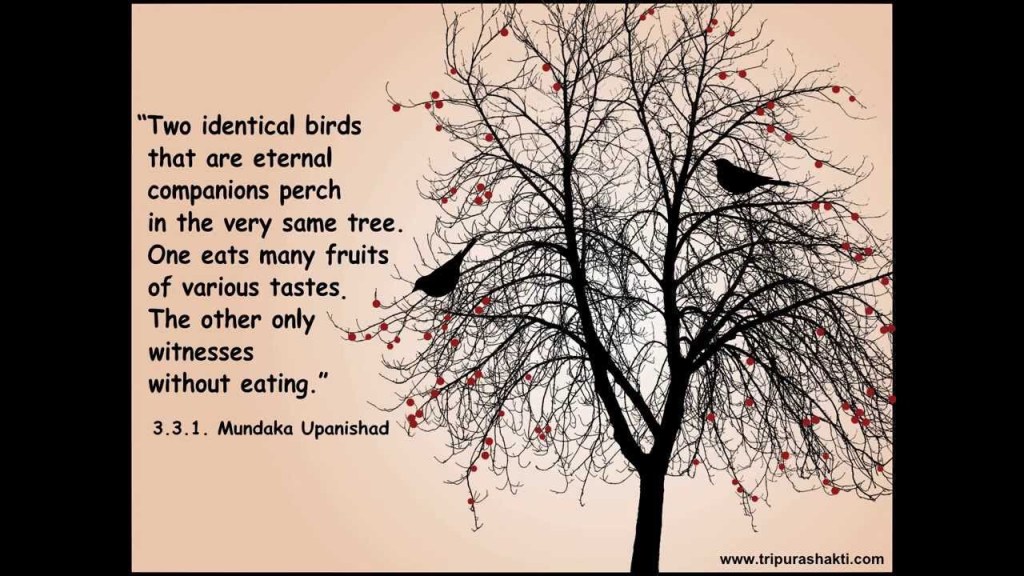
Talking about the relationships of the unattached witness and the attached soul, the famous two birds in one tree Sloka from the Upanishads provides the classic conceptual framework for this Sloka in Dakshinamurthy Stothram.
The Shruti, says: By Mâyâ, Siva became two birds always associated together; the One, clinging to the one unborn (Prakriti), became many as it were (vide Mundaka- Up. 3-1; Yâjniki-Upanishad 12–5).
Meaning of the Sanskrit Words – “Suparnau – two of good motion or two birds; (the “word Suparna” being used to denote birds generally); Sayujau – inseparable, constant, companions; Sakhayau – bearing the same name or having the same cause of manifestation. Being thus, they are perched on the same tree (‘same,’ because the place where they could be perceived is identical). ‘Tree’ here means ‘body;’ because of the similitude in their liability to be cut or destroyed. Parishasvajate – embraced; just as birds go to the same tree for tasting the fruits.
Two birds bound to each other in close friendship are perched on a tree. While one of the birds is busy consuming the fruits of the tree with great relish, the other seems to be in a state of detached equanimity just looking at its compatriot. The tree in this example represents the body. The bird busying itself with the material pleasures accorded by the tree is the ‘Jivātma’ (individual soul), that has an inextricable identification with the body and mind. Such an identification makes the Jivātma both the ‘karta’ (doer) and the ‘Bhokta’ (enjoyer). The observing bird on the other hand, represents the ‘Paramātma’ (the Supreme Self). The Supreme Self remains uninfluenced and untainted by any material pleasures and possessions and remains a still tranquil witness.
Adi Śankarācārya in his commentary to this sloka says – This tree as is well known has its root high up (i.e., in Brahman) and its branches (prana, etc..) downwards; it is transitory and has its source in Avyakta (maya). It is named Kshetra and in it hang the fruits of the karma of all living things. It is here that the Ātman, conditioned in the subtle body to which ignorance, desire, karma and their unmanifested tendencies cling, and Isvara are perched like birds. Of these two so perched, one, i.e., kshetrajna occupying the subtle body eats, i.e., tastes from ignorance the fruits of karma marked as happiness and misery, palatable in many and diversified modes; the other, i.e., tbe lord, eternal, pure, intelligent and free in his nature, omniscient and conditioned by maya does not eat; for, He is the director of both the eater and the thing eaten, by the fact of His mere existence as the eternal witness (of all); not tasting, he merely looks on; for, his mere witnessing is direction, as in the case of a king.”
The Way Forward
Swami Dayananda Saraswathi in his lecture says that in all but one relationship listed by Adi Sankara , the “bedha”- the difference between the Atma and the Maya influenced Jeeva continues to exist eternally irrespective of the transactions. The guru-shishya relationship even though is a cause and effect relationship is the only one which ensures that the influence of Maya is nullified and the true nature of Jeeva is revealed through the guru’s teachings. In that state, even the guru-shishya relationship withers away and so too the other relationships.
And that is perhaps why Adi Śankarācārya says, even this confused jeeva is really none other than that dakṣiṇāmūrti only and therefore he says Tasmai Shri Gurumoorthaye; To that Gurumoorthy, dakṣiṇāmūrti , my namaskaraha.
அன்பு சிவமிரண் டென்ப ரறிவிலார்
அன்பே சிவமாவ தாரு மறிகிலார்
அன்பே சிவமாவ தாரு மறிந்தபின்
அன்பே சிவமா யமர்ந்திருந் தாரே
என்ற திருமந்திரப் பண் இக்கருத்தினைப் பிரதிபலிக்கிறது.
This, in essence is the eighth Sloka.
Long distance shoot using iPhone from the balcony of my house.
Ever since we returned back to Bangalore in April 2021 from the USA, it has been exactly the same conditions like what we faced when we entered NewYork in early February 2020. LOCKED DOWN.
Locked down essentially means you get lots of time to do “Roof top walking” a familiar routine in the early morning and evening for me; this time with a difference – with lots of friends and companions. Strange!
Yes. It is literally an expedition to the animal kingdom and in particular THE BIRDS. I can assure you that if the lockdown continues further I can probably claim to have understood what these wonderful creations of God speak among themselves.
Here is Cathy, the Crow and Peggy, the Pigeon in a conversation on a bright and sunny day. True to the current situation, they had their cup of woes too. Let us hear them.
Well, Don’t worry Cathy and Peggy. Normalcy should be restored soon. Best wishes.
After a week’s stay at the Southampton Village it was time to move to Wainscott in the Hamptons for the Memorial Day week end. Wainscott didn’t disappoint us at all. It matched Southampton “leaf by leaf”, “hedge by hedge” and “green by green”. My iPhone popped out of my pocket and started the job even without I realizing it !
The background music is by Dr. Jayanthi Kumaresh in the Raga “Dharmavathi”. Of course, the little birds and the waters of Wainscott added beauty to the BGM score by lending their voices too. Here is a glimpse of that in under 5 minutes in my You Tube channel prabhu53. Pl visit.
After nearly 4 decades in Aeronautical Industry, I decided to keep away from the Industry and focus on my other interests such as Travel, Languages, Spirituality and Photography. I could manage to stay focused for nearly 6 years now. Last week during my early morning walk I could hear giggles/noises stating that I can’t keep away from aerodynamics even after retirement. To my surprise the birds in my roof top spoke to me. Here is their version of lift, drag, take off, vertical take off, cruise etc




 Prabhu's Ponder