Angkor Thom was the last and most enduring capital city of the Khmer Empire, established in the late 12th century by King Jayavarman VII in what is now Cambodia. Angkor Thom served as the final capital of this powerful empire, which ruled much of Southeast Asia from the 9th to the 15th centuries.
It is not a single temple, but a massive walled royal city containing temples, a Royal Palace, and impressive bas-reliefs, with the Bayon temple and its famous smiling faces being a central feature. The site is located in the Angkor Archaeological Park, a UNESCO World Heritage site, and is a popular tourist destination.
Key features of the city includes the Bayon temple, the Terrace of the Elephants and a Royal Palace, all within a large, walled and moated area. It is known for its architectural genius and intricate bas-reliefs that depict both mythical and historical scenes from Khmer life and battles.
”Angkor Thom is a ruined citadel several kilometers north of Angkor Wat. Angkor Thom encloses a rectangular area of nine square kilometers, and at its peak may have held a population of over 100,000, living in tiled or thatched houses. The building of the citadel dates to around the year 1200. Angkor Thom enclosed the Royal Palace (now vanished) and a handful of major temples; the complex was bounded by walls and a moat (now mostly dry) and pierced by five gates. The city was surrounded with rice fields, which provided food; these were irrigated with reservoirs, which also supplied drinking water.
While Angkor Wat is Hindu in inspiration, Angkor Thom resonates with sculpted images expressing the Mahayana Buddhist ideal of Lokesvara (compassion), Prajnaparamita (wisdom), and the Buddha (enlightenment). Although still incorporating Hindu elements, Angkor Thom is a three-dimensional representation of Buddhist cosmology. Temple ground plans reveal a mandala-like base, with radiating symmetrical forms. At the exact center of Angkor Thom lies the Bayon Temple.
What at first appears to be of masonry actually consists of massive stones shaped into fluid sculptures, without apparent use of cement or mortar.
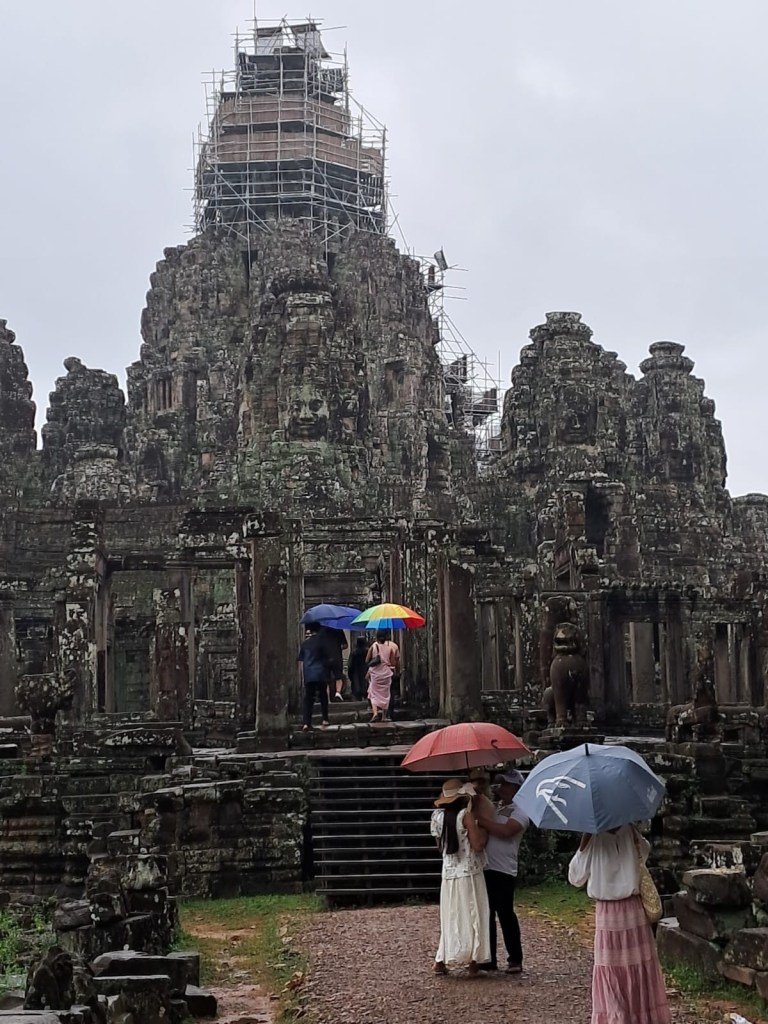
On the top terrace of the Bayon, you come face-to-face with myriad of these giant stone heads topped with lotus crowns. There are dozens of them, originally 54 towers with four heads each of which 37 towers remain. The enormous heads, ranging in size from ten to fifteen feet, features eyes downcast under lowered lids.
Disorder in the construction of the Bayon is reflected in the numerous architectural changes. It seems that after the Cham sacked Angkor in 1177, Jayavarman VII decided the Hindu deities had failed, so he switched allegiance to Mahayana Buddhism. However, he made no attempt to alter existing Hindu elements. The Bayon was caught in the middle — the foundations are Hindu, but the superstructure is Buddhist. It is estimated that the Bayon took 20 years to build. Jayavarman VII’s son and grandson reverted the use of the temple to Hindu (Shivaist) worship, with Brahmans from India gaining great influence over the Angkor court. Heads and faces on statues were destroyed and replaced with Hindu gods.”
Located on a site measuring 162.6 hectares (1.6 km2; 401.8 acres) within the ancient Khmer capital city of Angkor, it was originally constructed in 1150 CE as a Hindu temple dedicated to the deity Vishnu.
Angkor Wat was built at the behest of the Khmer king Suryavarman II in the early 12th century in Yaśodharapura (present-day Angkor), the capital of the Khmer Empire, as his state temple and eventual mausoleum.
Angkor Wat combines two basic plans of Khmer temple architecture: the temple-mountain and the later galleried temple. It is designed to represent Mount Meru and is surrounded by a moat more than 5 km (3.1 mi).
Enclosed within an outer wall 3.6 kilometres (2.2 mi) long are three rectangular galleries, each raised above the next. The expansive Temple complex covers an area of 400 acres. At the centre of the temple stands a quincunx of towers.
In 1177, approximately 27 years after the death of Suryavarman II, Angkor was sacked by the Chams, the traditional enemies of the Khmer. Thereafter, the Khmer empire was restored by Jayavarman VII, who established a new capital at Angkor Thom and the Bayon as the state temple, situated to the north. The temple was dedicated to Buddhism as the king’s wife Indradevi was a devout Mahayana Buddhist who encouraged him to convert. Angkor Wat was therefore also gradually converted into a Buddhist site with many Hindu sculptures replaced by Buddhist art.
The construction of Angkor Wat suggests that there was a celestial significance with certain features of the temple. This is observed in the temple’s east–west orientation, and lines of sight from terraces within the temple that show specific towers to be at the precise location of the solstice at sunrise. The Angkor Wat temple’s main tower aligns with the morning sun of the spring equinox.
Integrated with the architecture of the building, one of the causes for its fame is Angkor Wat’s extensive decoration. The inner walls of the outer gallery bear a series of large-scale scenes mainly depicting episodes from the Hindu epics the Ramayana and the Mahabharata.
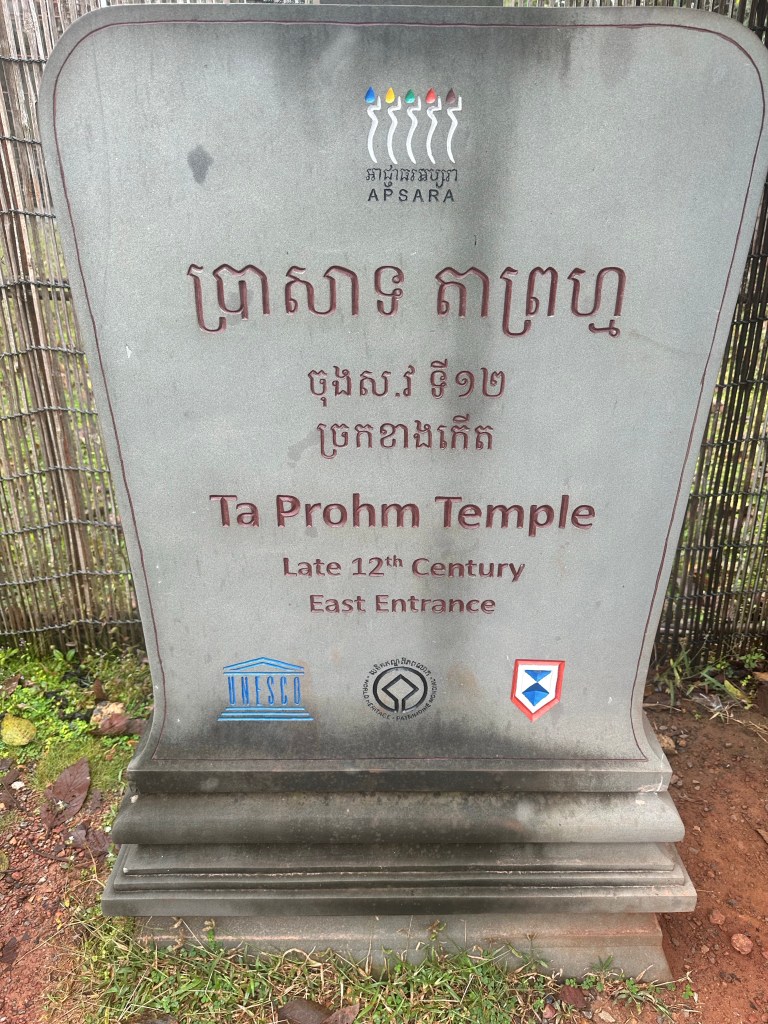
In 1186 A.D., King Jayavarman 7, embarked on a massive program of construction and public works. Rajavihara (“monastery of the king”), today known as Ta Prohm (“ancestor Brahma”), was one of the first temples founded pursuant to that program.
Jayavarman VII constructed Rajavihara in honour of his family. The temple’s main image, representing the personification of wisdom, was modelled on the king’s mother.
The site was home to more than 12,500 people (including 18 high priests and 615 dancers), with an additional 80,000 inhabitants in the surrounding villages working to provide services and supplies.
After the fall of the Khmer Empire in the 15th century, the temple of Ta Prohm was abandoned and neglected for centuries.
In 1992, UNESCO inscribing Ta Prohm on the World Heritage List, initiated the conservation and restoration of Ta Prohm as a partnership project of the Archaeological Survey of India (ASI) and the Authority for the Protection and Management of Angkor and the Region of Siem Reap (APSARA).
By 2013, the ASI restored most parts of the temple complex, some of which were constructed from scratch. Wooden walkways, platforms, and roped railings were put in place around the site to protect the monument from further damages from tourists.
It is emotionally draining to see “one of the most imposing [temples] built for personification of wisdom and was dedicated to a mother, best merging with the jungle, to the point of becoming a part of it”.
Nothing but a soulful “Subha Pantuvarali” , (a raga that stirs one’s soul, evokes grief and sorrow in the heart and focusses one towards the inner consciousness) can describe the feeling one goes through on visiting this place.
I am no exception to that when I visited this place recently.
Here is my YouTube video . Pl subscribe to my channel
The nine day Navratri Festival just ended for us in India and for Indians abroad. The grace and colors of Garba in Gujarat, the beauty of dolls display (Golu) in Tamil Nadu and the divinity of the Durga Puja celebrations in Bengal are the hallmark of the festivities.
Out here in Pennsylvania in the USA, while we organized and celebrated Navratri with a Golu (display of Dolls), we didn’t miss the grace, colors, beauty and divinity at all. Nature was present in its full glory.
In fact, there is a fashion parade going on right now to celebrate Navratri and welcome Diwali soon in our neighborhood. Surprised! Yes!
Navyata 2022 is happening in our neighbourhood.
Welcome to Navyata 2022 – the fashion parade of Nature.
Navyata 2022
Note: Keyboard support was provided by my little grandson Dhruv.
When we say “wild and wonderful” where does our mind jump to immediately?
“Hakuna Matata. kusafiri” is the answer.
Confused with the answer? In the East African language of Swahili, it simply means “no worries”, “take it easy”. The answer is “Safari”.
Safari -An introduction
In Swahili, the word safari means “journey”, originally from the Arabic noun سفر, safar, meaning “journey”, “travel”, “trip”, or “tour”; the verb for “to travel” in Swahili is kusafiri. These words are used for any type of journey.
Safari entered the English language at the end of the 1850s thanks to the British explorer Richard Francis Burton. In 1836, British Army Engineer,
William Cornwall Harris led an expedition purely to observe and record wildlife and landscapes. Harris established the safari style of journey, starting with a not too strenuous rising at first light, an energetic day walking, an afternoon rest then concluding with a formal dinner and telling stories in the evening over drinks and tobacco.
The hunting aspect traditionally associated with the safari is said to have its origins where villagers got together to hunt wild boars and reclaim land for farming. However it was the British who used Safaris for hunting for personal pleasure and popularized it.
Gujarat – The wild and wonderful
Our trip to Gujarat contained two segments where we stuck to the spirit of William Cornwall Harris style of Safari as a means to understand the wild and wonderful Gujarat.
Segment 1 – Gir – The kingdom of the “Wild and Wonderful”.
Part A – Jungle Safari
The Gir National Park was established in 1965 in the erstwhile Nawab of Junagarh’s private hunting area, with a total area of 1,412 km2(545 sq mi), of which 258 km2 (100 sq mi) is fully protected as a national park and 1,153 km2 (445 sq mi) as wildlife sanctuary.
Kicking off the day at 0530 Hrs we started our Safari in the jungles of Gir. A four hour drive in an open Gypsy (A jeep) took us the nook and corner of the sprawling Gir Forest. We were lucky to spot a lioness marking her territory right at the start of the Safari. The rest of the Safari covered other animals and birds. Here is an overview.
Sasan Gir – Jungle Safari
This was followed by an exquisite lunch and siesta at the FERN GIR FOREST RESORT.
Part 2 – Devalia Safari
Evening Safari was a bit different; we wanted to present ourselves as “strange moving creatures with two legs” to the wild and wonderful. So we locked ourselves in a cage mounted on a Gypsy and paraded ourselves to the wild animals in the Gir Forest. Needless to say that the Wild and Wonderful didn’t bother about us at all and were busy at their routines.
Gujarat Tourism calls this place as “ Devalia Safari Park ” also known as “Gir Interpretation Zone- Devalia”. Here is our Safari with a dufference:
Devalia Park – Safari with a difference
Experience in this segment summed up – “High” on expectations (with increased Lions population and previous day sightings expectations built up) and “Moderate” on success in sighting.
Segment 2 – The Little Rann of Kutch – A saline sublime
In this segment, we moved away from the Jungle to the vast, dry and extremely hot saline desert.
Covering an area of 4954 Km2, Little Rann of Kutch is one of the most remarkable and unique landscapes of its kind. Wild Ass Sanctuary is located in this Rann which harbours the last population of Wild Ass (Equus hemionus khur).
It is a vast desiccated, unbroken bare surface of dark silt, encrusted with salts which transforms into a spectacular coastal wetland after the rains. The present saline desert of the Little Rann (saline desert-cum-seasonal wetland) of Kutch is believed to have been shallow sea.
We checked into the Royal Safari Camp at Bajana and relaxed after a sumptuous meal.
Part A – The Wild Ass Safari
We were ready for the Evening Safari. Temperature soared to 43 deg C (in the last week of March itself) and here we are driving in an open Gypsy towards the saline desert from the village center.
Wild Ass Safari – LRK
Part B – Nature’s Aviary at the Saline Desert
We even got down from the Gypsy and walked around the waterbodies to have an exclusive “darshan” of the birds around there. Wow. What a sight.
Nature’s Aviary
Experience in this segment summed up – “Low” on expectations (what do you expect, except a few Wild Asses and that too in a hot desert) and “High” on success in sighting (not only Wild Asses but also an impressive show by the Birds and Aditya, the Sun while setting).
Lessons learnt – Safari and Vedanta
This is our second Jungle Safari after the one at Kanha Tiger Reserve at Madhya Pradesh in 2018.
Safaris like these drive home several lessons, many of them straight from our Vedanta.
Here are some of my learnings:
1. If you are keeping your expectations (desires) high, you are bound to get disappointed (frustrated). After all you are looking for a few hundred wild animals (which are mostly territory oriented) in an area spanning thousands of square kilometers.
2. What you get to see (or otherwise) need not necessarily be seen (or otherwise) by someone who are either ahead of you or behind you. Your experience is unique to yourselves.
3. Time and Space can decide what you get or loose. In other words your experience is time and space limited.
4. Enjoy what you see, your experience. That moment is precious. The idea of being present and savoring the moment is not a novel idea, but it’s often a forgotten one. David Attenborough’s extraordinary documentaries on Animal Kingdom are awesome; no doubt about that. But nothing will ever have as big an effect as seeing the real beauty of the world and its inhabitants on safari by yourselves.
5. Silence is golden. Feel it and enjoy it. Through the day enjoy that moment where a bird or a monkey or a deer provides an alarm for an approaching animal. In the night at the Camp, listen to the insects’ hum and chirp; the stars in the sky and the sounds of nature.
6. See the positives. Even dirty roads and bushy terrain offers great views.
7. The Sun always provides spectacular views both in the morning and evening. Enjoy it and pray Aditya for keeping us alive.
8. Be patient. You have no choice. Sometimes what you want and expect doesn’t happen right away; sometimes what you want takes much longer than you thought it would.
9. Ears are better than mouth. Listening is Often Better Than Talking. Listen to the safari guide or just listen to the sounds of the bush. The point is that when we listen, our bodies are much more attuned to everything that’s happening around us. You also learn what you may not have known.
10. Life is not a rat race. Reconnect with the beauty of little things and enjoy.
Post retirement we had a wonderful plan of exploring every year, one of the States and Union Territories in our country. That was working out nicely till 2019, when the dreaded CoVid 19 stuck. The years 2020 and 2021 saw us getting trapped in the residence.
At last, the opening came in March 2022. We decided that we will visit Gujarat (despite the fear of an oppressive heat). A detailed plan was drawn out (10 night & 11 days) covering nearly 2500 Kms of road journey. The tour was well coordinated and organized by Akshar Travels, Gujarat.
Here is a pictorial summary of our tour plan.
The explorer
Great experience it was. From the time we landed in Rajkot till the time we boarded our return flight at Ahmedabad, it was non stop learning about animals, places, heritage, culture, food and of course people.
From the non stop “Thambakoo” chewing Rajasthani driver (thanks to Film Stars who are responsible for this addiction in many people) to the tribal people selling their wares in Little Rann of Kutch, evidences of our Sanatana Dharma, everyone in search of pure happiness kept cropping up by the minute again and again.
My iPhone X literally cried for help. Help came only through places where photography was not allowed. Consolidating the photos and preserving them is a mammoth task. That process has just started and the first focus is on my favorite, the Sun – Aditya. The reason is “After all Gujarat is shining. Isn’t it?
Here is Shining Gujarat, a video of Sun Shine across our entire route in Gujarat
Today is the first day of the New Year for Tamils who follow the solar calendar. Festival means plenty of food to eat and enjoy apart from prayers and rituals. Vegetarians in India have no issues. What about our clans in the Western World ?
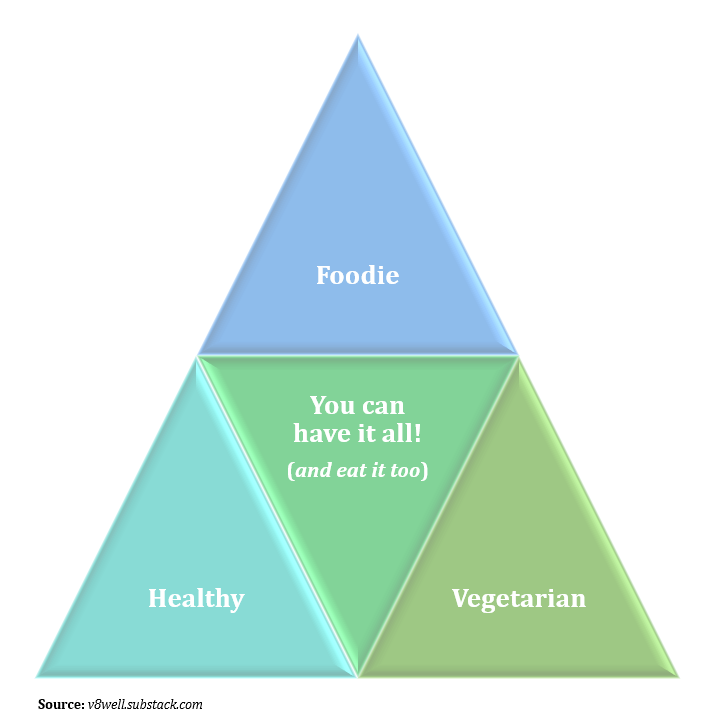
Veggies face the culinary trilemma of being vegetarian, trying to eat healthy and being a foodie.
Some common modern-day myths
Being a vegetarian makes you healthy. Yes, we are practically immortal at this point!
A vegetarian cannot be a foodie. Given we are limited to tofu and eggplant parmesan.
A foodie by definition, cannot eat healthy. See above.
This Substack is an attempt to conquer the impossible trinity of vegetarianism. Please do visit for receipes.
Pandemic may come and hopefully go; but there is no doubt that if it is early April, you will see the Central Park at the Newyork city springing up to life, providing happiness, cheer and hope.
Time to sign off from the USA for the year 2021.
Sankey Tank at Malleswaram, Bangalore is ready for me.
The essence of Spring time rising viewed from the 25th floor of Upper East of Manhattan with iPhoneX accompanied by the soft music by my grandchildren. What else do one need to brighten up the day?




 Prabhu's Ponder