O Bestower of Boons! I consider those devotees of Thine most fortunate, who always chant Thy sacred names, and so revel in the ocean of Bliss. Contemplating on Thy divine form they are engaged in narrating Thy divine stories. Moving about freely, they are immersed in the joy of Thy thoughts. They, indeed, have fulfilled all their desires in life.
Meaning in Tamil
உன்திருநாமங்களைமீண்டும்மீண்டும்உரைவோர்
மூழ்கித்திளைப்பர்பேரானந்தக்கடலினிலே, வரதனே!
உன்வடிவம்உள்நிறுத்திஉரைத்திடுவரே,
உன் மகிமைமிகு திருவிளையாடல்களை, உலகோனே!
கட்டின்றி நகரும் அப்பக்தர்குழாம் எந்நேரமும்,
மட்டின்றி திளைத்தனரே உன் பேரின்பக் கடலிலே, கண்ணா!
கடந்தனரே வாழ்வதனின் தம் ஆசைக் கடல் அனைத்துமே
கண்டனரே தமை உலகில் புண்ணியரென, குருவாயூரப்பனே! 3.1
Having brought out the distinct advantages of Bhakti Yoga in the previous Slokas, Bhattathri concludes this Dasakam with a fervent prayer to Lord Guruvayurappan in Sloka 10.
O all pervading Lord! Devotion to Thee is easily attainable just by submerging oneself in the nectarine flood of Thy stories. This can be done without much effort and it instantly leads to pure Knowledge – Bliss. O Lord of Guruvaayur! May I soon experience that state of melting of the heart in intense love for Thy lotus feet.
Meaning of the Sanskrit Words
त्वद्भक्तिः तु = त्वत्-भक्तिः तु = devotion to Thee, indeed
कथारसामृतझरीनिर्मज्जनेन = कथायाः + रसः + अमृतम् + झरी = कथारस-अमृतझरी = in the flow of nectar showering from Thy stories
निमज्जनम् = by submerging in its bliss =
स्वयम् सिद्ध्यन्ती = is self attainable, directly
विमलप्रबोधपदवीम् = विमल-प्रबोध-पदवीम् = the state of pure knowledge and enlightenment
अक्लेशतः = (नक्लेशः = अक्लेशः) = without any effort
तन्वती = bestows (because it gives)
सद्यः सिद्धिकरी = instant achievement
जयति = (and) is superior (to the other two paths)
अयि विभो = O Thou Universal Lord!
सा एव अस्तु मे = may I have that (Bhakti)
त्वत्पदप्रेमप्रौढिरसार्द्रता = त्वत्-पद-प्रेम-प्रौढि-रस-आर्द्रता = the state of melting of the heart from the bliss of intense love for Thy feet
There are six important Slokas (Slokas 9-14) of Isavasya Upanishad that clearly bring out the limitations of following the paths of Karma, Upasana and Gnana in isolation, in our spiritual journey. A seamless integrated approach is what is recommended for ordinary mortals like us in our journey. I get a feeling that Bhattathri echoes this philosophy in Sloka 9. Let us study this Sloka.
O Lord! Some people follow the path of Karma Yoga,and perform the various disciplines for long and attain mental purity. This only entitles them to become fit for the practice of Gyaana or Bhakti yoga. Some others strive hard pondering over the attributeless Supreme Brahman, based on logic and reason. They, without melting their hearts in love for Thee, take a long time to reach their goal of perfection.
Meaning of the Sanskrit Words
अत्यायासकराणि = अति-आयास-कराणि = great + effort + to be done = demanding great effort –
कर्मपटलानि = कर्मणाम् पटलम् कर्मपटलम् = Karma + portion/piece/section/chapter = the disciplines of Karma (yoga) = கர்மயோக
आचर्य = to be approached = by performing = புரிந்து
निर्यन्मलाः = निर्यन्तः + मलाः = set free + impurity = become purified (in mind) = மலமகற்றி
बोधे = awakening/knowledge = (required) for following the path of Gyaana (yoga) = ஞானோதயம்
भक्तिपथे अथवा अपि = भक्ते: + पथम् + अथवा + अपि = devotee + path + rather/and + also = and also for the path of Bhakti (yoga) = பக்தி மாரக்கமதிலும்
उचितताम् आयान्ति = उचितताम् + आयान्ति = fitness + gain = (one) gains fitness – தகுதி பெற்று
किम् तावता = किं + तावता = why + to that extent = what is the use (after spending so much effort) = இத்துனை முயற்சியின் பலன் என்ன
क्लिष्ट्वा तर्कपथे = क्लिष्ट्वा तर्कपथे = क्लिष्ट्वा + (तर्कस्य पथम् ) तर्कपथम् = distress/strain + logical reasoning + path = of straining in the path of logical reasoning (Gyaana yoga) = மிகை முயல் தருக்க விளை ஞான யோகம்
परम् तव वपुः ब्रह्माख्यम् = परं + तव + वपु: + ब्रह्म + आख्यम्- = Supreme + You + body + Brahman + name/known = (because) Thy unmanifested aspect known as Supreme Brahman = பிரமனெனும் பரம் பொருள்
अन्ये पुनः = others, however மற்றோர் எனினும்
चित्तार्द्रत्वम् ऋते = चित्त + आर्द्रत्वम् + ऋते = mind/heart + wet/moist/ + without = without melting of the heart (in love) – உளம் உருகி
विचिन्त्य = pondering over (trying to fathom)= தீர எண்ணி
என்ற திருஞானசம்பந்தரின் திருப்பதிகம் என் நினைவிற்கு வருகிறது.
Meaning of the Sanskrit Words
निष्कामम् – desire less, without self desire
नियतस्वधर्मचरणम् – नियतः + स्वधर्मः (स्वस्य ध) + चरणम् = assigned/laid down + one’s own duty + practice/follow = performance of one’s duties
यत् कर्मयोगाभिधम् = यत् + कर्मयोगः + इति + अभिधम् = that + karma yoga + which is + named = that which is called Karma yoga – கர்மயோகம்
तत् दूरेत्यफलम् = तत् + दूरात्एत्यम् + फलं = that + distant + fruitful = that becomes fruitful only in a distant future
यत् औपनिषदज्ञानोपलभ्यम् पुनः = यत् + औपनिषदः + उपलभ्यम् + ज्ञानं + पुनः = (Note – औपनिषदोपलभ्यं च तत् ज्ञानं च = औपनिषदज्ञानोपलभ्यम्) = that which + the fruit of the Upanishad which is Brahman + knowledge + again = (again) that which consists in attaining knowledge of Brahman as described in the Upanishads
तत् तु अव्यक्ततया = तत् + तु + न व्यक्तता = अव्यक्त = that + indeed + not evolved = तत्-तु-अव्यक्ततया = that indeed being abstract
सुदुर्गमतरम् चित्तस्य = सुदुर्गमतरम् + चित्तस्य = very difficult to cross + for the mind = is very difficult for the mind to pursue
तस्मात् विभो = hence, O All pervading Lord
त्वत्प्रेमात्मकभक्तिः एव = त्वत्प्रेम (त्वयि प्रेम ) + आत्मा + भक्तिः + एव = Love for you + soul + devotion + only = the Bhakti yoga which consists only in love for Thee
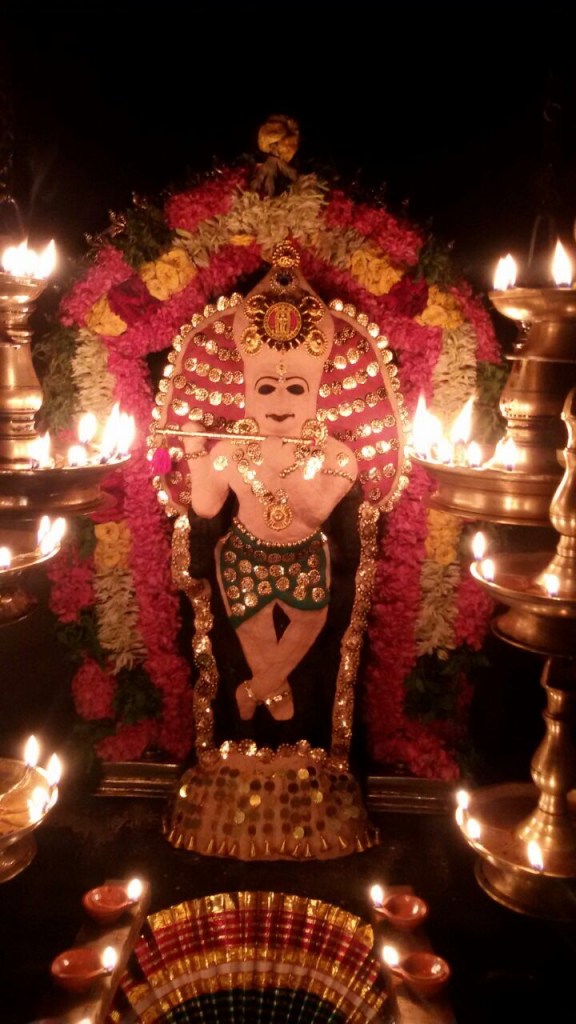
The name Krishna means all attractive. He is also God and possesses the opulence of beauty in full. Physical bodies always have faults not least of which the fact that they will age, get sick and die. Sri Krishna has a body full of eternality (sat), knowledge (cid) and bliss (ananda). He is incomparable.
Oh Vishnu, Oh Lord, who in this world would not be enchanted by your form, which is superior to, what is considered to be the greatest in all the three worlds, more charming than the most charming, more brilliant than the most brilliant even, sweeter than the sweetest even, more beautiful than even the most beautiful and which is the wonder of wonders in this world.
Meaning of the Sanskrit Words
यत्-त्रैलोक्य-महीयसः अपि महितम् = that which is superior to (what is considered to be) the greatest in all the three worlds
मोहनात् सम्मोहनम् – more charming than the most charming
कान्ति-निधानतः अपि कान्तम् = more brilliant than the most brilliant even
माधुर्य-धुर्यात् अपि मधुरम् = sweeter than the sweetest even
सौन्दर्य-उत्तरतः अपि सुन्दरतरम् = more beautiful than even the most beautiful
त्वत्-रूपम् = Thy form,
आश्चर्यतः अपि आश्चर्यम् = (which is) the wonder of wonders
भुवने = in this world
न कस्य कुतुकं पुष्णाति = (is there any one) whose desire/entrancement (to Thee) is not aroused(enhanced/flourished)
Non-duality that is the central core of Advaita philosophy identifies the Supreme Self (that transcends everything) with the innermost Self (that is immanent in every being). If God or the Supreme Reality does not have a separate status other than our Selves, then who is to worship whom? Hence the concept of Bhakti, or Devotion, seems to contradict the Oneness inherent in Advaita. This apparent conflict is easily resolved by Sriman Narayaneeyam. Bhattattiri’s conception of Bhakti emphasizes the nirguNa aspect of the Ultimate in no uncertain terms, even while he expatiates on the worship of the visible form.
That the Ultimate is non-dual there is no question. But to be able to realise it as a fact of experience one has to go through the processes of Bhakti of God with form and content, with name and description, with qualities and adjuncts. Such a God is known by the technical name of saguNa brahman, in contrast to the nirguNa brahman which is the formless and nameless Absolute.
Bhattathri clearly brings out through his spiritual experience that The Absolute Being is not manifest to the senses or the intellect and is difficult to grasp or attain to. But when it is manifest as Guruvayur Krishna it is like the wavy surface of the Ocean of Blissful spirit, definite, clear and easy to grasp. Therefore one resorts to the worship of the Krishna form that is lovable and most captivating by its sweet beauty and other blessed attributes. Slokas in Dasakam 2 depict that beauty. Let us study them.
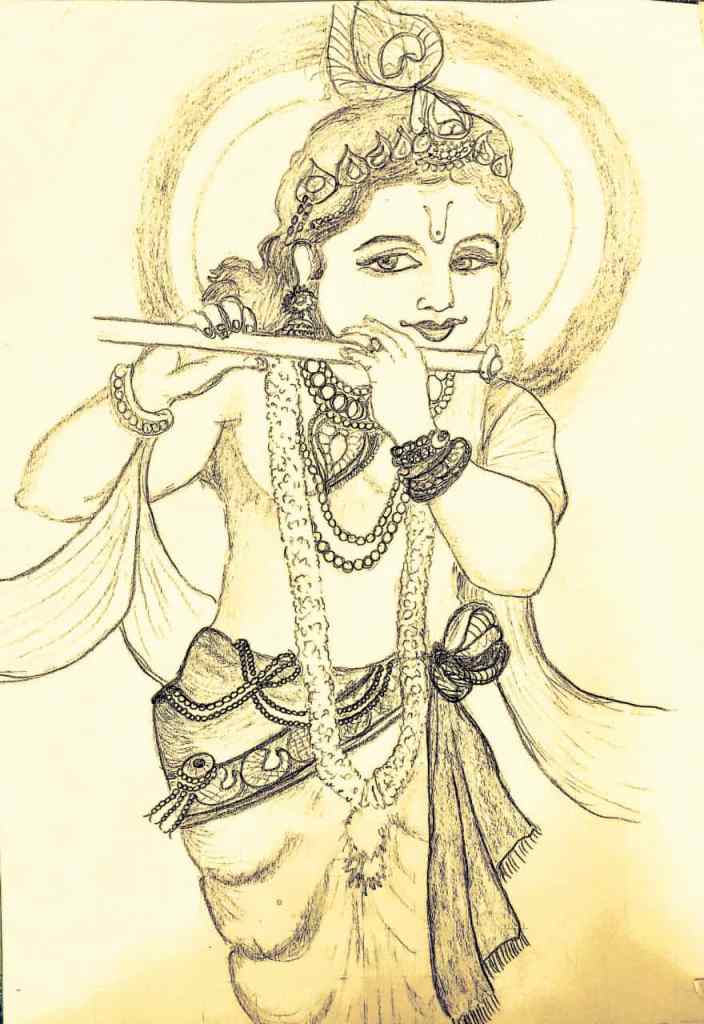
I meditate upon this form of You, adorned with a crown which rivals the sun in its brilliance, whose forehead is made more resplendent by the upright mark (tilak of sandal paste), whose eyes are brimming with mercy, with a shapely nose, with shining cheeks reflecting the brilliance of a pair of fish shaped ear pendants, with the Kaustubh jewel shining on the neck, and bosom resplendent with garlands of flowers (and tulsi) necklaces ( of pearls and gems) and the mark of Srivatsa.
Meaning of the Sanskrit Words
• सूर्य-स्पर्धि-किरीटम्- with a crown which rivals the Sun (in brilliance)
• ऊर्ध्वतिलक-प्रोद्भासि-फालान्तरम् by the upright mark (tilak of sandal paste) whose forehead is made more resplendent,
• कारुण्य-आकुलनेत्रम्- whose eyes are brimming with mercy
• आर्द्र-हसित-उल्लासम् (whose face) is lit up with a benevolent smile புன்முறுவல் பூத்த திருமுகம்
• सुनासापुटम् with a shapely nose
• गण्डोद्यन्-मकर-आभ-कुण्डल-युगम् with cheeks shining due to the brilliance of a pair of fish shaped ear pendants –
• कण्ठोज्ज्वलत्-कौस्तुभम् with the Kaustubh jewel shining on the neck
• त्वत्-रूपम् Thy form
• वनमाल्य-हार-पटल-श्रीवत्सदीप्रम् (and Thy bosom) resplendent with garlands of flowers (and tulsi) necklaces ( of pearls and gems) and the mark of Srivatsa
“My Lord Govinda, because of separation from You, I consider even a moment a great millennium. Tears flow from My eyes like torrents of rain, and I see the entire world as void.”
Sanskrit Verse 8
आश्लिष्यवापादरतांपिनष्टु
मामदर्शनान्मर्महतांकरोतुवा।
यथातथावाविदधातु
लम्पटोमत्प्राणनाथस्तुसएवनापरः॥८॥
Meaning in Tamil
இறுகப்பற்றிடுஉன்பதமலர்பாதம்பணிஏவலன்எனை!
இலையெனில்ஏறிமிதித்திடுஉடலனைத்தையும் ! என்
இதயமதைநொறுக்கிடுஉன்காட்சிதனைமறைத்து !
விரும்பியதைசெய்திடுலீலைபுரிமாயன்அன்றோநீ !
இருப்பினும்உனையன்றிவேறெவருளரோஎன்மனம்தனில் !
Meaning in English
“Let Kṛṣṇa tightly embrace this maidservant who has fallen at His lotus feet, or let Him trample Me or break My heart by never being visible to Me. He is a debauchee, after all, and can do whatever He likes, but still He alone, and no one else, is the worshipable Lord of My heart.”
Video Link
Here is wishing all of you Happy Janmashtami
By the grace of Lord Krishna, blessings of my parents and elders I intend to start understanding Narayaneeyam Dasakam 2 as my next assignment.
“O My Lord, O Kṛṣṇa, son of Mahārāja Nanda, I am Your eternal servant, but because of My own fruitive acts I have fallen into this horrible ocean of nescience. Now please be causelessly merciful to Me. Consider Me a particle of dust at Your lotus feet.”
Sanskrit Verse 6
नयनंगलदश्रुधारया
वदनंगदगदरुद्धयागिरा।
पुलकैर्निचितंवपुःकदा
तवनाम–ग्रहणेभविष्यति॥६॥
Meaning in Tamil
உன்நாமம்துதிக்கையினில்என்பொறியாம்
கண்கள்ஆனந்தநீர்மல்கிதாரையெனவழியவும்
வாய்மிடறுவாக்குதிணறிஇடறுடன்தளரவும்,
உடல் பேரின்பநிலையுடன்மயிர்கூச்செரிந்து
பரவசம்அடைவதும்எப்பொழுதுஎன்பரமனே!
Meaning in English
“My dear Lord, when will My eyes be beautified by filling with tears that constantly glide down as I chant Your holy name? When will My voice falter and all the hairs on My body stand erect in transcendental happiness as I chant Your holy name?”
“One who thinks himself lower than the grass, who is more tolerant than a tree, and who does not expect personal honor but is always prepared to give all respect to others can very easily always chant the holy name of the Lord”.
Sanskrit Verse 4
नधनंनजनंनसुन्दरीं
कवितांवाजगदीशकामये।
ममजन्मनिजन्मनीश्वरे
भवताद्भक्तिरहैतुकीत्वयि॥४॥
Meaning in Tamil
பொருள்வேண்டேன்புகழ்வேண்டேன்
மனைவேண்டேன்கவிவரைகடமைவேண்டேன்
இப்பிறவிஎப்பிறவிதனிலும்உள்நோக்கிலா
பக்திநிறைஉன்னிருபாதசேவைபுரிந்திட
வேண்டுகிறேன்வாசுதேவனேஉலகுய்வோனே
Meaning in English
“O Lord of the universe, I do not desire material wealth, materialistic followers, a beautiful wife or fruitive activities described in flowery language. All I want, life after life, is unmotivated devotional service to You.”



 Prabhu's Ponder