Dakshinamurthy Stothram- Sloka 5 – Part 1 – Introduction

Preamble

In Vedanta one of the word which is used quite often is “saṃsāraḥ”.There is also a wonderful Question and Answer in Sanskrit.

Q: सम्सारे किम् सारं ?

A: सदा अनुचिन्थनेमेव सारं

Q: What is the essence of worldly life ?

A: The very fact that you always keep thinking about it is the essence.

Swami Dayananda Saraswathi used to say in his lectures that the word “samsara” has different connotations. Birth-death is samsara; Sukha dukha is samsara ; Household choir is samsara; Wife is called samasaram in Tamil Nadu; “Becoming” is samsara; Subject-object division is samsara ; Doership enjoyership is samasara; The division of “I” and “not I” is samsara; Atma anatma divide is samsara. All these imply a demarcation line between the two. Where does this line run? Not outside . It runs upto and including where “I” sees to feel “I am”.

Therefore when it comes to identification of the Atma (Self) there are many misconceptions (“adyāsahaḥ”) that people have. Adi Śankarācārya identifies the many misconceptions, when it comes to identification of the Atma (Self). These errors in perception are:

1. error of a non-thinking person; the layman like us making erroneous conclusion. This is understandable and correctable

2. error of the so-called thinker, who makes thoughtful errors and comes to wrong conclusion. This kind of people are difficult to correct.

The wrong conclusions that thinker following different philosophies make are as under:

1. Ātma identified with physical body (deha ātmā vādaḥ): The first category of people, misunderstand or conclude that the body (deham) is Ātma. They do not accept anything surviving after the death of the body. For them death is the total destruction of the individual, they do not believe in a mind which can survive; because for them, mind is nothing but functioning brain and emotions are neurological disturbances etc. Thirumoolar, one of the sixty-three Nayanmars and one of the 18 Siddhars, in his main work the Thirumandhiram cautions against this conlusion and states that one can’t avoid rebirth if one adopts this policy as this will result in “attachment” from which one cannot come out.

மலமென் றுடம்பை மதியாத ஊமர்

தலமென்று வேறு தரித்தமை கண்டீர்

நலமென் றிதனையே நாடி யிருக்கின்

பலமுள்ள காயத்தில் பற்றுமிவ் வண்டத்தே.

“இந்த உடல் மலத்தால் ஆனது!” என்று எண்ணி அதை ஒதுக்கிவிட வேண்டும். அவ்வாறு செய்யாமல் அதையே நல்ல தலம் என்று எண்ணி இன்பத்துடன் உடலைத் தரித்துக் கொண்டால், மேலும் உடலில் விளையும் நன்மைகளையே நாடிக்கொண்டு இருந்தால், அந்தப் பற்றின் காரணமாக மீண்டும் மீண்டும் ஒருவனுக்குப் பிறவிகள் தொடர்ந்து கொண்டே இருக்கும்.

Half a century ago, my father a common man like most of us and was the Head Master of a Government run High School gave me this advice when I entered the “Teens”. He used to say in Tamil “கண்டதே காட்சி, கொண்டதே கோலம் என்று இருக்காதே”. At that time I didn’t understand the real meaning. But being with him and watching his “simple living-noble thinking” lifestyle taught me lessons which were definitely not part of the curriculum in my Masters and MBA courses subsequently. I can now visualise and get as to what was he hinting at.

A Tamil scholar and poet Keeran (புலவர் கீரன்) in a discourse on “Thiruvasagam” brings out two interesting observations and ask us to ponder the these two facts which will reinforce my dad’s statement.

  • Among all the living beings, only humans have the capacity to introspect and look at SELF. மனித இனம் ஒன்றே மன சாட்சியை நோக்க முடியும். விலங்கினங்களால் முடியாது.
  • After death, bodies of animals are more valuable than the human body. இறந்தபின் விலங்கினங்களின் உடலுக்கு மதிப்பு அதிகம்;மனித உடலுக்கு அல்ல;

2. Ātma identified with Prana: Then comes another group of people who say that anatomy is not individual, but the physiology is the individual; physiology, the functions of the body; so, for them, prana is I, the ātmā; I breathe, I am alive, I feel hungry, I feel thirsty: on the strength of these and other notions of the sort, some conclude that Prâna is Ātman. Finding that the dead body which is to all appearance quite of the same nature as the living is yet not self-conscious and does not breathe or perform other functions of a living being, they hold that Ātman must be the Prana, the vital principle, whose presence in the body makes it alive and whose departure reduces it to a corpse.

3. Ātma identified with Sense Organs: The third category of people believe that “indrīẏāṇi” – sense organs are the ātmā; I hear, I see, I smell, I cause motion: from an experience of this sort, some rise higher and look upon the indriyas, the sense-organs, as Ātman. As self-consciousness arises only when the sense-organs are active, Ātman must be identical with the sense-organs. There is no evidence of the existence of Prana distinct from the senses; for no motion is observed during sleep when the senses are quiescent: and breathing, &c., visible during sleep are a mere illusion. As the sense-organs do not perceive objects simultaneously, i.e., as the scope of each sense-organ is restricted to one kind of objects and as there are several sense-organs occupying the body, each of them is an Ātman by itself.

4. Ātman identified with Intellect (buddhim): And then the next one” calāṃ buddhiṃ” – calāṃ buddhiṃ means buddhi means consciousness in this context, vijnānam; they say consciousness is ātmā; but calāṃ buddhiṃ, that consciousness is subject to fluctuations; fluctuating, fleeting, flow of consciousness like the water fall, you see the water, but the second-second, the next second, the water fall you see, is not the same waterfall, it has been replaced by another and another. So, you have a seeming continuous water fall, but there is no continuous water fall and continuous existence is only a changing entity. Similarly, that flowing consciousness is the ātmā, is the philosophy of ẏogācāra Buddhist; On the strength of the notion “I understand,” others regard Buddhi (Intellect) as the Ātman.

5. Ātma identified with Emptiness (śūnyam): Another sect argues that if consciousness is subject to arrival and departure: between the two consciousnesses, what should be there? There should be emptiness alone and therefore śūnyam, blankness, emptiness is the ultimate truth in which emptiness the consciousness comes and goes. Because arriving and departing consciousness cannot be permanent; What is the only permanent thing; vacuum; shoonyam; they are called śūnya vāda buddhisam; previous one is ẏogācāra; last one is śūnyam

Adi Śankarācārya discounts all the above false identification of the Ātman in this sloka. We will see the Sloka in the next blog in the coming week.
SIKSHASTAKAM – Prayer to Lord Krishna – Verses – 7&8

Sanskrit Verse 7

युगायितं निमेषेण

चक्षुषा प्रावृषायितम्।

शून्यायितं जगत् सर्वं

गोविन्द विरहेण मे ॥७॥

Meaning in Tamil

உனைப் பிரிந்த ஒரு கணமும் யுகமன்றோ கோவிந்தா

விசைப் பொழிவென கண்ணீர் பெருகியதே கண்ணா

உலகம் ஒரு நிலையிலா வெறுமையென தோன்றியதே

Meaning in English

“My Lord Govinda, because of separation from You, I consider even a moment a great millennium. Tears flow from My eyes like torrents of rain, and I see the entire world as void.”

Sanskrit Verse 8

आश्लिष्य वा पादरतां पिनष्टु

मामदर्शनान् मर्महतां करोतु वा।

यथा तथा वा विदधातु

लम्पटो मत्प्राणनाथस् तु एव नापरः ॥८॥

Meaning in Tamil

இறுகப் பற்றிடு உன்பதமலர் பாதம்பணி ஏவலன் எனை!

இலையெனில் ஏறி மிதித்திடு உடலனைத்தையும் ! என்

இதயமதை நொறுக்கிடு உன் காட்சிதனை மறைத்து !

விரும்பியதை செய்திடு லீலைபுரி மாயன் அன்றோ நீ !

இருப்பினும் உனையன்றி வேறெவருளரோ என் மனம்தனில் !

Meaning in English

“Let Kṛṣṇa tightly embrace this maidservant who has fallen at His lotus feet, or let Him trample Me or break My heart by never being visible to Me. He is a debauchee, after all, and can do whatever He likes, but still He alone, and no one else, is the worshipable Lord of My heart.”

Video Link

Here is wishing all of you Happy Janmashtami

By the grace of Lord Krishna, blessings of my parents and elders I intend to start understanding Narayaneeyam Dasakam 2 as my next assignment.

God Bless. வளமுடன் வாழ்க

Dakshinamurthy Sloka 4 – The Light within – அருட் பெரும் ஜோதி

In the last three blogs as introduction to the Sloka, we understood that the core of all of us viz., the inner consciousness known as the ātmā is compared to a maha deepam அருட்பெரும் ஜோதி (the light like Sun). The ātmā is described or revealed by comparing it to a light principle as the nearest example due to its self-luminous and self-evident nature called svayam prakāśatvam.

We also saw through experiments that in every perception, I, the ātmā, is independently self evident; and anātmā the object is dependently evident. The infinite consciousness by itself never illumines anything by itself. It is a upakaranaa or upadhi. It needs a medium to illumine. The medium borrows the light and reflect on the object. The mind borrows light from “me” temporarily and throws it on the object thro the 5 indriyas thro which it escapes.. That is called perception/gnana. The light of consciousness, when reflected at an inner equipment, reaches the object to illumine them. This process of reflecting light on objects and perceiving them through the atma-mind-indriyas combination is called व्रित्त्त पररणाम vritti pariṇāma, and when that takes place alone, the object becomes known. In other words for the knower to know we need cit (light), mind (anthakarana) and organs (indriyas) otherwise the object is masked or unknown (avidya).

With this understanding let us now study the Sloka

Audio Link

https://www.dropbox.com/s/np6at9nb77dj0n8/Sloka%204%20-%20Naanaa%20Chidra%20Ghattoudara.mp3?dl=0

Sanskrit Verse:

नानाच्छिद्रघटोदरस्थितमहादीपप्रभा भास्वरं
ज्ञानं यस्य तु चक्षुरादिकरणद्वारा वहिः स्पन्दते ।
जानामीति तमेव भान्तमनुभात्येतत्समस्तं जगत्
तस्मै श्रीगुरुमूर्तये नम इदं श्रीदक्षिणामूर्तये ॥४॥

Audio Link

https://www.dropbox.com/s/np6at9nb77dj0n8/Sloka%204%20-%20Naanaa%20Chidra%20Ghattoudara.mp3?dl=0

Meaning in Tamil

ஐந்துளைக் குடமுள்ளிட்ட பெருவிளக்கின் ஒளியென

ஐம்பொரிவழி அதிரலையென வெளிப்படும் ஒன்றே,

பரம்பொருளின் பேரொளியால், ‘எனை அறிவேன்’ எனும்

ஆன்மாவின் உள்ளுணர்வில் ஒளிவிடும் இவ்உலகம்! அந்த

ஆதிஅந்தமிலா மோனநிலை பரம்பொருளாம் ஆசான்

தக்ஷிணாமூர்த்தி  பொற்பாதம் பணிந்திடுவோம்

Meaning in English:

All this world shines after Him alone shining in the consciousness “I know”—after Him alone whose consciousness, luminous like the light of a mighty lamp standing in the bosom of a many-holed pot, moves outwards through the sense-organs such as the eye. To Him who is incarnate in the Teacher, to Him in the Effulgent Form Facing the South, to Him (Siva) be this bow!

Understanding the Sloka:

Here Śankarācārya wants to point out that the ātmā, the existence consciousness is ever evident and therefore does not require any special process to know. Knowing the ātmā is not a special event taking place by your special effort. Any other object in the world becomes known at a particular time by your special effort and becomes an event in time.

First Line

नानाच्छिद्रघटोदरस्थितमहादीपप्रभा भास्वरंज्ञानं यस्य तु चक्षुरादिकरणद्वारा वहिः स्पन्दते ।

Naanaac-Chidra-Ghatto[a-U]dara-Sthita-Mahaa-Diipa-Prabhaa Bhaasvaram Jnyaanam Yasya Tu Cakssur-Aadi-Karanna-Dvaaraa Vahih Spandate |


ज्ञानं यस्य jñānam yasya; yasya means ātmānaha; ātmānaha jñānam. So, the light of ātmā, the light of consciousness of ātmā is भास्वरम् bhāsvaram; is brilliant; because it has to create a long beam; so it can see even the farthest star, I am able to see. Therefore, it is bhāsvaram; it is brilliant. Brilliant like what?

नानात्छिर घटोदर त्स्थत महादीप प्रभा, nānācchidra ghaṭodara sthita mahādīpa prabhā; like the prabhā, brilliance, like the brilliance of maha deepam; a very bright lamp, so that consciousness of ātmā is brilliant like the brilliance of a very bright lamp or big lamp; घट उदर त्स्थत gada udara sthitha; which is placed within a pot;

वहिः स्पन्दते Vahih Spandate Emerges out as a pulse/light

Second Line

जानामीति तमेव भान्तमनुभात्येतत्समस्तं जगत्. Jaanaamiti Tam-Eva Bhaantam-Anubhaaty-Etat-Samastam Jagat

Continuing from the understanding of the first line which means that we presuppose the word तत् tat meaning that bright light of consciousness, that emerges out (वहिः स्पन्दते) through the five apertures, I know that viz. जानामीति Jaanaam-Iiti And then what happens, each beam of light falls on an object, one beam of light falling on sābda, another falling on sparsa; another falling on rūpa, and the moment the light falls on them; what happens, they all become known or bright; the non-luminous one becomes luminous; I know means what; that has become knowable or luminous.

When I say I know (जानामि) the object, the process of knowledge is only one; Verb is single; but on the two sides of the verb, there is a subject and there is an object. The subject reveals self-evidence; object is dependently evident; Depending on whom? Me. Therefore every jānāmi reveals one dependently evident object and independently evident subject. Adi Sankara uses the words; जानामि इति jānāmi ithi – इत्ति iti indicates a process of cognition of the object by the subject which by itself is self evident भानम् bhānam. Since the cognised object is proved only through cognition; it is called dependently evident; अनुभानम् anubhānam.

Thus जानामीर्त तमेव भान्तम् jānāmīti tameva bhāntam, in every jānāmi statement, that ātmā alone reveals itself and sarvam tam anubhāti. Not Sarvam, but yetat samastaṃ jagat. Śankarā uses the same word, bhāntam and anubhāti. yetatsamastaṃ jagat, the whole universe.

Last Line of the Sloka

तस्मै श्रीगुरुमूर्तये नम इदं श्रीदक्षिणामूर्तये Tasmai Shrii-Guru-Muurtaye Nama Idam Shrii-Dakssinnaamuurtaye

tasmai – means prabuddha puruṣāya; to that woken-up person, who is a jnāni; who is liberated; who is the knower, the known and the process , to that jnani my namaskaaram. So tasmai prabuddha puruṣāya, jnānine namaha. And who is that jnāni?

Shree gurumurthaye – who alone is a guru, who alone can serve as a guru and who is my guru, gurumoorthaye.

Namaha – my salutations.

Thus we can see again that a complex concept in Philosophy of knower- known, the relationship between “being” and “knowing” and the process of cognition is explained by Adi Sankara in just two lines using a simple experiment using a pot and a lamp.

இதனையே “உயிர் இடைவிடாது சிவனோடு பொருந்தி நின்று நீண்டு செல்லும் மனமும் சத்தம், பரிசம், ரூபம், இரசம், கந்தம் ஆகிய புலன்களின் உண்மையை அறிந்துவிட்டு, சுத்தமாயை அசுத்தமாயைகள் பற்றாவகை எண்ணி, தலைவனாகிய முழுமுதற் பொருளை அடைதல் சித்தாந்த நெறியாகும்” என திருமூலர் திருமந்திரத்தில் உபதேசிக்கிறார்

2373. நித்தம் பரனோடு உயிருற்று நீள்மனம்
சத்தம் முதல்ஐந்தும் தத்துவத் தால்நீங்கிச்
சுத்தம் அசுத்தம் தொடரா வகைநினைந்து
அத்தன் பரன்பால் அடைதல்சித் தாந்தமே.

Dakshinamurthy Stothram – Sloka 4 – Introduction – Part 3 – Throwing some light on “Light”! – Vedantic Concepts

In our attempt to understand the relationship between “being” and “knowing”, after answering a questionnaire, we conducted two experiments last week; in the first we threw light inside a dark room with the help of a mirror and sun and in the second experiment we spread the light from a oil wick lamp through a “holi” pot in a dark room on five selected objects.

Let us now see the Vedantic Concepts behind these experiments.

The concepts behind the first experiment

In the first experiment, the Sun as the powerful light source ( Maha deepam) is comparable to the ātmā. Just as Sun has got its own light, ātmā has got its own “cit”-consciousness; it is self-evident because one does not need either a Sun or a mirror to see oneself. Remember the Part 1 Blog of Questions and Answers (If someone asks you when you are in a dark room “Are you there?” what response do we give? Yes “I am here”). And the mind of every individual is comparable to the mirror. The entire world is comparable to the dark room.

Now the whole world is seen because of two factors. What are the factors? The mirror_like mind and the Sun_like ātmā. This ātmā and Mind together, both of them are together responsible for the experience of the world. One can view this from two perspectives.

1. You can say mirror, backed by the Sun, illumines the dark room. Similarly, we can say the mind experiences everything backed by ātmā. How the mind borrows consciousness from ātmā; just as the mirror borrows brightness from the Sun. Mind borrows brightness and that mind illumines the world. So here the emphasises is on the mind alone. In Vedānta, when the emphasis is given to the mind, that is called प्रमात् (pramaatR) , the consciousness-backed-mind is called, the knower; and mind the knower, expereinces the world backed by ātmā. Here the emphasis is to the mind, because that is the subject.

2. In the second perspective, you do not say the mind illumines the world. ātmā, the consciousness illumines the world; but you have to acknowledge the role of the mirror. Mirror is very important, therefore you use the expression; through the reflecting medium of mind; through the instrumentality of the mind, ātmā alone illumines the world. And when the instrument is removed, what happens? When the mirror is removed, Sun will continue to shine; but it cannot illumine the dark room; the room will again go dark; Similarly, when the mind mirror is there, ātmā illumines the world. When the mind mirror is closed, the world is dark, not because ātmā has turned inert; but the mind-medium is closed. And therefore the world goes dark.

3. When do you close it? The answer is “During sleep”. What happens to ātmā during sleep.? ātmā continues to be self-evident consciousness, the light like the Sun; but the world goes dark because the medium of mind is closed; even during bright daylight, if the mind closes down, it will be dark.

4. Therefore, who is the illuminator of everything? ātmā, the eternal light. And therefore, whenever you are knowing anything, every knowledge indriya jñānam (śabda jñānam, sparśa jñānam, rūpa jñānam); every perception pre-supposes (indirectly reveals) the presence of ātmā; you do not require a separate proof for the existence of ātmā; Every object that we see in the dark room is thanks to the presence of Sun like ātmā. Even when there is no object, you say nothing is known; that nothing is known is known. That nothing is known is known, again because of the presence of consciousness. And therefore, Sankaracharya says; जानाशम jānāmi; jānāmi means, I know; This is called svayam prakāśatvam of ātmā; self-evidence of ātmā;

So in every perception, I, the ātmā, is independently self evident; and anātmā the object is dependently evident; In every perception, I the ātmā, is independently evident like the sun, and the anātmā is dependently evident like the dark room. This is the learning from the first experiment.

The Concepts behind the Second Experiment

Now let us come to second experiment with “holi” pot.

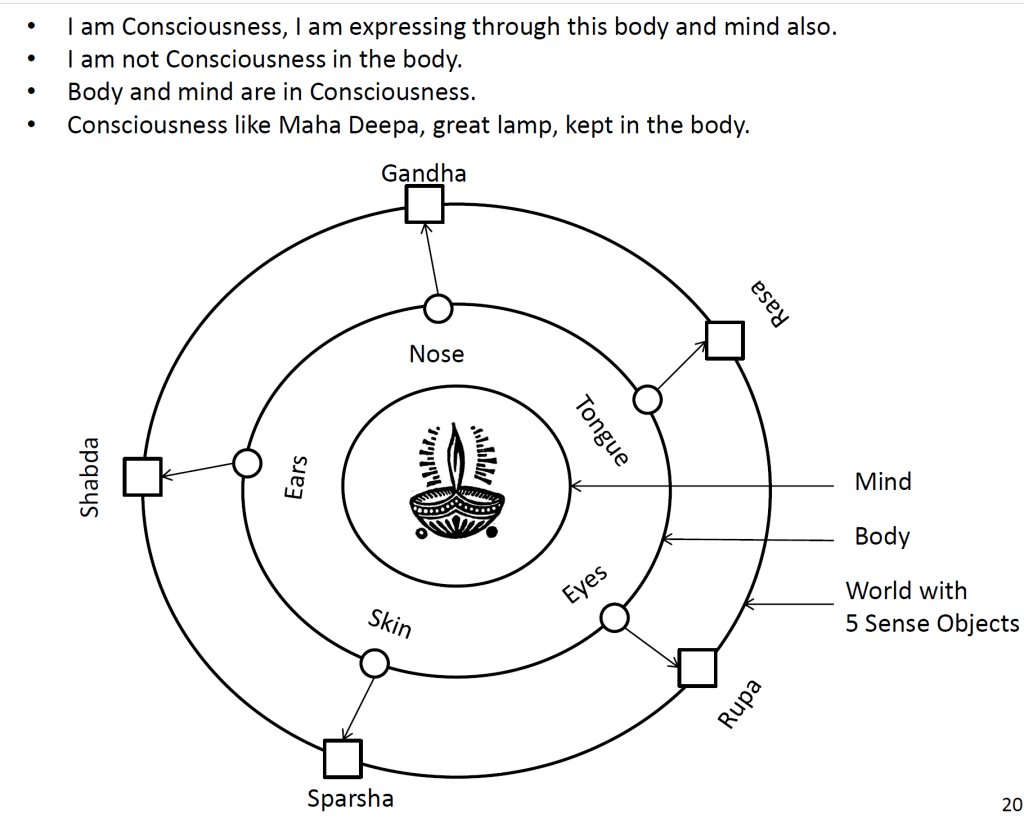
The room where the lamp is burning is the material world, full of ignorance, known as māyā. Pot is the human body. The Atma/Self that exists in the body is the light. The five holes in the pot are five sensory organs. Experience of the sensory organs is the five objects placed on the holes. They are śabda, sparśa, rūpa, rasa, gandha (five tanmātra-s or rudimentary subtle elements). Amala/Gooseberry is the taste (rasa); Veena is the sound (śabda); musk is the smell (gandha); gem by form (rūpa) and touch (sparśa) by the fan. The earthen lamp that holds the oil and wick is the biological system of the human body. Wick is the mind. Oil that makes the wick to burn is the prāṇa. With all these things, perception of the material world is not possible. Without that light, nothing can be perceived. Similarly, without the Self, nothing can be experienced.

We saw in Part 1 of the Introduction, the process of sighting/experiencing an object. We also termed it as व्रित्त्त पररणाम vritti pariṇāma. Vritti or thought-wave is a modification of the mind through a process. Just as waves and bubbles arise from the surface of the ocean, so also these Vrittis arise from the surface of the mind. The function of a Vritti in the mind is to cause removal of the veil of ignorance covering objects by reflecting the light from the ātmā i.e., only lend existence by throwing light. Gnanam is a process of throwing light (That is why in Tamil they call both the light & and the process of throwing light to uncover Gnana as விளக்கு & விளக்குதல்/விளக்க உரை and not allowing it to escape through the indriyas ( the pot with 5 holes and 5 items).

Every wave of thought in the mind (vritti pariṇāma) is illumined by an awareness – the maha deepa. This maha deepa goes out through thro 5 indriyas and get back to the reflecting medium – mind for “I know” (jaanaami ithi) – The learning from the Second Experiment.

Eg of maha deepa – you are able to see a star million miles away. The kind of illumination that you were able to put it on the star. Amount of illumine that you have put – that is maha deepa.

We should understand that the infinite consciousness by itself never illumines because it is illumination itself like the Sun. It is an upakaranaa or upadhi. It needs a medium to illumine. The medium borrows the light and reflect on the object. The mind borrows light from “me” temporarily and throws it on the object thro the 5 indriyas thro which it escapes.. That is called perception/gnana. The light of consciousness, when reflected at an inner equipment, reaches the object to illumine them.

Here is a pictorial summary.

வேதாந்தத்தின் இக்கருத்துக்களை கவனித்தோமானால், அன்பர் திரு. அப்பாதுரை அவர்கள், வளைதளத்தில் பதிவிட்ட நசிகேதன் கதையில் (கடோபனிஷத் தமிழாக்கம்) ஒரு கவிதை (87) ஞாபகத்திற்கு வருகிறது {http://nasivenba.blogspot.com/2012/03/blog-post_23.html}.

கதிருங் கணப்பொறியுங் கங்குல் கலையுங்

கதிர்க்குங் கணங்களுங் கங்குல் – கதிநாடிக்

கட்கிலியைக் கண்பெறுங் காலையிற் காரிரியக்

கிட்டுங் ககனக் கனல்.

திரவனும் மின்னலும் இருளே. நிலவும் ஒளிவீசும் விண்மீன்களும் இருளே. தன்னறிவைத் தேடி, எளிதில் புலப்படாத ஆன்மாவை அகத்தே அறியும் வேளையில் அண்டத்தின் இருளகற்றும் ஒளி பிறக்கும். அங்கே சூரியனும் பிரகாசிப்பதில்லை; சந்திரனும் தாரகைகளும் பிரகாசிப்பதில்லை; மின்னல்களும் ஏன் தீயும் பிரகாசிப்பதில்லை. அவன் பிரகாசிக்கும் பொழுது எல்லாம் பிரகாசிக்கின்றன; அவனுடைய ஒளியால் இவை எல்லாமே பிரகாசிக்கின்றன. வடமொழிப் பாடலில் ‘அவன்’ என்று குறிப்பிடப்படுவது ஆன்மா. சூட்சுமக் குறிப்பு.

Interestingly, in my exchanges on “Existence” in Twitter last week, I was fortunate to receive an excellent quote from Mr. R. Prabhu. This is from one of the verses of a very well known Siddha – Sivavaakiyar சிவவாக்கியர் which reflects the relationship between the “being” and the “knowing”.

இல்லைஇல்லை என்றுநீர் இயம்புகின்ற ஏழைகாள்,

இல்லைஎன்று நின்றதொன்றை இல்லை என்னலாகுமோ

இல்லைஅல்ல ஒன்றுமல்ல இரண்டும்ஒன்றி நின்றதை

எல்லைகண்டு கொண்டபேர் இனிப்பிறப்பது இல்லையே

With this understanding let us now see the Sloka No 4 in the next blog.

SIKSHASTAKAM – Prayer to Lord Krishna – Verses – 5&6

Sanskrit Verse 5

अयि नन्दतनुज किंकरं

पतितं मां विषमे भवाम्बुधौ।

कृपया तव पादपंकज

स्थितधूलिसदृशं विचिन्तय ॥५॥

Meaning in Tamil

நந்த குமரனே! பிறவிப் பெருங்கடல் வீழ்ந்து

நலியும் எளியொன் யான்! பரிவுடனே கருணை

நல்கி அருள் புரிவாய் கண்ணனே ! எனை உன்னிரு

நறுமலர் பாதம்தனில் சேர் புழுதியென ஏற்றிடுவாய் !

Meaning in English

“O My Lord, O Kṛṣṇa, son of Mahārāja Nanda, I am Your eternal servant, but because of My own fruitive acts I have fallen into this horrible ocean of nescience. Now please be causelessly merciful to Me. Consider Me a particle of dust at Your lotus feet.”

Sanskrit Verse 6

नयनं गलदश्रुधारया

वदनं गदगदरुद्धया गिरा।

पुलकैर्निचितं वपुः कदा

तव नामग्रहणे भविष्यति ॥६॥

Meaning in Tamil

உன் நாமம் துதிக்கையினில் என் பொறியாம்

கண்கள் ஆனந்த நீர்மல்கி தாரையென வழியவும்

வாய்மிடறு வாக்கு திணறி இடறுடன் தளரவும்,

உடல் பேரின்ப நிலையுடன் மயிர்கூச்செரிந்து

பரவசம் அடைவதும் எப்பொழுது என் பரமனே!

Meaning in English

“My dear Lord, when will My eyes be beautified by filling with tears that constantly glide down as I chant Your holy name? When will My voice falter and all the hairs on My body stand erect in transcendental happiness as I chant Your holy name?”

Video Link

Dakshinamurthy Stothram – Sloka 4 – Introduction – Part 2 – Throwing some light on “Light”! – The experiments

We are used to a “question paper based exam followed by practicals” – Aren’t we? Exactly; that is what we are going to do now in our study of Dakshinamurthy Stothram, Sloka 4.

In the previous introductory blog, we saw through sets of questions and answers, as to how the Self (ātmā) is comparable to the “maha deepam” the great light source. Let us continue the conceptual exploration through two experiments.

Experiment 1 – Sun, Dark Room & Mirror Experiment:

Place some objects inside a pitch-dark room. On a bright & sunny day, position a mirror outside at an angle; open the window of the dark room and try reflecting the sunlight through the window into the dark room by adjusting the angle of the mirror. What do you observe? You see that the objects which are otherwise invisible are illumined by the patch of sun light entering the dark room via the mirror and the window.

The question is: who or what illumines the dark room? The mirror or the Sun?

Suppose we say mirror, can we try the same experiment during midnight; keep the mirror at the same angle or at any other angle and try to illumine. The mirror is not able to provide light. So, we cannot say mirror is the illuminator.

If we say that the Sun alone illumines the dark room and not the mirror, then, what will happen if we remove the mirror? Again, the room will continue to be dark, because if the mirror is not there, with a roof over the room, the sunlight can not directly penetrate in the room and illumine. Therefore, mere Sun alone cannot illumine like mere mirror cannot illumine. Therefore, a combination of both the Sun and the mirror together illumine the objects of the dark room.

Pictorially the above experiment can be summarised as under

So, what are we trying to get out of this experiment. What is the illation here?

Experiment 2 – The “holi” pot and lamp Experiment

Light and place a bright lamp (wick lamp with burning oil) on the surface of the earth within a room which is densely dark. Place a pot having five holes with its mouth down over the lamp. Outside of that pot place (in front of each of the hole), an amala (நெல்லிக்காய்) fruit, veena, musk, good gem and a fan.

Now the question is about the perception of the collection of separate objects. Is it attributed to any of the following viz. Lamp or Oil or Wick or Pot or the objects themselves? What is the significance of the 5 holes and the five objects ? Why only these objects ?

The lamp is not able to directly illumine the objects, because it is covered by a pot with five holes; Therefore cooperation of pot is required in the sense that we need a pot with holes and not just the pot. In a lighter vein, therefore we require a ‘holi pot’.

The pot with holes alone can’t illumine and we require the lamp. The holes without the lamp within, cannot also illumine the ibject.

Same arguments go for the oil, the wick and the objects. None of them are self-illumine too and only those objects which fall within the range of the beam of light that comes out of the holes are perceived.

So, what are we trying to get out of this experiment. What is the illation here?

Well, “Practicals” are over. What did we learn?

Let us get into the details in the blog next week.

To be continued……

SIKSHASTAKAM – Prayer to Lord Krishna – Verses – 3&4

Sanskrit Verse 3

तृणादपि सुनीचेन

तरोरपि सहिष्णुना।

अमानिना मानदेन

कीर्तनीयः सदा हरिः ॥३॥

Meaning in Tamil

நாணலினும் குறு அகந்தை கொண்டு

நெடிது வளர் மரமொப்ப பொருமையுடன்

செருக்கு ஏதம் சிந்தனையில் இல்லாமல்

நலிந்தோர்க்கும் நன்மதி தரும் நல்லோர்

எளிவுடனே பண்ணிசைப்பார் உன் நாமம்

Meaning in English

“One who thinks himself lower than the grass, who is more tolerant than a tree, and who does not expect personal honor but is always prepared to give all respect to others can very easily always chant the holy name of the Lord”.

Sanskrit Verse 4

धनं जनं सुन्दरीं

कवितां वा जगदीश कामये।

मम जन्मनि जन्मनीश्वरे

भवताद् भक्तिरहैतुकी त्वयि॥४॥

Meaning in Tamil

பொருள் வேண்டேன் புகழ் வேண்டேன்

மனை வேண்டேன் கவிவரை கடமை வேண்டேன்

இப்பிறவி எப்பிறவிதனிலும் உள்நோக்கிலா

பக்திநிறை உன்னிரு பாத சேவை புரிந்திட

வேண்டுகிறேன் வாசுதேவனே உலகுய்வோனே

Meaning in English

“O Lord of the universe, I do not desire material wealth, materialistic followers, a beautiful wife or fruitive activities described in flowery language. All I want, life after life, is unmotivated devotional service to You.”

Video Link