5.1: Neither am I bound by Death and its Fear, nor by the rules of Caste and its Distinctions,
5.2: Neither do I have Father and Mother, nor do I have Birth,
5.3: Neither do I have Relations nor Friends, neither Spiritual Teacher nor Disciple,
5.4: I am the Ever Pure Blissful Consciousness; I am Shiva, I am Shiva,
The Ever Pure Blissful Consciousness.
5. I have no apprehension of death; neither do I have any distinction of caste (or creed); I have neither father, nor mother, nor (even) birth; neither friend nor kith and kin; neither teacher (guru) nor disciple; I am of the nature of Pure Consciousness-Bliss-Absolute, I am Shiva, I am (verily) Shiva.
In my “blogging journey” so far, the focus is on Spirituality and Travel. In this journey there is one vital companion of mine, about whom I did not write anything and I just took “him/her” for granted. I always assumed that this companion can’t be separated from me and will always be with me in my soul satisfying pursuit as an integral part of myself. But having gone through the spiritual hymns that defined “I” in my previous blogs, it is quite natural for me to detach this integral companion and look at him/her a bit closely.
The result of this detached look is this Category of my blog. CARNATIC MUSINGS.
In this Category the soul of several compositions in Sanskrit will be looked at and the meaning they provide will be absorbed and presented in Tamil. The Tamil meaning provided is by no means in a musically tunable form. It is just an expression of my limited vocabulary in Tamil. To begin with, the blogs will cover a song each from the Trinity of Carnatic Music. Subsequently, Readers/Viewers requests will be given priority. May I request your indulgence? You can send your request through mail or comment. The request should be about Carnatic Music Compositions.
Once again a word of CAUTION: “I” am not a specialist in Music; neither do “I” know to sing nor “I” know the “Sastra” of any music leave alone Carnatic Music. The only connection that “I” have is that undefinable relationship that a Cobra has when the Snake Charmer plays his tune in front of it with his “Magudi/Pungi” (Wind Instrument).
Note: For those who are brand new to Carnatic Music, I would recommend adequate “googling” like me. The blogs here will not able to be of any assistance. My apologies.
I intend to begin the blogs in this category from June onwards.
भोज्यं (Bhojyam): Object to be Enjoyed or Experienced
भोक्ता (Bhoktaa): Enjoyer or Experiencer
चिदानन्दरूपः (Cid-Aananda-Ruupah): Nature of Blissful Consciousness
चित् (Cit) = Consciousness
आनन्द (Aananda) = Bliss
रूप (Ruupa) = Nature
शिवोऽहम् (Shiva-Aham): I am Shiva, the Blissful Consciousness
शिव (Shiva) = signifying Consciouness
अहम् (Aham) = I
Meaning of the Verse
4.1: Neither am I bound by Merits nor Sins, neither by Worldly Joys nor by Sorrows,
4.2: Neither am I bound by Sacred Hymns nor by Sacred Places, neither by Sacred Scriptures nor by Sacrifies,
4.3: I am Neither Enjoyment (Experience), nor an object to be Enjoyed (Experienced), nor the Enjoyer (Experiencer),
4.4: I am the Ever Pure Blissful Consciousness; I am Shiva, I am Shiva, The Ever Pure Blissful Consciousness.
4. Neither virtue (punyam) nor sin (papam) nor happiness nor sorrow; nor a holy chant nor a holy place of pilgrimage nor Veda nor sacrifice; I am neither enjoyment, nor enjoyable object, nor the enjoyer; I am of the nature of Pure Consciousness-Bliss Absolute, I am Shiva, I am (verily) Shiva.
मात्सर्यभावः (Maatsarya-Bhaava): Feeling of Jealousy
मात्सर्य (Maatsarya) = Jealousy
भाव (Bhaava) = Feeling
धर्मो (Dharmo): Righteousness
धर्म (Dharma) = Righteousness
चार्थो (Ca-Artha): And Wealth
च (Ca) = And
अर्थ (Artha) = Wealth
कामो (Kaamo): Desire
काम (Kaama) = Desire
मोक्षः (Mokssah): Liberation
चिदानन्दरूपः (Cid-Aananda-Ruupah): Nature of Blissful Consciousness
चित् (Cit) = Consciousness
आनन्द (Aananda) = Bliss
रूप (Ruupa) = Nature
शिवोऽहम् (Shiva-Aham): I am Shiva, the Blissful Consciousness
शिव (Shiva) = signifying Consciouness
अहम् (Aham) = I
Meaning of the Verse
3.1: Neither do I have Hatred, nor Attachment, Neither Greed nor Infatuation,
3.2: Neither do I have Pride, nor Feelings of Envy and Jealousy,
3.3 I am Not within the bounds of Dharma (Righteousness), Artha (Wealth), Kama (Desire) and Moksha (Liberation) (the four Purusarthas of life),
3.4: I am the Ever Pure Blissful Consciousness; I am Shiva, I am Shiva, The Ever Pure Blissful Consciousness.
3. I have neither aversion nor attachment, neither greed nor delusion; I have neither arrogance nor jealousy; I have no duty (to perform) nor any wealth (to acquire); neither desire nor liberation; I am of the nature of Pure Consciousness-Bliss Absolute, I am Shiva, I am (verily) Shiva
Notes: Greed, delusion, pride and jealousy together with lust and anger constitute shad ripu (also called ari shad varga), the six-fold internal enemies of a human being. Dharma (righteousness), artha (wealth), kama (desire), and moksha (liberation) are together known as purusharthas, the four objectives of a human being.
सप्तधातुः (Sapta-Dhaatuh): The Seven Ingredients [of the body]
सप्त (Sapta) = Seven
धातु (Dhaatu) = Ingredient
पञ्चकोशः (Pan.ca-Koshah): The Five Sheaths [of the gross and subtle body]
पञ्च (Pan.ca) = Five
कोश (Kosha) = Sheath
वाक्पाणिपादं (Vaak-Paanni-Paadam): Speech, Hand and Foot
वाच् (Vaac) = Speech
पाणि (Paanni) = Hand
पाद (Paada) = Foot
चोपस्थपायु (Copastha-Paayu): The organ of Excretion
चुप् (Cup) = Move
पायु (Paayu) = Organ of Excretion, Anus
चिदानन्दरूपः (Cid-Aananda-Ruupah): Nature of Blissful Consciousness
चित् (Cit) = Consciousness
आनन्द (Aananda) = Bliss
रूप (Ruupa) = Nature
शिवोऽहम् (Shiva-Aham): I am Shiva, the Blissful Consciousness
शिव (Shiva) = signifying Consciouness
अहम् (Aham) = I
Meaning of the Verse
2.1: Neither am I the Vital Breath, nor the Five Vital Airs,
2.2: Neither am I the Seven Ingredients (of the Body), nor the Five Sheaths (of the Body),
2.3: Neither am I the organ of Speech, nor the organs for Holding ( Hand ), Movement ( Feet ) or Excretion,
2.4: I am the Ever Pure Blissful Consciousness; I am Shiva, I am Shiva, The Ever Pure Blissful Consciousness.
2. I am not indicated by prana, nor the five-fold vital airs nor the seven elements (sapta dhatuh) of the body, nor the five sheaths; nor the organs of speech, nor hand, nor leg; and not generative or excretory organs, I am of the nature of Pure Consciousness-Bliss-Absolute, I am Shiva, I am (verily) Shiva.
Notes: Five vital airs are : Prana (controls respiratory system), Apana (controls excretory system), Vyana (controls circulatory system); Samana (controls digestive system), and Udana (controls ejection of the prana from the physical body). Seven basic elements (sapta dhatuh) consist of: skin, flesh, fat, bone, blood, bone marrow, and semen. Five sheaths (pancha kosha) are believed to veil our understanding of the atman include, in order from gross (outer most) to the subtle (inner most): annamaya kosha (food sheath); pranamaya kosha (vital air sheath);manomaya kosha (mind sheath); vijnanamaya kosha (intellectual sheath); and anandamaya kosha (bliss sheath).
मनोबुद्ध्यहङ्कार (Mano-Buddhi-Ahangkaara): Mind, Intelligence or Ego
मन (Mana) = Mind மனம்
बुद्धि (Buddhi) = Intelligence அறிவு
अहंकार (Ahamkaara) = Ego அகந்தை
चित्तानि (Cittaani): memory/intent/The Mind stuff
चित्त (Citta) = memory/intent/Mind stuff
नाहं (Naaham): Not I
न (Na) = Not
अहम् (Aham) = I
न (Na): Not
च (Ca): Also
श्रोत्रजिह्वे (Shrotra-Jihve): Organ of Hearing [Ears] or the Organ of Taste [Tongue]
श्रोत्र (Shrotra) = The organ of Hearing செவி
जिह्व (Jihva) = The Tongue, the organ of Taste நா
घ्राणनेत्रे (Ghraanna-Netre): Organ of Smelling [Nose] or the Organ of Seeing [Eyes]
घ्राण (Ghraanna) = The Nose, the organ of Smelling
नेत्र (Netra) = Eyes, the organ of Seeing
व्योम (Vyoma): Sky
भूमिर्न (Bhuumih-Na): Not the Earth
भूमि (Bhuumi) = Earth
न (Na) = Not
तेजो (Tejo): Energy signifying Fire
तेजस् (Tejas) = Energy signifying Fire
वायुः (Vaayuh): Air
चिदानन्दरूपः (Cid-Aananda-Ruupah): Nature of Blissful Consciousness
चित् (Cit) = Consciousness
आनन्द (Aananda) = Bliss
रूप (Ruupa) = Nature
शिवोऽहम् (Shiva-Aham): I am Shiva, the Blissful Consciousness
शिव (Shiva) = signifying Consciouness
अहम् (Aham) = I
Meaning of the Verse
1.1: Neither am I the Mind, nor the Intelligence or Ego,
1.2: Neither am I the organs of Hearing (Ears), nor that of Tasting (Tongue), Smelling (Nose) or Seeing (Eyes),
1.3: Neither am I the Sky, nor the Earth, Neither the Fire nor the Air,
1.4: I am the Ever Pure Blissful Consciousness; I am Shiva, I am Shiva, The Ever Pure Blissful Consciousness.
Notes: Mind (manah), intellect (buddhih), ego (ahamkara), and memory (chittani) together are referred to by the technical term antah karana or internal instrument. Ear, tongue, nose, eyes, and skin together are the five jnana indriyas. Space, earth, fire, air, and water are the five elements (pancha bhutas).
Before we start exploring Nirvana Shatakam and look at the answers to the vital question of “ Who am I?”, it is essential for us to understand what am I made of, what do I do and what is beyond me. To my limited knowledge, there cannot be a more deeper analysis to these questions than by the Saints & Philosophers of Hindu Religion. One needs a lifetime to understand the material available in the religion. I will definitely restate again and again that I am a novice in this field of philosophy (“Vedanta”) and can only skim at the surface without any deep understanding. Yet from this ocean of information and knowledge I will venture out and reproduce one approach advocated by the legendary Swami Chinmayananda (http://www.chinmayamission.com) which helps me in the process of understanding myself.
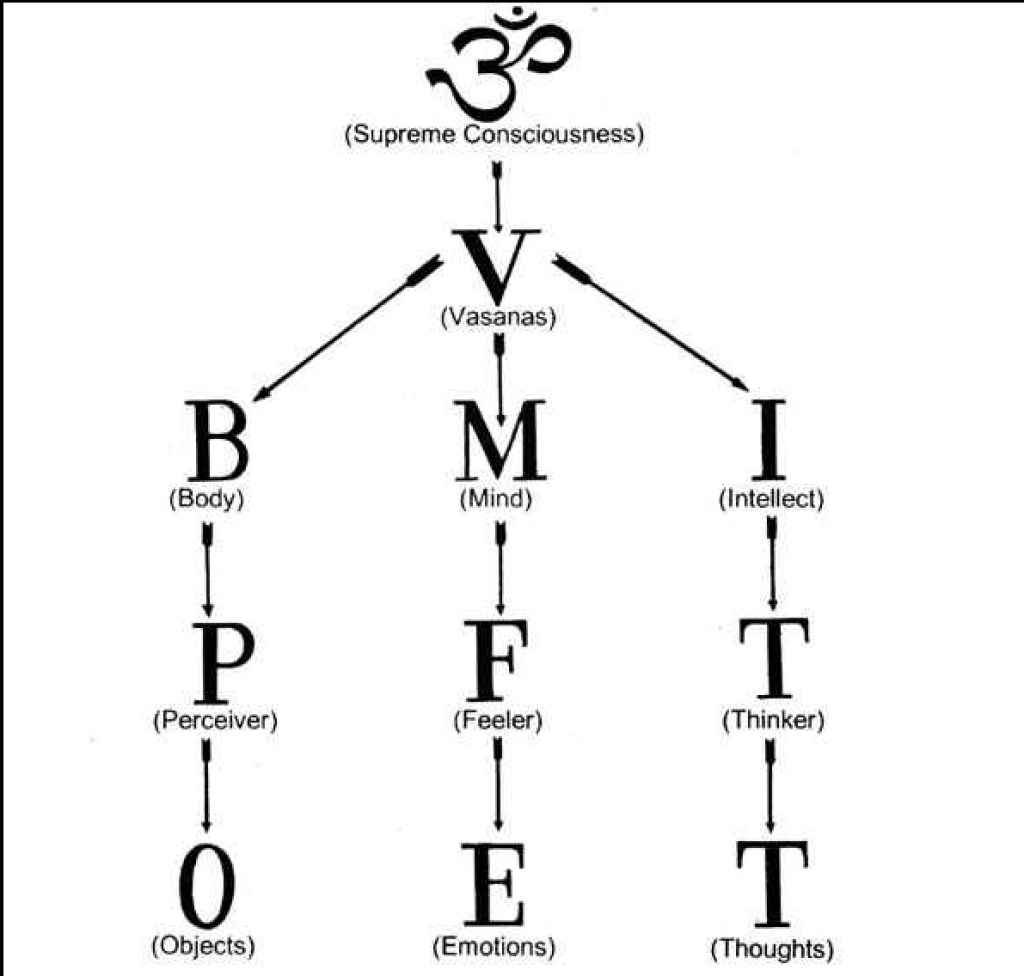
BMI Chart
Interpretation of Symbols :
The Symbol of Truth
Om
viewed through the veil of
Vasanas
Expresses through the instruments of:
the Body (B), Mind (M), Intellect (I)
As the individual entity or ego:
the Perceiver (P), Feeler (F), Thinker (T)
In the world of:
Objects (O), Emotions (E), and Thoughts (T).
I – The person
Here is how the Swamiji helps us in Understanding Ourselves (Our Personality). When we say “experience” we are looking at three fundamental factors:
1. the experiencer (the subject)
2. the object of experience (the object)
3. the relationship between the two, the experiencing (the act)
The Individual as an experiencer (PFT) is the subject who gains experiences of the world (OET) through the instruments of experiencing (BMI). Through the body, the person experiences the world of objects; through the mind, one experiences the world of emotions, and through the intellect, the world of ideas.
When the subject identifies with the intellect, he becomes the thinker, experiencing the world of thoughts and ideas; when identified with the mind he becomes the feeler, experiencing the world of emotions and feelings; and when identified with the body, he becomes the perceiver, experiencing the world of objects.
Therefore each individual acts out the various roles of a perceiver, feeler, and thinker as he seeks his happiness in the world of objects, emotions, and thoughts.
In every experience in life, man contacts the world through the media of four constituent entities in him. They are his body, mind, intellect, and the Consciousness, symbolized by the symbol Om, which is the Life Principle in him.
Now let us have an idea of what these elements are as explained by the Swamiji.
Body, Mind, Intellect:
“ The physical body (பிண்டம்) is solid matter, the densest aspect of the human personality. It contains five organs of perception (ஞானேந்திரியம்) and the five organs of action (கர்மேந்திரியம்). The size and shape of the body differ from individual to individual, but the essential ingredients and the functions of the organs are common to all.
The variable factor in man is the mind and intellect equipment. The mind is the seat of impulses and feelings, and it is common to all living creatures. Animals also possess a mind. It all boils down to how one applies the mind.
Human being alone has the capacity to discriminate and analyze his/her feelings as and when they arise. He/She alone can allow his/her actions to be guided and directed by his/her power of discrimination instead of being driven and carried away by momentary impulses and feelings. This faculty of discrimination, this power of judgment, this capacity to discern what is to be done and what is to be avoided, is the function of the intellect.
Vasanas:
The quality and textures of the mind and intellect equipment differ from one individual to another, depending upon one’s inherent and innate tendencies or inclinations, which are called vasanas.
Vasanas create desires in the intellect; desires produce thoughts in the mind, and thoughts manifest in the form of actions at the level of the physical body. Desires, thoughts and actions are, therefore, only manifestation of vasanas in the respective individual. Each one of us thus becomes a helpless statement of our past though this impulse of vasanas.
(Note: How did we get these Vasanas in oneself? This is a separate subject by itself. For this particular blog I would just compare Vasanas to the Residual Magnetism in a material.)
Om, the Symbol of Truth:
In the ultimate analysis, the whole aim of living for a human being is to condition the body, mind and intellect to ensure that the vasanas are transcended in order for us to regain our true nature. At this individual level, when the vasanas are completely transcended, the Self manifests of its own accord. Only then does man know his true birthright. At the Individual level, this Self is called an Atman and at the level of the cosmic totality, this Divine Self called Om, the Life Principle, is called the Brahman.
The Ground Reality:
Due to our vasanas and the consequent desires, agitations, and actions, we are ignorant of this Divine Self. Therefore, we identify with our body, mind, and intellect and their limitations. An individual is the Self as though contaminated by this ignorance. The only method for regaining one’s true nature is to vigilantly and ceaselessly divert one’s mind and intellect away from preoccupation with objects, emotions, and thoughts and direct it to an awareness of the divine Self”. (Material Courtesy – Chinmaya Mission).
How do I proceed?
This is the essence of Spirituality. The paths that we take to get rid of this ignorance are the path of knowledge (Gnana) , the path of devotion (Bhakthi) and the path of action (Karma). These three paths are not independent and are seamlessly integrated. At this point I will quote the blog I wrote on May 17, 2019, about Knowledge and Devotion as part of my attempt to write in Tamil, Adi Sankara’s Sivananda Lahari. In that blog I quoted the eminent Indian Scholar C. Rajagopalachari. He brings out the integration of the three yogas beautifully by saying “ When intelligence matures and lodges securely in the mind, it becomes wisdom. When wisdom is integrated with life and issues out in action, it becomes bhakti. Knowledge, when it becomes fully mature, is bhakti. If it does not get transformed into bhakti, such knowledge is useless tinsel. To believe that gnyaana and bhakti, knowledge and devotion, are different from each other, is ignorance”.
Nearly a year later I am fortunate to attempt to write in Tamil, the philosophical treatise in Vedhanta by Adi Sankara called Nirvana Shatakam. Understanding the simple concepts outlined by the Swamiji will help us unravel the truths brought out by Adi Sankara
Remember the two vital questions which I missed while I was “role playing” during the Corana Virus! Who am “I”? What do I mean when I use the word “Happy”?
There are numerous ways by which one can explain “happiness” – the state of being happy. I was looking for an apt definition for happiness. Pop! Came the answer from Twitter. Here is the link
Left me speechless. There are many messages that we’ve all received on whatsapp/social media that try to give us courage during the lockdown. This delivers the same message that the Ishavasya Upanishad gave us centuries ago: our happiness depends entirely on our attitude… pic.twitter.com/8UkpJ7StHQ
Here is my interpretation. Modern psychology brings out the science behind “happiness”. As an “experiencer”, I look at “being happy” in a different perspective. When I am in deep sleep without any application whatsoever of my mind and sense organs, I am in a state unaffected by anything – “It is a Bliss” – indicating how happy I am when I am sleeping without any miseries. That is what I mean by the word “happy”. That kind of happiness is what I want in every second of my life. Am I the only one desiring like that? The lady there in Anand Mahindra’s tweet brings out exactly what is happiness. It depends on oneself (attitude of myself decides what is happiness). So who is myself or who am I?
This question however is a complex one. The self inquiry in the question has one challenge. Am I splitting myself as inner and outer Self? Dr S Radhakrishnan, a great philosopher and the former President of India, says “To divide human being into outer desire and inner quality is to violate the integrity of human life. The two orders of Reality – the transcendental the empirical are closely related”. If I agree with this argument, then, who am I ?
I don’t have an answer ready made. The real answer cannot be provided either by a theory or by dialectic. These alone, as in themselves and without reference to personal experience cannot carry conviction. But I am still in the process of experiencing the answer (otherwise called as my life) and won’t be able to answer till my experiences (life) end.
Luckily, the experiences elucidated by legendary philosophers and thinkers are available for me. Their teachings are presented either as metaphysics or ethics. In the traditional Hindu system this is called “Brahmavidya” and “Yogashastra”. The universally acclaimed classic Indian treatise “Bhagwad Gita” is a combination of both – the science of Reality and the art of Union with Reality.
In India, there are two outstanding treatises, considered equivalent to The Divine Response available for the vital question “Who am I?”. The answer to my question was provided as early as in 8th Century by Adi Shankaracharya. He brought out the “Brahmavidya” to the question “Who am I?” through a hymn in Sanskrit comprising six verses – “Atma Shatakam or Nirvana Shatakam”. The word shatakam means six and the word nirvana means freedom or liberation. It is thus a hymn of six verses on liberation, each of which is like a jewel in the garland of Vedanta. It is also called as atma shatakam or six verses on the nature of the Self. The first three lines in each of the first five verses negate all that is not “I”(Atman), while the last line in each verse strongly affirms what “I”(Atman) is.
In the year 1902, in a town called Thiruvannamalai, Tamil Nadu, Bhagwan Shri Ramana Maharishi provided answers to one Sri M. Sivaprakasam Pillai, a graduate in Philosophy, who was at the time employed in the Revenue Department of the South Arcot Collectorate. This was published in 1923. The teachings of Bhagwan Shri Ramana Maharishi is published by SriRamanasramam in Thiruvannamalai as “Who am I”.
My next series of blogs will focus on Adi Shankaracharya’s Nirvana Shatakam/Atma Shatakam.
Tam-Eka-Dantam-Eva Tam Vicintayaami Santatam ||5||
Meaning of the Sanskrit Words
नितान्तकान्तदन्तकान्तिमन्तकान्तकात्मजं (Nitaanta-Kaanta-Danta-Kaantim-Antaka-Antaka-Aatmajam): Who is Very Dear to Devotees as Beautiful Ekadanta and Who is the Son of One Who Restrained Yama
नितान्त (Nitaanta) = Extraordinary, Excessive, Considerable, Very Much
कान्त (Kaanta) = Desired, Loved, Dear
दन्त (Danta) = signifying Ekadanta [another name of Sri Ganesha]
कान्ति (Kaanti) = Loveliness, Beauty, Splendour
अन्तक (Antaka) = Yama
अन्तक (Antaka) = Putting an End, Causing Death
आत्मज (Aatmaja) = Born from, a Son, self-originated
अचिन्त्यरूपमन्तहीनमन्तरायकृन्तनम् (Acintya-Ruupam-Antahiinam-Antaraaya-Krntanam): Whose Form is Inconceivable and without any Limit and which Cuts through the Obstacles [of Devotees]
अचिन्त्य (Acintya) = Inconceivable, Surpassing thought
रूप (Ruupa) = Form, Appearance
अन्त (Anta) = End, Limit, Boundary
हीन (Hiina) = Left, Abandoned, Bereft or Deprived of, Low, Vile
अन्तराय (Antaraaya) = Intervention, Obstacle
कृन्तन (Krntana) = Cutting of, Dividing
हृदन्तरे (Hrd-Antare): Within the Cave of the Heart
हृद् (Hrd) = Heart
अन्तर (Antara) = Interior of anything
निरन्तरं (Nirantaram): Having no Interval, Uninterrupted, Perpetual, Continually
वसन्तमेव (Vasantam-Eva): Abides in this manner
वस (Vasa) = Dwelling, Residence
एव (Eva) = Exactly so, in this Manner, Indeed, Truly
योगिनां (Yoginaam): Yogis
योगिन् (Yogin) = Yogi, Ascetic, contemplative Saint
तमेकदन्तमेव (Tam-Eka-Dantam-Eva): [I Reflect upon] Him, the Ekadanta
तम् (Tam) = His
एक (Eka) = One
दन्त (Danta) = an Elephant’s Tusk, Ivory
एव (Eva) = Exactly so, in this Manner, Indeed, Truly
विचिन्तयामि (Vicintayaami): I Reflect upon
विचिन्त् (Vicint) = to Think of, Reflect upon, to Perceive, Discern, Observe
सन्ततम् (Santatam): Stretch or Extended along, Woven together, Continuous, Uninterrupted
Meaning of the Verse
5.1: (Salutations to Sri Vinayaka) Whose Beautiful Form of Ekadanta is very much Dear to His Devotees, and Who is the Son of the One (referring to Lord Shiva) Who Put an End to (i.e. restrained) Antaka (i.e. Yama).
5.2: Whose essential Form is Inconceivable and without any Limit, and which Cuts through the Obstacles of His Devotees,
5.3: Who Continually Abides in the Cave of the Heart of the Yogis.
5.4: I Continually Reflect upon Him, the Ekadanta (another name of Sri Vinayaka).
धनंजयादिभूषणम् (Dhananjaya-Aadi-Bhuussannam): Who Himself is Adorned with Poers like that of Fire etc
धनंजय (Dhanamjaya) = Fire
आदि (Aadi) = Beginning with, Etc, and so on, and Others
भूषण (Bhuussanna) = Adorned, Decorated
कपोलदानवारणं (Kapola-Daana-Vaarannam): From Whose Cheeks flow down the Juice of Grace
कपोल (Kapola) = Cheek
दान (Daana) = act of Giving, Gift, Donation, Rut-Fluid
वारुणी (Vaarunnii) = any Spirituous Liquor, of a River
भजे (Bhaje):
भज् (Bhaj) = To Revere, Adore
पुराणवारणम् (Puraanna-Vaarannam): Juice of Praise form the Puranic Scriptures
पुराण (Puraanna) = Ancient, Old, the Puranic Scriptures
वारुणी (Vaarunnii) = any Spirituous Liquor, of a River
Meaning of the Verse
4.1: (Salutations to Sri Vinayaka) Who Wipes out the Sufferings of the Destitutes who take His Refuge; Who is the Receptacle of the Words of Praises of the Ancients,
4.2: Who is the Former Son (the latter being Kartikeya) of the Enemy of Tripurasuras (i.e. Lord Shiva), and Who Chews down the Pride and Arrogance of the Enemies of the Devas,
4.3: Who wields Terrible Power to Destroy the delusion of the Five Elements constituting the World (from the mind of His Devotees); Who Himself is Adorned with the Powers (behind the Five Elements) like Fire etc,
4.4: From Whose Cheeks flow down the Juice of Grace; Salutations to Him Whose Praise similarly flows down like Juice from the Puranas.



 Prabhu's Ponder