Narayaneeyam – Dasakam 1 – Verse 6

Sanskrit Verse

तत्ते प्रत्यग्रधाराधरललितकलायावलीकेलिकारं
लावण्यस्यैकसारं सुकृतिजनदृशां पूर्णपुण्यावतारम्।
लक्ष्मीनिश्शङ्कलीलानिलयनममृतस्यन्दसन्दोहमन्त:
सिञ्चत् सञ्चिन्तकानां वपुरनुकलये मारुतागारनाथ ॥६॥

Audio Link

https://www.dropbox.com/s/h27ueo0086egh4b/Sloka%206.mp3?dl=0

Meaning in Tamil

Meaning in English

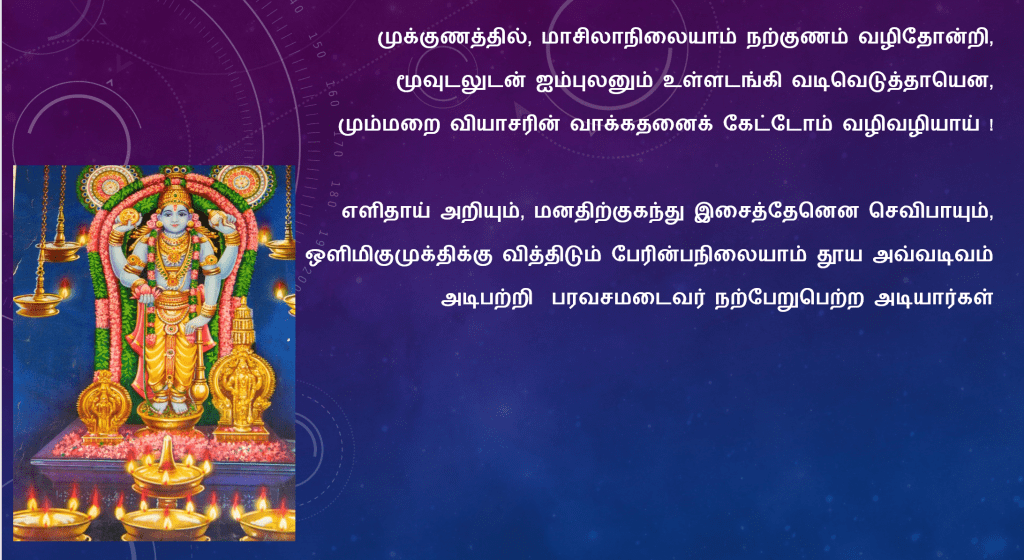
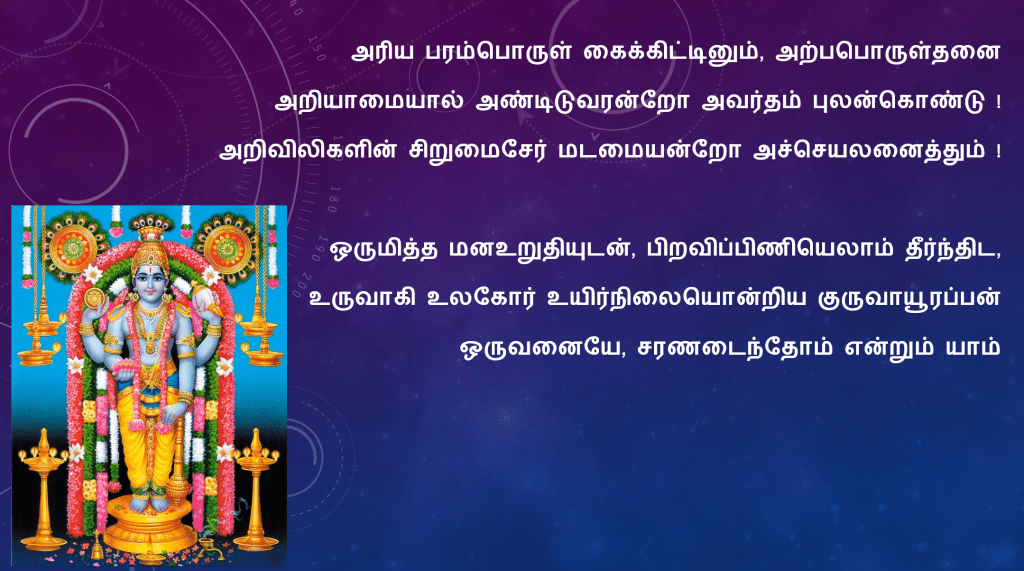
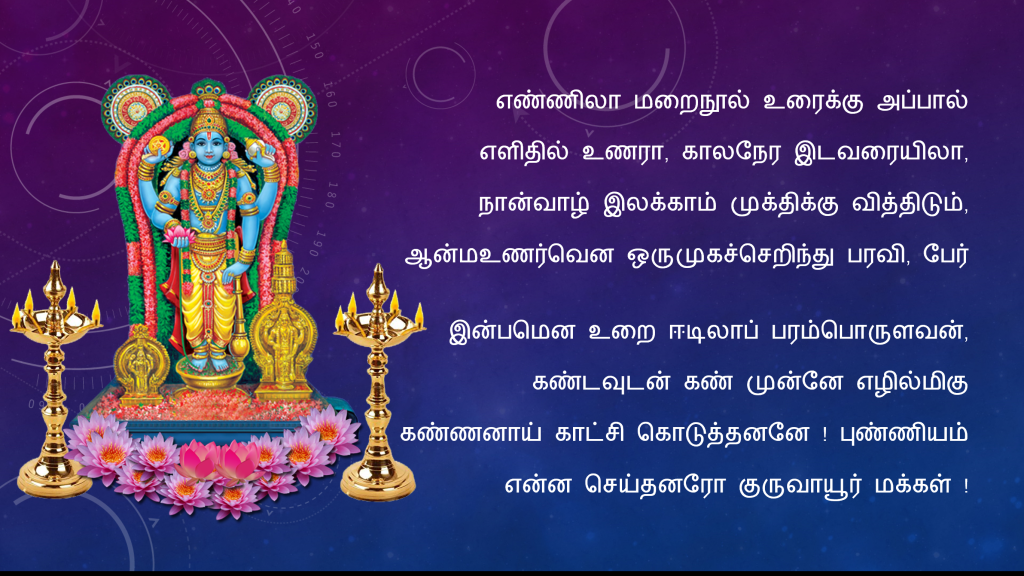
Your form is like the beauty of the fresh rain bearing clouds, and of a beautiful bunch of blue lotuses. Your form is an embodiment of beauty, in the eyes of the people who have done meritorious deeds, and is a complete incarnation of all their good deeds. You are the abode where Goddess Laxmi delights without inhibition. You are the source of a torrential flow of nectarine Bliss, soaking the hearts of people who meditate. On that form of Yours I continuously meditate, O Lord of Guruvayur!

English Transliteration

Tatte pratyagradhaaraadhara lalita kalaayaavalii kelikaaraM

laavaNyasyaikasaaraM sukRaitijanadRaishaaM puurNa puNyaavataaram .

lakshmii nishshanka liilaa nilayanamamRsitasyanda sandOhamantaH

si~nchat sa~nchintakaanaaM vapuranukalaye maarutaagaaranaatha…6

Meaning of the Sanskrit Words

• (हे) मारुतागारनाथ = O Lord of Guruvaayur

• (अहम्) अनुकलये = I meditate upon

• तत् ते वपुः = that body of yours

• प्रत्यग्रधाराधरललितकलायावलीकेलिकारम् = which ridicules (केलिकार) the fresh (प्रत्यग्र) rain-bearing (धारा-धर) clouds (धाराधर) and the bunch (आवली) of lovely (ललित) dark-colored kalaaya (कलाय) flowers, due to its superior dark-colored beauty

• लावण्यस्य एकसारम् = which is the ultimate (एक) essence (सार) of beauty (लावण्य)

• सुकृतिजनदृशां पूर्णपुण्यावतारम् = which is the full (पूर्ण) manifestation (अवतार) of the virtues (पुण्य) in front of the eyes (दृश्) of virtuous (सुकृति) people (जन)

• लक्ष्मीनिश्शङ्कलीलानिलयनम् = which is the location for Lakshmi to play without any worry

• सिञ्चत् = which is raining

• सञ्चिन्तकानाम् अन्तः = in the minds of those who are meditating

• अमृतस्यन्दसन्दोहम् = the combined flow of emerging nectar

Narayaneeyam – Dasakam 1 – Verse 5

Sanskrit Verse

निर्व्यापारोऽपि निष्कारणमज भजसे यत्क्रियामीक्षणाख्यां
तेनैवोदेति लीना प्रकृतिरसतिकल्पाऽपि कल्पादिकाले।
तस्या: संशुद्धमंशं कमपि तमतिरोधायकं सत्त्वरूपं
त्वं धृत्वा दधासि स्वमहिमविभवाकुण्ठ वैकुण्ठ रूपं॥५॥

Audio Link

(Courtesy Shri. Sankararama Sharma – Ref https://www.sanskritfromhome.in/shankararama-sharma/)

https://www.dropbox.com/s/9ag98doaj19icdk/Sloka%205.mp3?dl=0

Meaning in Tamil

English Transliteration

Nir vyaapaarO (a)pi niShkaaraNam aja bhajase

yatkriyaam iikshaNa akhyaaM

tena ivO deti liinaa prakR^itir asati kalpa a(a)pi kalpaadi kaale .

tasyaaH samshuddhamam shaMkam api tam ati rOdhaayakaM satvaruupaM

sa tvaM dhR^itvaa dadhaasi sva mahima vibhava akuNTha vaikuNTha ruupam .. 5

Meaning in English

Oh Birthless Lord! Even though You are not bound by any activities, and You are without any motive, You do resort to that activity known as ‘eekshanaa’ – the will to create. Because of that only. Nature (‘Prakriti’) manifests itself. This Prakriti, is latent in You, as if non existent in the beginning of a new cycle of creation. Then, from the pure Saatvik portion of ‘Prakriti’ (Maya) (which does not in any way obstruct Your Brahmic effulgence), Oh Lord of Vaikunth, You manifest Yourself, in full glory, with a Divine form here in Guruvayur.

Meaning of the Sanskrit Words

निर्व्यापार: – अपि – jobless/free from any occupation, even (though not bound by any activities)

निष्कारणम् – without any reason/motive,

अज भजसे – unborn, choose (thou resort to),

यत्-क्रियाम्-ईक्षणा-आख्यां – that, action/performance/doing, sight/look/care for, inform/tell/make it known (that activity known as ‘eekshanaa’ (the will to create)

तेन-एव-उदेति लीना प्रकृति:-because of that, only, came to manifest, the latent, Nature or ‘Prakriti’

असति-कल्पा-अपि कल्पादि-काले -.असत् non existent/unreal, period, and, beginning of the period, timely/seasonable

(which abides in Thee) as if non existent in the beginning of a new cycle of creation

तस्या: संशुद्धम्-अंशं – that, purified of sin, part

of that (Prakriti) an absolutely pure part

कमपि तम्-अति रोधायकं सत्वरूपं – which does not stop/obstruct (Thy glory of) the Saatvic form

स त्वं धृत्वा दधासि -that Thou did take and assume

स्व-महिम-विभव-अकुण्ठ वैकुण्ठ रूपं – O Lord of Vaikuntha! a majestic form which does not obstruct Thy glories

…….majestic, omnipresence/rich/wealthy, eternal, vaikuntam, form

Narayaneeyam – Dasakam 1 – Verse 4

Sanskrit Verse

निष्कम्पे नित्यपूर्णे निरवधिपरमानन्दपीयूषरूपे
निर्लीनानेकमुक्तावलिसुभगतमे निर्मलब्रह्मसिन्धौ
कल्लोलोल्लासतुल्यं खलु विमलतरं सत्त्वमाहुस्तदात्मा
कस्मान्नो निष्कलस्त्वं सकल इति वचस्त्वत्कलास्वेव भूमन्

Audio Link

(Courtesy Shri. Sankararama Sharma – Ref

https://www.dropbox.com/s/nvk97yq7sqt87g4/Sloka%204.mp3?dl=0

Meaning in Tamil

Meaning in English

Brahman is akin to the mighty ocean, changeless, ever full with the nature of unlimited nectarine bliss. Like many pearls in the ocean, innumerable liberated souls are absorbed in this Brahmic bliss and hence it is extremely resplendent. Just like the waves rise in the ocean, it is said that Shuddha Satwa form has risen from the Brahman. You, here in Guruvayur is that Satwa form. Hence it is appropriate to call Lord Guruvayurappan as Poorna Avataar (Nishkalaa) even though some may argue that if You have a form then you are Ansha Avataar (Sakalaa).

English Transliteration

NiShkampe nityapuurNe niravadhiparamaanandapiiyuuSharuupe

nirliinaanekamuktaavalisubhagatame nirmalabrahmasindhau .

kallOlOllaasatulyaM khalu vimalataraM sattvamaahustadaatmaa

kasmaannOniShkalastvaM sakala iti vachastvatkalaasveva bhuuman..4

Meaning of the Sanskrit Words

निष्कम्पे – (in the) vibrationless (changeless)/motionless

नित्यपूर्णे – नित्य पूर्ण – (and in the) ever full

निरवधिपरमानन्दपीयूषरूपे – निरवधि परमानन्द पीयूष रूपे – unlimited, bliss, nectarine, personified (form)

निर्लीन-अनेक-मुक्तावलि-सुभगतमे -liberated/unaffected, several, pearl necklace/ string of pearls, prosperity/loveliness

(in which) many liberated ones having merged and hence is extremely resplendent (or resplendent because of many pearls in the ocean)

निर्मल-ब्रह्म-सिन्धौ – in the pure ocean of Brahman

कल्लोल-उल्लास-तुल्यं- waves, happiness/joy, like (like waves rising)

खलु विमलतरं सत्त्वम्-आहु: – so then, pure (state of being stainless), satwam, invoke

[(so) indeed (Thy form) of extremely pure Shuddha Satwa it is said (to have risen from Brahman)]

तत्-आत्मा – that form of Thine

कस्मात्-न निष्कल: – त्वं – why not it be called Nishkala (undivided /seedless/without any parts (or without any kalaa or Purn-avataara

सकल इति वच: – total, this, word/term

त्वत्-कलासु-एव – you, time defined, only

[(is for Thy (other) part incarnations only)]

भूमन् – abundance (oh infinite one)

Narayaneeyam – Dasakam 1 – Verse 3

Sanskrit Verse

सत्त्वं यत्तत् पराभ्यामपरिकलनतो निर्मलं तेन तावत्
भूतैर्भूतेन्द्रियैस्ते वपुरिति बहुश: श्रूयते व्यासवाक्यम्।
तत् स्वच्छ्त्वाद्यदाच्छादितपरसुखचिद्गर्भनिर्भासरूपं
तस्मिन् धन्या रमन्ते श्रुतिमतिमधुरे सुग्रहे विग्रहे ते

Audio Link

(Courtesy Shri. Sankararama Sharma – Ref https://www.sanskritfromhome.in/shankararama-sharma/)

https://www.dropbox.com/s/c1kc3ixizuzwskp/Sloka%203.mp3?dl=0

Meaning in Tamil

Meaning in English

Sage Vyaasa have stated again and again in many scriptures that You are born from the form of Satva Guna. That Satva Guna, which compared to the other two Gunas (Rajas and Tamas) is absolutely pure and not tainted by them. That form is constituted of subtle elements and organs of senses and actions. Your form, because of such purity, totally reveals the Supreme Bliss and Consciousness within (which is the resplendent Brahman) without any obstruction. In that form, the fortunate ones (who have good deeds to their credit) revel. That form is delightful to the mind and ears, which the devotees can easily grasp in Your image.

English Transliteration

sattvaM yattat paraabhyaamaparikalanatO nirmalaM tena taavat

bhuutairbhuutendriyaiste vapuriti bahushaH shruuyate vyaasavaakyam .

tat svachChatvaadyadachChaadita parasukhachidgarbhanirbhaasaruupaM

tasmin dhanyaa ramante shrutimatimadhure sugrahe vigrahe te .. 3

Meaning of the Sanskrit Words

सत्त्वं यत्- तत् – that pure Satwa guna which पराभ्याम् – compared with the other two (Rajas and Tamas) अपरिकलनत: being not mixed (and so)निर्मलंabsolutely pureतेन तावत् भूतै: -from it (shuddha satva) was bornभूतेन्द्रियै: – ते वपु: -Thy form constituted of the subtle elements and organs of sense and actionइति बहुश: श्रूयते thus is repeatedly heardव्यासवाक्यंfrom the words of (sage) Vyasaतत् स्वच्छ्त्वात्-that (form) because of its purityयत्-आच्छादित-परसुखचित्-गर्भ-निर्भासरूपंwhich, because of unobstructed supreme bliss and consciousness within, is supremely resplendent (Brahman)तस्मिन् धन्या रमन्तेin that form the fortunate ones (who have good deeds to their credit) revelश्रुति-मति-मधुरे which is delightful to the ears and the mindसुग्रहे विग्रहे ते(devotees can) easily attain (grasp) in Thy image.

Narayaneeyam – Dasakam 1 – Verse 2

Sanskrit Verse

एवंदुर्लभ्यवस्तुन्यपि सुलभतया हस्तलब्धे यदन्यत्
तन्वा वाचा धिया वा भजति बत जन: क्षुद्रतैव स्फुटेयम्
एते तावद्वयं तु स्थिरतरमनसा विश्वपीड़ापहत्यै
निश्शेषात्मानमेनं गुरुपवनपुराधीशमेवाश्रयाम:

Audio Link

(Courtesy Shri. Sankararama Sharma – Ref https://www.sanskritfromhome.in/shankararama-sharma/)

https://www.dropbox.com/s/he4wumnzonyve81/Sloka%202.mp3?dl=0

Meaning in Tamil

Meaning in English

In this manner, such rare things are so easily accessible to all. Alas, people, pursue other worldly things with their body speech and mind. This, is pitiable indeed. However, we Thy devotees, surrender , to Thee, O Lord of Guruvaayur who is the embodiment of the entire soul of all beings of the universe, with fully resolved minds for the eradication of all worldly sufferings.

English Transliteration

evaM durlabhyavastunyapi sulabhatayaa hastalabdhe yadanyat

tanvaa vaachaa dhiyaa vaa bhajati bata janaH kshudrataiva sphuTeyam .

ete taavadvayaM tu sthirataramanasaa vishvapiiDaapahatyai

nishsheShaatmaanamenaM gurupavanapuraadhiishamevaashrayaamaH .. 2

Meaning of the Sanskrit Words

एवं – thus. दुर्लभ्य-वस्तुनि अपिvery – rare things too (are). सुलभतया – so easily. हस्त-लब्धे – is accessible (to all) यत्-अन्यत्yet – other things (worldly pleasures). तन्वा वाचा धिया वा – (with their) body speech and mind. भजति बत जन: – alas people pursue क्षुद्रता-एव स्फुट-इयं -/this is clearly pitiable एते तावत्-वयं तु – but we here (Thy devotees) however स्थिर-तर-मनसा – with mind fully resolved विश्व-पीड़ा-अपहत्यै – for the total eradication of all (our) sufferings. निश्शेष-आत्मानम्-एनं – Lord, who is the soul of all beings in the universe. गुरुपवनपुराधीशम् – to that Lord of Guruvaayur. एव-आश्रयाम:- alone we surrender

Narayaneeyam – Dasakam 1 – Verse 1

Sanskrit Verse

सान्द्रानन्दावबोधात्मकमनुपमितं कालदेशावधिभ्यां
निर्मुक्तं नित्यमुक्तं निगमशतसहस्रेण निर्भास्यमानम्
अस्पष्टं दृष्टमात्रे पुनरुरुपुरुषार्थात्मकं ब्रह्म तत्वं
तत्तावद्भाति साक्षाद् गुरुपवनपुरे हन्त भाग्यं जनानाम्

Audio Link

(Courtesy Shri. Sankararama Sharma – Ref https://www.sanskritfromhome.in/shankararama-sharma/)

https://www.dropbox.com/s/y4rq6tcsgc757ul/Sloka%201.mp3?dl=0

Meaning in Tamil

Meaning in English

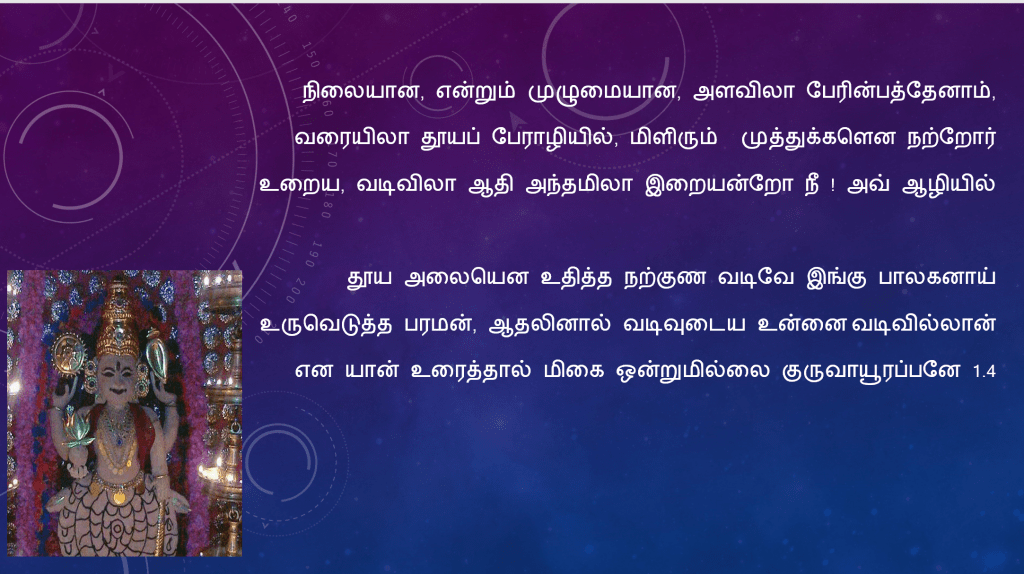
The Supreme Reality-The Brahma Tatwa ,which is dense concentrated Bliss, which is of the nature of the Pure Consciousness, which is without parallel or comparison, and is totally free of time and space limitations, and is always free (of Maya) which hundreds and thousands of the Upanishadic statements seek to explain, and yet, is not clear. This Brahma Tatwa which is not easy to grasp in the beginning, but the realisation of which, is the highest purusharth (i.e. liberation), that (very Reality) shines right in front (in concrete form), (as an Image of Shri Krishna) in the Guruvaayur temple. Oh (wonderful indeed) is the good fortune of the people (who seek Thy Grace).

English Transliteration

SaandraanandaavabOdhaatmakamanupamitaM kaaladeshaavadhibhyaaM

nirmuktaM nityamuktaM nigamashatasahasreNa nirbhaasyamaanam .

aspaShTaM dR^iShTamaatre punarurupuruShaarthaatmakaM brahma tatvaM

tattaavadbhaati saakshaadgurupavanapure hanta bhaagyaM janaanaam .. १

Meaning of the Sanskrit Words

Please refer http://narayaneeyam-firststep.org/dashaka1

सान्द्र-आनन्द-अवबोधात्मकं Which is of the nature of intense Bliss and Supreme Consciousness अनुपमितं without comparison काल-देश-अवधिभ्यां निर्मुक्तं totally free from the limitations of time and space नित्यमुक्तंever free (from the control of Maya-the unmanifest Prakriti) निगम-शतसहस्रेण (whose nature) innumerable scriptural texts निर्भास्यमानंtry to reveal अस्पष्टं (and yet) is not easy to grasp (in the beginning) दृष्टमात्रे पुन:but then immediately on realisation उरु-पुरुषार्थात्मकं becomes the highest purushartha (i.e. moksha, liberation) ब्रह्म तत्वं Brahman, the Reality तत् तावत् that very (Reality), then भाति साक्षात् गुरुपवनपुरे shines right in front (in concrete form) at Guruvayur हन्त भाग्यं जनानाम् Oh! What good fortune for the people

* நான் வாழ் இலக்கு என்பது அறம், பொருள், அவா, முக்தி எனும நான்கு இலக்குகளைக் குறிக்கும். It basically refers to the four objectives of life in his /her ascent to self realization. It is called “Purushaarthaa” .

Narayaneeyam

Deep down inside me, there has always been a desire to study Narayaneeyam. Along with this desire, comes the fear of the unknown – 1000 plus verses in Sanskrit, my poor/no knowledge of Sanskrit and my abysmal and amateurish level of spirituality. So I keep dithering and didn’t do anything towards this during the pandemic year.

My experiments with my blogs in 2020 has now given me the courage to venture. I am browsing the topic and collecting reference materials. I have joined classes at Vyoma’s sanskritfromhome.in and have words of encouragement from my teacher/Guru Sri. Sankararama Sharma. I am listening to the discourses by learned scholars.

We have a saying in Tamil “தை பிறந்தால் வழி பிறக்கும்” ( we will find a way when we enter the Tamil month of Thai – when the Sun starts its northern journey).

So here I am diving into the ocean of bliss without knowing swimming, having confidence that the Lord will help me and show the way in my long and deep journey.

While the verse by verse work will commence beginning this Friday, the full first Dasakam in AV format will be posted on Mahara Sankaranthi day in my YouTube channel “prabhu53”. The work on the rest of the 99 Dasakams will be later on as per the dictations of Lord Guruvayurappan.

Please feel free to let me know the errors (hopefully not blunders) that I may have committed.

The Dance of the Yuga – Conclusion – Prayer – Carnatic Musing 9

I consider myself as extremely fortunate to make an attempt to understand the Dance of the Yuga from a three dimensional (Literary, Music and Dance) perspective. My learning has been immense. There is only one to thank – The Lord Himself. What better way to conclude these set of blogs than with a composition by Lalitha Dasar made universally popular by the legendary Carnatic Musician Chembai Vaidyanatha Bhagawathar and later on by Dr KJ Yesudass.

Audio Link – Chembai Vaidyanatha Bhagawathar

https://www.dropbox.com/s/x2zl12skipscsra/Paavana%20Guru%20%20-%20Chembai%20-%20%20Hamsaanandi-NbjeMhwgo2Q.mp3?dl=0

Audio Link – KJ Yesudass

https://www.dropbox.com/s/9perlmzyaxii7bv/Padmasree%20Dr%20KJ.%20Yesudas-Paavanaguru%20Pavanapura%20-Chembai%20Sangeetholsavam-Classical-uu1Qp9aPYqE.mp3?dl=0

Meaning in English

I surrender to the holy lord of the town created by Lord Guru and Lord Pavan (Guruvayur). The Lord is Sri. Krishna, who is dark like the rain bearing cloud and lives in the cattle rearing village (Gokulam). He is worshipped by Narada and Shiva and is the is protector of the three worlds. He is worshipped by Brahma and Indra ,shines greatly holding a flute and gives happiness to the damsels of his village. He cannot be defeated and is very magnanimous. He as pretty as hundred Gods of Love (Manmatha). He is a never ending source of mercy and is like the Chakora bird to the moon like face of Radha. He is the divine brother of Parvathi.

Sanskrit Verses

Pallavi

पावनगुरु पवन पुराधिषमाश्रये

Anupallavi

जीवनधर सङ्काशं कृष्णं

गोलोकेशं जीवनधर नारद गिरीशं

त्रिभुवनावनान्वेषम्

Charanam

पूजितविधिपुरन्दरं राजितमुरलीधरं

व्रजललनाऽऽनन्दकरं अजितमुदारम् – कृष्ण

स्मरशतशुभकाकारं निरवधि करुणापूरं

राधावदनचकोरं ललितासोदरं परम्

English Transliteration

pallavi

pAvanaguru pavana purAdhiShamAshrayE

anupallavi

jIvanadhara sankAsham krSNam gOlOkEsham bhAvita nArada girIsham tribhuvanAvanAvEsham….pavana

caraNam

pUjitavidhi purandaram rAjita muraLIdharam vraja lalanAnandakaram ajitamudAram

smarashada shubhakAkaram niravadhi karuNApUram rAdhA vadana cakOram laLitA sOdaram param…pavana

Meaning of the Sanskrit Words

Pallavi

पावन – pure/holy

गुरु – Lord Guru

पवन – Lord Vayu

पुराधि – Town

षमाश्रये – surrender

Anu Pallavi

जीवनधर – life preserving or water bearing (cloud)

सङ्काशं – appearance

कृष्णं – Lord Krishna

गोलोकेशं – गो लोकेशं cow, leader of the world

भावित – worshipped

नारद – Saint NArada

गिरीशं – Who lives in the Mountains (Lord Shiva)

त्रिभुवन – three worlds            

अवन – preserver/protects

अवॆशम् – posses

पूजित – Worshipped

विधि – destiny (in this case Brahma who decides destiny)

पुरन्दरं – name of Indira

राजित – brilliant/illuminated

मुरलीधरं – flute playing

व्रज – group/band/flock

ललना – woman

अनन्दकरं – delighting

अजितं -unconquered

उदारम् – generous /bountiful/illustrious/lofty

स्मरशत- स्मर शत – cupid hundred

शुभाका कारं – शुभ , beauty, author/source

निरवधि – infinite/endless

करुणापूरं – compassion/mercy

राधा – Radha

वदन – face

चकोरं – Chakora ird

ललिता – Parvati

सोदरं – brother

परम् – divine/supreme

Meaning in Tamil

பல்லவி

திருத்தலகுரு வாயூர் அப்பனை சரணமடைந்தேனே

அனுபல்லவி

கருமேக வண்ணன் கண்ணன் ஆயர்பாடி நாயகன்

கயிலை ஏகம்பனும் நாரதனும் வணங்கும்

மூவுலகு காத்தருளும்…… திருத்தல

சரணம்

பிரமனும் இந்திரனும் துதிக்கும் ஒளிநிறை குழலோனே

கோபியரின் மனமகிழ் வெல்லஇயலா தயாளனே- கண்ணா

காமன் நூறினும் மேல் எழில்கூட்டும் அழகன் அளவிலா கருணையன்

ராதையின் வதனம் எதிர்நோக்கும் நிலவருந்துபுள் பறவையவன்

உமையவளின் அருள்திரு சகோதரன் …….. திருத்தல

Happy Krishna Janmashtami

Here is my dedication to Lord Krishna; the Tamil translation of the ten Slokas of Dasakam 55 of Narayaneeyam.

நாராயணீயம்பதிகம் 55 – காளிங்க நடனம்

நதிவாழ் நச்சுடை நாகம்தனை வெருட்டிட உறுதியிட்டு

நதிக்கரையில் நச்சுக்காற்றினால் நலிந்து மக்கிய இலைமிகு

கதம்ப மரம் ஏறினான் கருமைநிற மாயக் கண்ணன்….1

கொழுந்திலைத்தளிரென ஒளிமிகு கமலமலர்ப் பாதமுடன்

காழ் மர உச்சிக்கொம்பு ஏறி எழும்பித் தலைகீழ் பாய்ந்து

சுழிர்நிறை நதியில் வெகுஆழம் சென்றான் செல்லக் கண்ணன்..2

மூவுலகுச்சுமைதாங்கும் முகுந்தன் முக்குளித்ததும்

முழுநீரும் சுழன்று பொங்கி ஆர்பரிக்கும் ஓசையுடனே

மூழ்கடித்தே நதிக்கரையை வில் நூறுஅம்பு செல் தூரம்..3

ஆழ்சுழி நீர் பொங்கி எட்டுத்திக்கும் கரைபுரண்டோட

ஆர்ப்பரிக்கும் ஒசைகேட்டு எழு அரவரசன் காளிங்கன்

அடைந்திட்டான் நிலைகலங்கி சீற்றமுடன் கடுஞ்சினம்…4

முகடுபல நிறை கருமலைத் தொடரென பன்னாயிரம் படம்எடுத்து

திரள்வந்திழியுஞ்சாரலென அனல்மிகு தீப்பிழம்புடன் விடநீரும் கக்கும்

சினமிகு காளிங்கனை முன்நின்று கண்டான் மோகனக் கண்ணன்..5

கண்கள் அனல்கக்க கொடுவிடக்காற்று வெளிமூச்சாய் வந்திட

கடும்வெப்பம் சூழ கடித்திட்டான் காளிங்கன்! கடுவிடம் பயனற்றிடவே,

மறுகனம் சிக்கெனப்பற்றி சுற்றிவளைத்தான் சின்னக்கண்ணனை…6

கண்ணனைக் காணா கடுந்துயர் கொண்டு ஆநிரையும்

ஆயர்ரபாலகரும் நதிக்கரை சென்றனர் இழிசகுனம் பலகண்டு

ஆயர்பாடியில் ஆயரும் விரைந்தனர் யமுனை நதி நோக்கி….7

மாயவனைக் காணா மாளாத்துயர் கொண்டு மாண்டிடுவோமென

மக்கள் உறுதியிட்ட நேரம்தனில் மின்னலென அரவுப்பிடிவிடுத்து

குறுநகையுடன் நதி வெளி உதயமானான் நந்தகுமாரன்….8

சின்னஞ்சிறுபதங்கள் சிலம்பொலிக்க கைவளை காப்பு குலுங்க

சிறு எழில்மென்மலர் பாதங்கள் பெரு ஐதலைநாக மகுடமேற

சிறப்புடனே ஆனந்த நடனம் ஆடினான் அச்சுதனாம் நாராயணன்…9

மகிழ்நீர் சொரி ஆயர்குழாம் நடனமாட, முனியோர் கரியவனின் துதிபாட,

விண்ணவர் மலர் சொரிந்து மகிழ, ஜதியுடன் பதம் சேர்த்து நடனமாடும்

குருவாயூரப்பனே! என்னுள் உறை மாளாத் துயர்நீக்கி அருள்வாயே!..10

The Dance of the Yuga – Part 1 – Narayaneeyam – Dasakam 55 – Blog 2 – Slokas 6-10

“இயல்” Literary/Prose – Sensing through Bhakti – Narayana Nambhoodhri (Bhattadhri) – Narayaneeyam Dasakam 55

Audio Link

https://www.dropbox.com/s/h6emn8fe9i36qax/kalinga%20narthanam%20-%20Narayaneeyam.mp3?dl=0

Sanskrit Sloka 6

ज्वलदक्षि परिक्षरदुग्रविष

श्वसनोष्मभर: महाभुजग:

परिदश्य भवन्तमनन्तबलं

समवेष्टयदस्फुटचेष्टमहो ॥६॥

English Transliteration

jvaladakshi parikshara dugraviSha

H shvasanOShmabharaH sa mahaabhujagaH |

paridashya bhavantamanantabalaM 

samaveShTayadasphuTacheShTamahO6

Meaning in English

With its eyes flaming and its breath emitting deadly poisonous fumes, generatingintense heat all round, that serpent lord, bit Thee hard, but finding Thee unmoved,wrapped itself tightly around Thee, who hath unlimited power and strength. Quiteamazing, indeed.

Meaning in Tamil

கண்கள் அனல்கக்க கொடுவிடக்காற்று வெளிமூச்சென

கடும்வெப்பம் சூழ கடித்திட்டான் காளிங்கன்!

கடுவிடம் பயனுறுமோ மாயவனிடம், கண்ட மறுகனம்

சிக்கெனப்பற்றி சுற்றிவளைத்தான் சின்னக்கண்ணனை

Sanskrit Sloka 7

अविलोक्य भवन्तमथाकुलिते

तटगामिनि बालकधेनुगणे

व्रजगेहतलेऽप्यनिमित्तशतं

समुदीक्ष्य गता यमुनां पशुपा: ।।७॥

English Transliteration

avilOkya bhavantamathaakulite

taTagaamini baalakadhenugaNe |

vrajagehatale(a)pyanimittashataM 

samudiikshya gataa yamunaaM pashupaaH || 7

Meaning in English

The Gopa boys and the cows were waitng on the banks were getting worried andrestless, when they did not see Thee, and went to the bank of the river Yamunaa. In the houses in Gokula also the Gopas saw hundreds of evil omens and they also rushed towards Yamuna.

Meaning in Tamil

கண்ணனைக் காணாமல் கடுந்துயர் கொண்டு

ஆநிரையும் ஆயர்ரபாலகரும் நதிக்கரை சென்றனர்

ஆயர்பாடியில் இழிசகுனம் பலகண்டு

ஆயரும் விரைந்தனர் யமுனை நதி நோக்கி

Sanskrit Sloka 8

अखिलेषु विभो भवदीय दशा

मवलोक्य जिहासुषु जीवभरम्

फणिबन्धनमाशु विमुच्य जवा

दुदगम्यत हासजुषा भवता ॥८॥

English Transliteration

akhileShu vibhO bhavadiiyadashaa

M avalOkya jihaasuShu jiivabharam |

phaNibandhanamaashu vimuchya javaat 

udagamyata haasajuShaa bhavataa || 8

Meaning in English

Oh Lord ! Seeing Thy condition, all of them, overcome by grief, decided togive up their life in order to save Thee, when, all of a sudden, Thou, freeing Thyself from the deadly grip ofthe serpent, rose above the waters, smiling casually.

Meaning in Tamil

மாயவனைக் காணாமல் மாளாத்துயர் கொண்டு

மாண்டிடுவோமென மக்கள் உறுதியிட்ட நேரம்தனில்

மின்னலென அரவுப்பிடிவிடுத்து குறுநகைதனை கொண்டு

யமுனைநீர் உள்ளிருந்து உதயமானான் மேகவண்ணன்

Sanskrit Sloka 9

अधिरुह्य तत: फणिराजफणान्

ननृते भवता मृदुपादरुचा

कलशिञ्जितनूपुरमञ्जुमिल

त्करकङ्कणसङ्कुलसङ्क्वणितम् ॥९॥

English Transliteration

adhiruhya tataH phaNiraajaphaNaan

nanR^ite bhavataa mR^idupaadaruchaa |

kalashi~njita nuupura manjumila

t karakankaNa sankula sankvaNitam || 9

Meaning in English

Then Thou mounted on the hoods of the serpent king and danced with Thy delicate beautiful feet. The gentle sound of the anklets mingled beautifully and rhythmically with the tinklings of the bangles on Thy wrists.

Meaning in Tamil

சின்னஞ்சிறுபதங்களின் சிலம்பொலியுடனே

கைவளை காப்புகள் குலுங்கொலி கலந்து

அழகிய மென்மலர் பாதகங்களுடன்

நாக மகுடமேறி நாட்டியம் ஆடினான் நாராயணன்.

Sanskrit Sloka 10

जहृषु: पशुपास्तुतुषुर्मुनयो

ववृषु: कुसुमानि सुरेन्द्रगणा:

त्वयि नृत्यति मारुतगेहपते

परिपाहि मां त्वमदान्तगदात् ॥१०॥

English Transliteration

jahR^iShuH pashupaastutuShurmunayO 

vavR^iShuH kusumaani surendragaNaaH |

tvayi nR^ityati maarutagehapate 

paripaahi sa maaM tvamadaanta gadaat ||10

Meaning in English

As Thou performed the dance, the Gopas rejoiced, the sages sang hymns, and the gods showered flowers. O Lord of the Guruvaayur temple! Such that Thou are, save me from the severe illness.

Meaning in Tamil

ஆயர்குழாம் ஆனந்தநடனமாடி, முனியோர் கரியவனின் துதிபாடி,

விண்ணோர் மலர் சொரிந்து, மகிழ்ந்தனரே அந்நடனம் கண்டு!

என்னுள் உறைமாளாத் துயர்நீக்கி அருள்வாயே குருவாயூரப்பனே!

Link to the Meaning of the Sanskrit Words

https://www.dropbox.com/s/bh4y3goqcbxhkhk/Narayaneeyam%20Dasakam%2055%3B%20Verses%206-10.docx?dl=0