நிலையறிந்து மோனஆசானின் அருளுடனே நாலிரு சித்தி பெற்று
பிறவிப் பெருங்கடல் தாண்டி ஈடேறி வீடுபேறு பெற்றிடலாம்
Meaning in English:
Since the Divine Essence in all is made clear in this hymn, hence by listening to it, contemplating on its meaning, meditating on it, and glorifying it, one becomes endowed with the greatness of the knowledge of the Divine Essence ( present in all ); perhaps the Divine Essence by Itself will awaken within him after that again, the eightfold manifestations of Divine powers (Siddhis) unimpeded.
Understanding the Sloka:
Extracted from Swami Paramarthananda’s lectures
iti idam sarvātvamiti spūṭikritam. – In this manner, in nine verses, the sarvātva bhāva which is the essence of all the Upanishads has been taught by me. Adi Śankarācārya says in this manner, in 9 verses, I have taught or condensed the essence of all the upanishads; the essence of prastāna trayam I have given and What is the essence? sarvātmatvam. And what do you mean by sarvātmatvam, sarvam ātma eva. Everything in the creation is ātma alone; other than ātma there is nothing. The so-called anātma is also mithya, which has the content of ātma alone; Just as the so-called ornaments also are not separate substances, they are also nothing but gold with different names. Similarly, the so-called anātma prapancha also is also ātma only, with a different name; Names are different, but the substance is only ātma. And this is called sarvātmatvam, sarvam ātma iti bhavaha, sarvātmatvam. If you want to put in our own language, जीवात्म परमात्म ऐक्र्म् jīvātma paramātma aikyam,; we can also say brahma satya jagat mityā, jīvo brahmaiva na parāḥ. This vedantic essence has been taught by me; Śankarā says:
Where did I teach it? अमुक्षष्मन् स्तवे amuṣmin stave, in this sthoram called dakṣiṇāmūrti Sthothram; here he did not use the word ashtake; because two more added, therefore no more Ashtakam, instead of using the word ashtakam, he uses the word sthavam; Sthavam is the same as sthoram; sthoram means a hymn or praise of the Lord.
In this dakṣiṇāmūrti sthoram, that has been taught and therefore, study of dakṣiṇāmūrti sthoram is equal to the study of the प्रस्तान त्रर्म् prastāna trayam; because the content of dakṣiṇāmūrti sthothram is the same as the content of the prastāna trayam; means upanishads, geetha and brahma sutram. In all the upanishads, Geetha and brahma sutra, whatever has been taught; that is given in capsule form
“Thena”, therefore since dakṣiṇāmūrti sthoram is equal to प्रस्तान त्रर्म् prastāna trayam; अस्र् श्रवणा asya śravaṇā, a person, a seeker of moksha, should do the śravaṇam of this work. (Systematic and consistent study of this work for a length of time under the guidance of a competent teacher). So śrava ṇat; and not only śravaṇam, tat artha mananāt, one should also do the mananam, to find out whether there are any doubts in accepting this teaching. And what is this teaching? There is nothing other than me; the ātma; सवात्य मत्वम sarvātmatvam that means, I alone am in the form of everything; I am all.
And then dhyānāt; and later this has to be assimilated, so that it becomes my second nature; So śravaṇa manana nididhyāsana sādanāni. And then सङ्कीतयनात् saṅkīrtanāt. The word saṅkīrtanāt is given two meanings; for those people who are not fit for śravaṇa manana nididhyāsanam; because they do not have साधना चतुष्टर् संपवत्त sādhanā catuṣṭaya saṃpatti and therefore everything goes above their head, for those unprepared people; the word संकीतयनम saṃkīrtanam means by mere पारार्णम् pārāyaṇam itself they will gradually grow. They need not know the meaning. Let them daily chant this dakṣiṇāmūrti sthothram; that itself will give them sadhana catuṣṭaya saṃpatti; later opportunity for śravaṇam, manana nididhyāsanam. This sthotra will make you climb all those steps. Therefore even pārāyaṇam is a form of sādhana.
On the other hand, if a person is a qualified person and therefore, he has gone through śravaṇa manana nididhyāsanam; for those people, what is the next sādhana? If you call it sādhana, saṃkīrtanam, means after I assimilate this wisdom, I communicate this to others. Communication or sharing is another form of nididhyāsanam. It is a very beautiful form of nididhyāsanam.
And thus by following all these sādhanas, he will get the result; What is the result; सवात्य मत्वमहाववभूशत स्र्ात ् sarvātmatvamahāvibhūti syāt, he will attain the greatest glory, called sarvātmatvam, sarvātmatvam means the wisdom that I am everything. There is no second thing to frighten me; to harass; to torture me; to hurt me, to limit me, to isolate me, there is no second thing at all; this wisdom and this non-dual status is called sarvātmatvam, which is mahāvibhūti, which is the greatest glory called kaivalyam; Non-dual state.
And not only that. Look at the fourth line, aṣṭadāpariṇadam aiśvaryam ca; aṣṭadāpariṇadam aiśvaryam means aṣṭamūrti dakṣiṇāmūrti aikyam. aṣṭadāpariṇadam means eight-fold; ऐश्वर्मय् aiśvaryam is ईश्वरत्वम् īśvaratvam, which means the dakṣiṇāmūrti भावः bhāvaḥ. So, I will attain this status of ashta Moorthy dakṣiṇāmūrti . That means vishvaroopa dakṣiṇāmūrti aikyam;
This equanity is called svamitvam. And this mokṣaḥ is also svastāha, it has come from outside, it is only discovery of the very nature. svastāha means natural freedom; he claims. This is called jīvanmukti which will lead to videhamukti; which is the फलम् phalam.
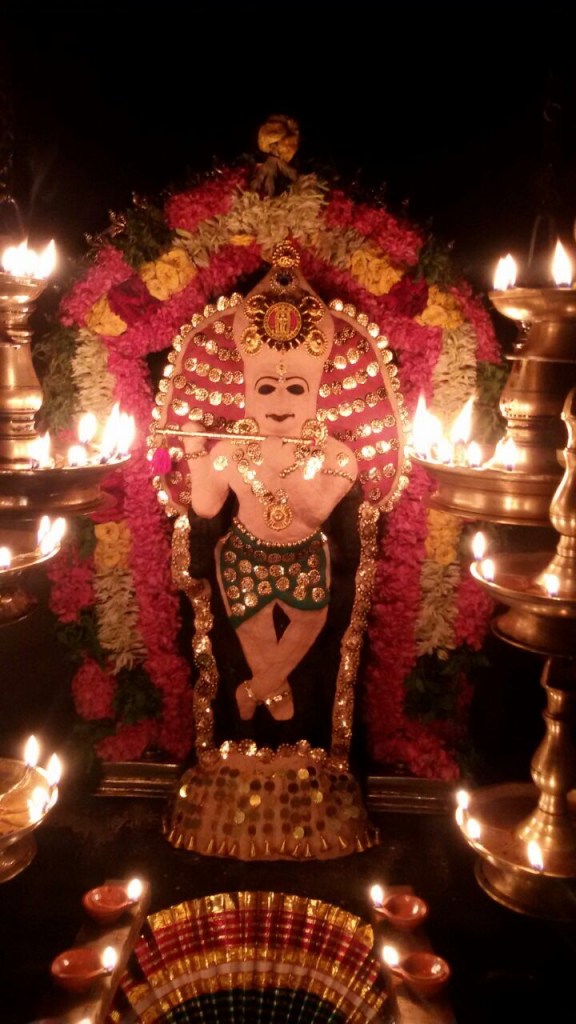
Lord Krishna’s beauty is beyond the imagination, infact all beauty arises from him only. As his name Krishna means ‘all attractive’ – means his beauty enchants everyone. In front of the beauty of Krishna everything fades and pales . Even the beauty we find in the world is only a spark of the transcendental captivating beauty of Lord Krishna , then how beautiful He, the source of all beauty will be . No wonder, the devotees who visit Guruvayur and see Him are in a state of Bliss and experience horripilation, says Bhattathri in this Sloka.
O Lord! Thy captivating form which continuously showers pure nectar, which is itself the Supreme Bliss-Consciousness holds the minds of those who hear Thy glories. Their minds are immediately stimulated and filled with joy. They experience horripilation all over their body and are bathed in the cool tears produced from ecstasy of joy.
Bhattathri continues his pun on Goddess Lakshmi by citing another reason for the “unstable” nature of Her when it comes to Her short stay at Her devotees’ place.
Oh Consort of Goddess Lakshmi, I will tell another reason to say,
That Goddess Lakshmi does not stay long with others,
That is because of her attractiveness to your pretty form,
For in the case of devotees of yours who are busy in meditating,
And singing about you, she is interested in hearing about,
The news of her darling and never leaves but stays with them. 2.5
Meaning of the Sanskrit Words
लक्ष्मीः – Oh Goddess Lakshmi
तावकरामणीयकहृता एव इयम् – तावक-रामणीयक हृता एव = your, beauty, fascinated/captivated, only, she = being thus captivated by Thy beauty only,
इयं परेषु अस्थिरा इति – she, is (committed to be in that position), unstable, in this manner/thus = परेषु अस्थिरा इति = she is unstable with others
अस्मिन् – in this respect
अन्यत् अपि प्रमाणम् – another proof also
अधुना – now/at present
वक्ष्यामि – I will state
लक्ष्मीपते – Oh consort of Goddess Lakshmi
ये त्वद्ध्यानगुणानुकीर्तनरसासक्ताः – ये त्वत्-ध्यान-गुण-अनुकीर्तन-रस-आस्क्ताः – those, your , meditate, virtue, singing, essence, devoted/strongly attached/engrossed = those who meditate and are always engrossed in singing Thy glory
हि भक्ताः जनाः – हि भक्ताः जनाः – = certainly (with) such devotees
तेषु एषा वसति स्थिरा एव – त= in those, she, stays, permanently/stable, always = with them she stays always
दयितप्रस्तावदत्तादरा – दयित–प्रस्ताव-दत्त-आदरा = beloved, (being), a song or hymn in praise, presented, respect/reverence/honour/praise = listening attentively to the praises of her beloved Lord
We saw in the introductory blog earlier that this “jivatma” which was “relation less” and who is otherwise a witness “Saakshi” becomes related due to the influence of Maya, becomes an actor and the misery starts with transactions and continues till we know our true self through “atma gnanam”. Adi Sankara outlines a few relationships in this Sloka.
The differentiations that we see in the world as Cause and Effect, as possessor-possession, relations as the disciple & teacher, and also as father & son etc., are all differentiations within the one Ātman. In Dream or Waking state, He, the One Puruṣaḥ is always present, and (as if) Maya wanders over Him and gives rise to all these Differentiations. Salutations to Him, the Personification of Our Inner Guru Who Awakens This Knowledge through His Profound Silence; Salutation to Sri Dakṣiṇāmurty.
Understanding the Sloka
The Role of Maya
Let us look at the third line first: य एष पुरुषो मायापरिभ्रामितः eṣa: puruṣaḥ māyāparibhrāmitaḥ;
1. It means – This ordinary person in the world; even though he may be worldly-educated; who is spiritually and scripturally-illiterate; he is māyā paribhrāmitaḥ; { माया māyā means avidya परिभ्रम Paribhrama = Moving To and Fro, Wander/drift}. மாயையவள் வசப்பட்டு உழலும்
2. This means that he is confused because of avidya and therefore instead of taking original sākṣi svarūpam as himself; he mistakes the incidental-ahaṃkāra as himself drifts into the attached-self called ahaṃkāra I; I am going to certainly become a relative individual, related to the external world; asaṃga sākṣi (the unattached witness), becomes ससंगजीवः sasaṃga jīvaḥ (attached soul); relationless pure sākṣi-I, have now drifted and fallen down to a relative samsāri-I;
3. This means that every relation is causing one form of samsāra or the other. There is no relationship which is free from problems; In fact, if there is a relationship free from problems then the end of the relationship will cause problems; If there is a relationship so beautiful and wonderful and enjoyable, even that wonderful relationship becomes a problem when the relationship has to end because of time/kala, because of prarabdhaḥ, because of any reason. Therefore, a problem free relationship is an oxymoron; it does not exist. And therefore, the sākṣi-I, who is ever free, now has fallen down to ahaṃkāra-I, with varieties of problems.
Relationship
A few empirical relationships are enumerated in the sloka i.e., कार्यकारण संबन्धः kāryakāraṇa saṃbandhaḥ; cause and effect relationship. I-as-jīvātma, the ahaṃkāra-I, am a product of my own past karma; my prarabdhaḥ karma has given me this personality; this physical, this emotional, this social personality. Therefore, I am never a free person; I am tossed up and down; by my own karma; thus I am a कार्मय kāryam; my karma becomes the kāranam for my situation.
Let us see a few of the cause & effect relationships.
1. स्वस्वामिसम्बन्धतः svasvāmisambandhataḥ; स्वस्वामि (Svasvaami = Possessor and Possession & सम्बन्ध (Sambandha = Relation). That means as ahaṃkāra, I am related to several possession, as owner-owned sambandhataḥ; and ownership means, there is a yogakṣema samsāra. yogakṣema samsāra means acquisition-maintenance samsāra is there like. உடையவன் – உடமை உறவுகள்.
शिष्याचार्यतया śiṣyacāryatayā; means guru-śiṣya sambandhataḥ. ஆசான் – சீடன் உறவுகள்.
पितृपुत्राद्यात्मना pitṛ putrādyātmanā; means father son adhi etc. தந்தை – மகன் உறவுகள் (சொந்தம் எப்போதும் தொடர் கதைதான், முடிவே இல்லாதது)
So, the māyā paribhrāmitaḥ puruṣaḥ drifted and fallen down from a relationless pure sākṣi-I, to relative samsāri-I in either of the स्वप्ने जाग्रति वा Svapne Jaagrati Vaa avastha, whether it is waking state or dream state, gets into the inevitable saṃsāraḥ.
Of course we get some interval and relief in सुषुशि अवस्त suṣupti avasta, wherein we do not worry about the family members and society and other problems, and unfortunately we cannot sleep for long. The sleep is only for a few hours and older we grow, lesser the sleep also. Therefore even sleep is not a permanent solution; even death is not a permanent solution, because punarjanma brings in punaha sambandhataḥ and samsāra; And therefore this jeevathama, puruṣaḥ ha; who is really a sākṣi; that purushā, māyā paribhrāmitaḥ; as is confused because of māya.
Relationships & The Birds on a Tree – A Vedic Perspective
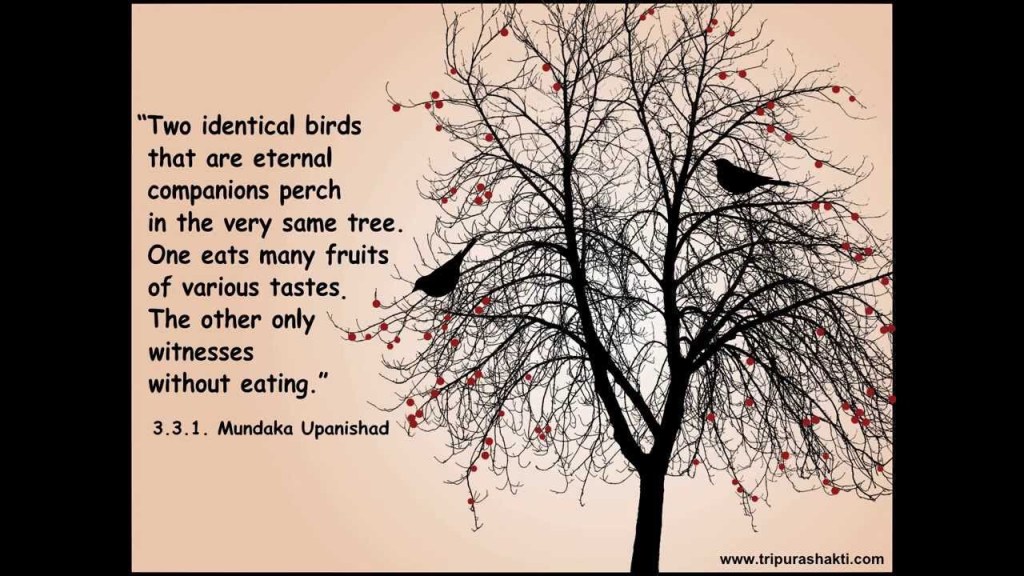
Talking about the relationships of the unattached witness and the attached soul, the famous two birds in one tree Sloka from the Upanishads provides the classic conceptual framework for this Sloka in Dakshinamurthy Stothram.
The Shruti, says: By Mâyâ, Siva became two birds always associated together; the One, clinging to the one unborn (Prakriti), became many as it were (vide Mundaka- Up. 3-1; Yâjniki-Upanishad 12–5).
Meaning of the Sanskrit Words – “Suparnau – two of good motion or two birds; (the “word Suparna” being used to denote birds generally); Sayujau – inseparable, constant, companions; Sakhayau – bearing the same name or having the same cause of manifestation. Being thus, they are perched on the same tree (‘same,’ because the place where they could be perceived is identical). ‘Tree’ here means ‘body;’ because of the similitude in their liability to be cut or destroyed. Parishasvajate – embraced; just as birds go to the same tree for tasting the fruits.
Two birds bound to each other in close friendship are perched on a tree. While one of the birds is busy consuming the fruits of the tree with great relish, the other seems to be in a state of detached equanimity just looking at its compatriot. The tree in this example represents the body. The bird busying itself with the material pleasures accorded by the tree is the ‘Jivātma’ (individual soul), that has an inextricable identification with the body and mind. Such an identification makes the Jivātma both the ‘karta’ (doer) and the ‘Bhokta’ (enjoyer). The observing bird on the other hand, represents the ‘Paramātma’ (the Supreme Self). The Supreme Self remains uninfluenced and untainted by any material pleasures and possessions and remains a still tranquil witness.
Adi Śankarācārya in his commentary to this sloka says – This tree as is well known has its root high up (i.e., in Brahman) and its branches (prana, etc..) downwards; it is transitory and has its source in Avyakta (maya). It is named Kshetra and in it hang the fruits of the karma of all living things. It is here that the Ātman, conditioned in the subtle body to which ignorance, desire, karma and their unmanifested tendencies cling, and Isvara are perched like birds. Of these two so perched, one, i.e., kshetrajna occupying the subtle body eats, i.e., tastes from ignorance the fruits of karma marked as happiness and misery, palatable in many and diversified modes; the other, i.e., tbe lord, eternal, pure, intelligent and free in his nature, omniscient and conditioned by maya does not eat; for, He is the director of both the eater and the thing eaten, by the fact of His mere existence as the eternal witness (of all); not tasting, he merely looks on; for, his mere witnessing is direction, as in the case of a king.”
The Way Forward
Swami Dayananda Saraswathi in his lecture says that in all but one relationship listed by Adi Sankara , the “bedha”- the difference between the Atma and the Maya influenced Jeeva continues to exist eternally irrespective of the transactions. The guru-shishya relationship even though is a cause and effect relationship is the only one which ensures that the influence of Maya is nullified and the true nature of Jeeva is revealed through the guru’s teachings. In that state, even the guru-shishya relationship withers away and so too the other relationships.
And that is perhaps why Adi Śankarācārya says, even this confused jeeva is really none other than that dakṣiṇāmūrti only and therefore he says Tasmai Shri Gurumoorthaye; To that Gurumoorthy, dakṣiṇāmūrti , my namaskaraha.
அன்பு சிவமிரண் டென்ப ரறிவிலார்
அன்பே சிவமாவ தாரு மறிகிலார்
அன்பே சிவமாவ தாரு மறிந்தபின்
அன்பே சிவமா யமர்ந்திருந் தாரே
என்ற திருமந்திரப் பண் இக்கருத்தினைப் பிரதிபலிக்கிறது.
This, in essence is the eighth Sloka.
Long distance shoot using iPhone from the balcony of my house.
We attribute success, wealth and prosperity to the presence of Goddess Lakshmi in our homes. She represents riches that every individual wishes to attain in his/her materialistic life. She is the epitome of opulence and her existence helps us achieve glorious heights. However, it isn’t easy to retain her. It is often said that Goddess Lakshmi does not stay in a family beyond three generations (max). Bhattathri quotes this characteristics of Goddess Lakshmi as a pun in this and the next Sloka to drive home the point that as a consort Goddess Lakshmi is more focussed on Lord Vishnu whose avatar is Lord Krishna of Guruvayur.
After getting and reaching your wonderful and greatly joyous form, that goddess who controls wealth, has become more attached to you. And because of this even after reaching the homes of her great devotees, She does not prefer to stay there. Oh Lord, Oh changeless one, due to the deep, strong and stable love towards your very pretty form, She has got a very bad name as the unstable one. Is it not uncharitable? 2.4
Meaning of the Sanskrit Words
तत्तादृङ्मधुरात्मकम् – तत्-तादृक्-मधुर-आत्मकम् = (of) that such incomparable beauty तव वपुः – Your form /figure सम्प्राप्य – having arrived (married) सम्पन्मयी – endowed with (prosperity and auspiciousness) सा देवी – that Devi (Lakshmi) परमोत्सुका – परम-उत्सुका = (who) became very much attached (to Thee) चिरतरम् – for a very long time न आस्ते – doesn’t dwell/stay स्वभक्तेषु अपि – स्व भक्तेषु अपि – her own, devotees, even (even with her own devotees) तेन अस्याः – so/because, बत कष्टम् – alas, difficult अच्युत – imperishable विभो – Lord त्वद्रूपमानोज्ञकप्रेमस्थैर्यमयात् = त्वत्-रूप-मानोज्ञक-प्रेम-स्थैर्यमयात् = Your, form, beauty, love, unwavering/ stable = because of the unwavering love for the enchanting beauty of Your form अचापलबलात् = अचापल-बलात् = firm/unwavering, power because of the power of (her) firm (love for Thee) चापल्यवार्ता = चापल्य-वार्ता = as fickle (goddess), News/the reputation उदभूत् – has risen
We saw in the introductory blog that the experience of the self is not a simple act of knowing but it is a complex act of re-knowing. When recognition of self occurs, the limited consciousness merges with the supreme consciousness. Tirumūlar compares this to space merging with space and light merging with light. Let us now see in this Sloka about this recognition – when, where and how do we re-cognise this Self.
बाल्यादिष्वपि जाग्रदादिषु तथा सर्वास्ववस्थास्वपि व्यावृत्तास्वनुवर्तमानमहमित्यन्तः स्फुरन्तं सदा । स्वात्मानं प्रकटीकरोति भजतां यो मुद्रयाभद्रया तस्मै श्रीगुरुमूर्तये नम इदं श्रीदक्षिणामूर्तये ॥७॥
Meaning in Tamil
இடைநிலையாய் பாலன் இளையன் விருத்தனென உடலிருந்தும்
அடையும் அறுபாதி அவத்தையும்* தொடர்விலாதெனினும் – அதனுள்
இடையிலா தொடராய் சுயநேருணர்வாய் அனைத்து நிலைதனிலும் உள்ளுறை
ஆதியும் அந்தமும் அருட்பரம்பொருளெனும் ஆன்மாவை அறியும் ஆற்றல்தனை
அமைதியின் வடிவாய் கரவழி மோனமுத்திரை காட்டி நாடுவோர்கு கற்பிக்கும்
ஆதிஅந்தமிலா மோனநிலை ஆசானாம் அந்த அருள்மிகு
தக்ஷிணாமூர்த்தி பொற்பாதம் பணிந்திடுவோம்
(*அறுபாதி அவத்தை – ஆன்மாவின் மூன்று நிலைகள் –
விழிப்பு, கனவு, ஆழ் உறக்கம்)
Meaning in English:
During boyhood and other stages of life (Youth, Old age etc), during waking and other states (Dreaming, Deep Sleep, Turiya etc) and similarly in all conditions the Ātman always shines as the “I” within, free from all conditions but at the same time present in all conditions. The Inner Guru awakens this Knowledge of One’s Own Ātman to those who surrender to Him; this Knowledge is represented by the auspicious Cin-Mudra. Salutations to Him, the Personification of Our Inner Guru Who Awakens This Knowledge through His Profound Silence; Salutation to Sri Dakṣiṇāmurty.
Where is Ātma experienced? Self is experienced by me. ātma, the real Self, is always experienced by me. It is ever-evident to myself; And when is the self-experienced? Sada spurantaṃ. It is ever-experienced. And where is it experienced? अन्तः स्फुरन्तं antaḥ spurantaṃ. Within the body-mind-complex, within the enclosure of body-mind-complex, it is ever-experienced. (आत्मानुभवः ātmānubhavaḥ is a सदा अन्तः स्फुरन्तं sada antaḥ sphurantaṃ; sada – always; antah – inside/internal; spurantaṃ meaning shining, experienced, evident, accessible, recognisable, is spurantaṃ).
And how do we refer to that experience? Every experience is identified through an expression. When I experience an object let us say a clock, I invent an expression to refer that experience; I say that it is a clock. What is that expression for ātma? This ever-experienced ātma, is referred to me by me as Aham – Aham iti. It is ever experienced in the form of I-am; I-am; I-am;
When do we experience? “I-am’ experience is there continuously. Throughout the waking state, “I-am” continues; the ātma is experienced as I am, during the dream state; even during the sleep state, “I am” continues. You do not verbalise during sleep; but that experience is verbalised after waking; “I am” experience is present in sleep, but it is verbalised, vocalised only in the waking state; verbalisation is later, but the experience is there; even during sleep. Therefore I-am, I-am, I-am, this continuously experienced I am is ātma.
From this Adi Śankarācārya conveys a very important thing, ātmā experience or ātmānubhavaḥ is continuously present; ātmānubhavaḥ is continuously present for everyone, all the time. And therefore, we should remember ātmānubhavaḥ is not a particular experience happening at a particular time. You cannot say I had ātmānubhavaḥ in meditation. Then you are making ātmānubhavaḥ an event in time. Adi Śankarācārya negates that by using the word सदा sadā. So ātmānubhavaḥ is not an event in time and therefore it does not require a process to make it an event in time. An event in time happens because of an effort, because of a process. Śankarā says ātmānubhavaḥ is not an event; which happens in time through a process or through an effort of any individual or individuals. Therefore, we should never say; I am working for ātmānubhavaḥ. This is one explanation of ātma.
This ever-experienced ātma is anuvartamānam, is continuously-present, anuvartha means to continuously present, to inhere, to permeate, to inform, anuvarthamānam; this ātma is continuously-present. When? In and through. In and through what? vyāvṛttāsu avāstāsu, vyāvṛttām means discontinuous, anuvartham means continuous, and avāstā means states/stages, So ātma is continuously present in and through the discontinuous-avāstās.
The word avāstā, if you take the life as a whole, the word avāstā means the stages of life and they are classified as four in our śātrās. There are four avāstās or stages of life, if you take life as a whole. And what are those avāstās? bālyam, kaumāram, yauvanam, vārdakyam; bālyam is childhood state, kaumāram means boyhood state; or stage; and yauvanam is youth stage; and vārdakyam means old-age stage. Thus, four avāstās are there. bālyadishu avāstāshu, in and through the four discontinous stages of life, like childhood etc. ātma is continuously present. How? I am a child, I am a boy, I am a youth; I am old; When child word is used, boy word is not there; when I say boy, youth word is not there; When I say old, youth, boy is not there. Child, boy, youth, old, there are anuvartam or vyāvṛttam, these four; they are vyāvṛttam means, mutually-exclusive-discontinous stages-of-life; but even though these stages are mutually exclusive; even though these stages are discontinuous, what is continuous? I am, I am, I am. That “I am” refers to the ātma.
And not only these four stages of life. If you take a particular day of your life, instead of taking the whole life, if you take a particular day, in the context of a day, avāstās are called states of experience, and they are classified into three. If you take life; four stages; if you take day; three states; four stages are called avāstās; three states are also called avāstās. One is taking a segment of life called a day, another taking the whole life. And what are the three states of experience? Adi Śankarācārya says जाग्रदाददषु jāgradādiṣu when we say jāgradādiṣu avāstāsu, we should translate as states of experience. And there also “I am waker”, “I am dreamer” and “I am sleeper”; wakerhood-state, dreamerhood and sleeperhood; They are vyāvṛttam or anuvrutham? They are vyāvṛttam, which means they are mutually exclusive, and they are discontinuous states. But in and through the discontinous states, what is common, “I am”, “I am”, that “I am”, and that continuous”I am” experience is ātmanubhavaha;
3. प्रकटीकरोति भजतां – Prakattii-Karoti Bhajataam
Here Śankarā talks about the knowledge that the Guru is teaching – the knowledge about the attributeless ever present and ever experienced ātma. Because they are floating and march pasting, this exclusion of attributes, and seeing the ever experienced continuous I-am as ātma is called ātma jnanam. Seeing the attributeless I-am as the ātma is called ātmajnanam. And therefore, ātma jnanam is not a new experience; but it is a new perception of the ever experienced I, excluding the attributes. And this ātma, the ātma, which is separated from attributes, प्रकटीकरोशत prakaṭīkaroti, is taught by the guru. Guru does not give a new experience. Guru does not ask the disciple to work for a new experience, Guru teaches the student to reshuffle; reclassify the available experience. You say “I am”, but do not include any attribute.
In Nirvana Satakam, Śankarā Says ,
नमे द्वेष रागौ, नमे लोभः मोहौः
मदौ नैव मे नैव मात्सर्य भावः
न धमॊ नचाथॊ, न कामॊ न मॊक्षः
शचदानन्दरूप शिवॊहम् शिवॊहम
Include the attribute; I am the empirical-ahaṃkāra; exclude the attribute, I am absolute-ātma. And therefore, the difference between ahaṃkāra and ātma is only in my reclassified-perception. That is why we say ātma-jnanam is a cognitive-change; a perspective-change, with regard to myself. And what is that change? Earlier when I was saying “I am” it was along with anger; along with desire; I included them; now I have learnt to exclude them. And the moment l learn how to exclude them; I can happily claim I am Brahman. Inclusive of attributes, as ahaṃkāra, I cannot claim I am Brahman. Exclusive of atttributes, as Aham, I can claim I am Brahman; I have not become Brahman; but I have claimed the Brahman that I was, I am, and I ever will be. And it is this new perspective which is the teaching of the guru.
Therefore, Adi Adi Śankarācāryacharya says: स्वात्मानं svātmānaṃ; this attributeless-I, this reclassified-I, the guru प्रकटीकरोशत; prakaṭīkaroti means reveals, teaches, instructs; to whom? भजतां bhajatāṃ, to the seekers who are willing for the new-look “I”. Who are willing for the new-look “I”; there is no change in the eye; in the look or perspective there is a new perspective; that I prakaṭīkaroti bhajatāṃ; bhajatāṃ means śiṣyānām (the seekers).
4. यो मुद्रयाभद्रया – Yo Mudrayaa Bhadrayaa
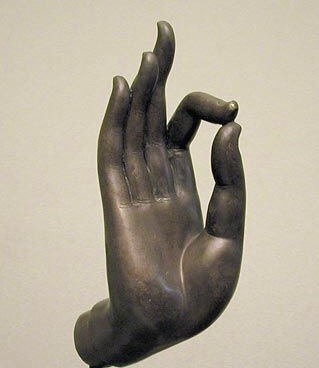
Now, Śankarā explains as to how the Guru transfers this knowledge to the Seekers. And how does he reveal? Two methods, by verbal and non-verbal communication. So, all the body gestures are non-verbal communication. That non-verbal communication is called badraya mudraya; bhadraḥ means auspicious, mudraḥ means hand gestures. The blessed symbol here referred to is variously named as follows:
Cinmudra, the symbol of consciousness;
Vyakhya-mudra, the symbol of exposition;
Tarka-mudra, the symbol of investigation;
Jnana-mudra, the symbol of wisdom.
It consists of a circle formed by joining the thumb and the index-finger at their tips. Through the auspicious hand gesture, called cinmudraḥ – karakalita cinmudra ānandarūpam.
We saw in the dhyāna slokaḥ; the index finger (let us call it the I – am-finger). With this I-am-finger only we attach attributes and point out “you are different, I am different ” meaning that we attach sthula, sukshma and karana sareera attributes through this finger.
And once I separate the “I am” from the attributes, then it can touch the thumb which refers absolute Brahmanhood; separate from the attributes, “I acquire”, I accomplish the status of absolute-brahmanhood. The relative I itself is the absolute-I, when it is freed from attributes. I plus attributes is relative-I, ahaṃkāra; I minus attributes am the absolute-I; ātma. This is what Dakshinamurthy conveys.
The CinMudra is also extensively quoted in several Tamil “Saiva Siddhanta” works. Here is one from Kanda Puranam and Tiruvanaika Puranam
சைவத்தில் சின்முத்திரை கந்தபுராணத்தில் விளக்கப்பட்டுள்ளது. உமையம்மை இமய அரசன் வேண்டுகோளுக் கிரங்கி அவனுக்கு மகளாக இறைவன் அனுப்பப் பிரிந்தவுடன் , இறைவன் தனியே இருந்தனன். அப்பொழுது வேதம் முழுதும் கற்றுணர்ந்த சனகாதி முனிவர் இறைவனிடம் வந்து,” ஐயனே!கடல் போல விரிந்த பொருட்பரப்புள்ள வேதங்களைக் கற்றும் மனம் அடங்காமல், நள்ளிரவில்சூறாவளிக் காற்றடிக்க எழும் அலைகள் மோதித் தாக்க அலைப்புண்ட கப்பல் போல மனம் ஒருநிலைப்படாமல் கலங்கினோம். இந்தக் கலக்கம் நீங்க அருளுவாயாக” என்று இரந்தனர். இறைவன் அந்தமில் ஆகமத்தின் அரும்பொருள் மூன்றும் (சரியை, கிரியை, யோகம்) கூறினன். முனிவரர்கள் மனம் அடங்கும் ‘ஞானபோதகம்’ போதி என்றனர். இறைவன் அது சொல்லத்தக்கதன்று; இப்பரிசினால் இருத்தல் கண்டீர் எனக் கூறி,
கட்டைவிரல் சிவபரம்பொருளைக் குறிக்கும் . சுட்டுவிரல் உயிரைக் குறிக்கும் சுட்டுவிரலுடன் ஒட்டிய நடுவிரல் உயிருடன் இணைந்த ஆணவமலத்தையும் மோதிரவிரல் மாயாமலத்தையும் சுண்டுவிரல் கன்மமலத்தையும் குறிக்கும். சுட்டுவிரல் மற்றைய மூன்று விரல்களையும் விட்டு விலகிப் பெருவிரலின் அடியினைப் பொருந்தி நிற்றல், உயிர் , மும்மலங்களையும் நீத்துச் சிவனின் தாளிணையில் படிந்து நிற்றல் முத்தி என்பதைக் குறிக்கும். இதனை,
“மும்மலம் வேறுபட் டொழிய மொய்த்துயிர்
அம்மலர்த் தாள்நிழல் அடங்கும் உண்மையைக்
கைம்மலர்க் காட்சியில் கதுவ நல்கிய
செம்மலை யலதுஉளம் சிந்தி யாதரோ.”
திருவானைக்காப் புராணம் – வரங்கொள்படலம்.
என உணர்த்திற்று.
5. तस्मैश्रीगुरुमूर्तयेनमइदंश्रीदक्षिणामूर्तये – Tasmai Shrii-Guru-Muurtaye Nama Idam Shrii-Dakssinnaamuurtaye
To that Guru, who gives me the knowledge of the attributeless-I, who teaches me to have a new perspective, without looking for a new experience, that teacher I prostrate; Tasmai. Gurumurthaye; śrī dakṣiṇāmūrtaye; who is none other than dakṣiṇāmūrti idaṃ namaha; my prostrations.
The name Krishna means all attractive. He is also God and possesses the opulence of beauty in full. Physical bodies always have faults not least of which the fact that they will age, get sick and die. Sri Krishna has a body full of eternality (sat), knowledge (cid) and bliss (ananda). He is incomparable.
Oh Vishnu, Oh Lord, who in this world would not be enchanted by your form, which is superior to, what is considered to be the greatest in all the three worlds, more charming than the most charming, more brilliant than the most brilliant even, sweeter than the sweetest even, more beautiful than even the most beautiful and which is the wonder of wonders in this world.
Meaning of the Sanskrit Words
यत्-त्रैलोक्य-महीयसः अपि महितम् = that which is superior to (what is considered to be) the greatest in all the three worlds
मोहनात् सम्मोहनम् – more charming than the most charming
कान्ति-निधानतः अपि कान्तम् = more brilliant than the most brilliant even
माधुर्य-धुर्यात् अपि मधुरम् = sweeter than the sweetest even
सौन्दर्य-उत्तरतः अपि सुन्दरतरम् = more beautiful than even the most beautiful
त्वत्-रूपम् = Thy form,
आश्चर्यतः अपि आश्चर्यम् = (which is) the wonder of wonders
भुवने = in this world
न कस्य कुतुकं पुष्णाति = (is there any one) whose desire/entrancement (to Thee) is not aroused(enhanced/flourished)
“Before the rise of knowledge, duality is misleading but when our understanding is enlightened, we perceive that duality is more beautiful than even non-duality and is conceived so that there might be worship”.
Narayana Bhattathri, an enlightened soul “looked at the Eternal one not so much as the God of philosophical speculation but as the God of Grace such as the heart and the soul need and seek; a God who inspires personal trust, love, reverence and loyal self-surrender”. No wonder he comes out with this poetic description of the Lord’s beauty. Let us enjoy his description.
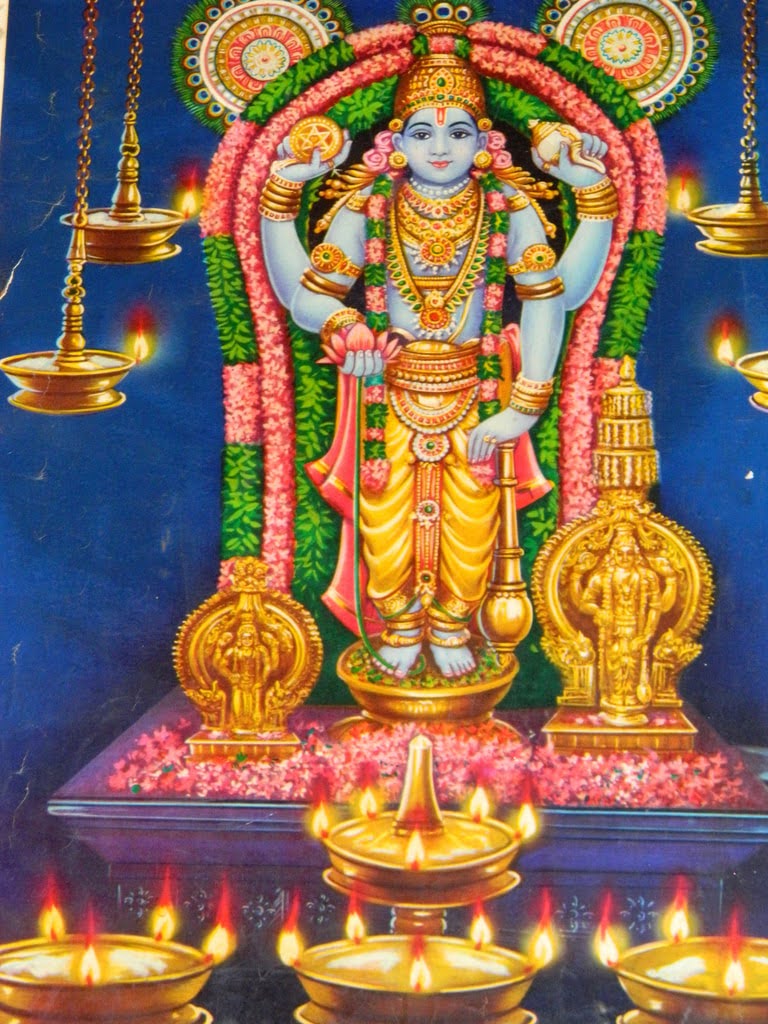
I take refuge in Your form with ornaments such as) Keyur (epaulets) Angada (armlets) Kankana (bracelets)and finger rings, studded with gems adorning the sacred four arms, holding the mace, the conch, the discus and the lotus, wearing a yellow resplendent silk cloth, fastened by a golden waist band with pure lotuses like lustrous feet. Oh Lord I take refuge in Your indescribable form that removes the woes of the devotees.
“In deep sleep there is an experience of absence and not an absence of experience”.
Swami Sarvapriyananda
This is exactly what our introductory blog to Sloka 6 talked about. Many and in particular the Sunyavadis mistake this as emptiness, says Adi Sankara in this Sloka. Let us get into the Sloka.
Just Like the Sun and the Moon are Eclipsed by Rahu, the Pure Consciousness is Eclipsed by Maya (for a spiritually ignorant person). A Spiritually Elevated Soul can enter that state of Unborn Deep Sleep (i.e., Pure Consciousness) by Withdrawing His Sense Organs to such an extent that Only the Real Essence remains. That state (Pure Consciousness) is experienced during Spiritual Awakening whereby one clearly Perceives that “Before I was Sleeping” (by being eclipsed by Maya). Salutations to Him, the Personification of Our Inner Guru Who Awakens This Knowledge through His Profound Silence; Salutation to Sri Dakṣiṇāmurty.
In the first line “divākarendu sadṛśo māyā samācchādanāt”, Adi Śankarācārya quotes the celestial phenomenon of solar & lunar eclipse as an example. He explains that just like the Sun & Moon are eclipsed by Rahu, Pure Consciousness is eclipsed by Maya
“Rahu” in mythological language is a dark snake which swallows the sun/moon; In astrological language, rāhu is only the shadow; that is why it is called chāyāḥ grahaḥ. Therefore, that shadow is eclipsing. We must understand that the eclipsed sun/moon is not non-existent; it is only not-prominent, dominant, pronounced during the eclipse. However, for the ignorant it appears as though the Sun/Moon is not there during the eclipse.
Similarly, when the transactions are not there; existence is not prominent. Non prominent existence is not non-existence. Non-transactable existence is non-prominent existence; it is as though nonexistent, but it is not non-existence.And therefore the general existence, in sleep, is as though eclipsed; because of:
maya’s āvanara śakti (veiling power);
resolution of the organs;
end of transactions.
All these three are important; and therefore it is eclipsed as it were. And therefore, Shankaracharya compares this general sattaḥ to the eclipsed Sun and moon.
करणोपसंहरणतो karaṇopa saṃharaṇataḥ; and consequently, because of withdrawal of the kāraṇam. upasaṃharaṇam means withdrawal; kāraṇam means the eleven organs. With the withdrawal of sense and action organs (upasaṃharaṇam of Kāraṇam – karaṇopa saṃharaṇataḥ – करणोपसंहरणत),
Now let us go to the third line. What is the proof for the presence of pure existence in suṣupti? You say it is not available for transaction. That means it is not available for proving also; because proving itself is a form of transaction. So how do you know the pure existence as my true nature? For this, we say three प्रमाणस् pramāṇas are there to prove it;
one is Shruti pramāṇas;
another is yukti pramāṇas,
and the third is anubhava pramāṇas.
Of these three pramāṇas, Adi Śankarācāryacharya gives in the third line, the powerful anubhava pramāṇam.
Let us see the Shruti,pramāṇa:
When a person goes to sleep, he is not becoming non-existent; but he is withholding himself into his pure nature called existent; sadā; sat, means existence. He merges into his pure nature of existence. स्वम् अवपतो भवशत svam apito bhavati; The sat which is his svarūpam into that he merges. So the Upanishad does not say he merges into asat. Therefore, Shruti, pramāṇam proves this.
The next one is yukti pramāṇam. Logic; in fact, we need not go to traditional logic; we can go to modern logic; modern science itself; by the law of conservation of energy and matter; nothing can be totally destroyed. An existent thing can never become non-existent. An existent thing can never become non-existent; destruction is what? You are not converting an existent thing into a non-existent thing. When pot is destroyed, what happens? Pot exists in a different form; it becomes what; clay. So, pot never becomes non-existent; then it becomes what; it is existent in a different form. So, there is no destruction, in the form of becoming non-existent. That being so, an existent thing cannot be converted into non-existence and vice versa also. And out of non-existence, an existent thing cannot come out. Out of nothing what comes? Nothing comes;
न सतो ववध्र्ते भावाः, न भावो ववध्र्ते सतः
na sato vidhyate bhāvāḥ, na bhāvo vidhyate sataḥ;
कथम् असतः सत्र् एथः
katham asataḥ satya ethaḥ
Existent-I cannot become non-existent in सुषुशप्त suṣupti and out of the non-existent I, again an existent-I cannot come; and therefore, in sleep I am existent; but not in the form of a qualified-I; I am existing in a different form. When pot is destroyed that potness attribute goes away. Similarly, when I resolve, my individuality goes away, the individuality_less-I. Like the potness_less clay. The attributeless-I am existent. I did not know then. You will not know. Because if you want to know, you have to become a knower. The moment you become the knower, you are no more in sushupthi. It becomes jagrat or swapna. Therefore, what is the second logic; the second pramanam, logic is; an existent thing can never become non-existent;
Then what is the third: अनुभव प्रमाणम् anubhava pramāṇam. And what is the anubhavam pramāṇam. Adi Śankarācārya calls it प्रत्र्शभज्ञा pratyabhijñā; pratyabhijñā means recognition. After waking up, this person says: I slept well; I slept well. What does it mean? I was very much existent there; as a sleeper. If ‘I’ am not there; the subject (see it as grammatical). If subject is not there; how can you use the verb, ’slept’?. Slept is a verb, whatever be the meaning. So, if you have to use the verb slept, it refers to the locus of the sleep, of the subject of sleep, which is I. And that-I, who slept before, that-I, that-I, am awake now. This is called recognition. and recognition means appreciating the continuity of I, in the sleeping state, as well as the waking state.
Let us take the word recognition itself. Recognition means re-cognition. When I say I recognise you – What do you understand? I have seen you somewhere; I know that you are so and so; and now I am recognising you; That means a continuity of your existence in the past and in the present is indicated. The verb of recognition indicates, the existence of the recognised-object in the past. In the past it existed as what? A cognised-object, and when you see again; it exists as the recognised-object, it existed in the past, as cognised-one, now as a recognised-one, which means continuity. of recognised-object. When I wake up, I am recognising myself. How? I who was sleeper in the past, am the I, which is the waker-in-the-present. ‘I slept well’ means I am recognising myself, which means I appreciate the fact, that I who was a sleeper in the past, am the waker-in-the-present.
Thus, Adi Śankarācārya argues self-recognition is the proof for self-continuity. And self-continuity proves that I existed in sleep also. And that proves in sleep, I am existent; it is not nothingness. Self-recognition proves self-continuity. Self-continuity proves that I am very much in the sleep also. That means sleep is not the state of nothingness.
And therefore, Adi Śankarācārya says प्रभोदसमर्े prabhodasamaye; at the time of waking; प्रत्र्शभज्ञार्ते pratyabhijñāyate; the self is recognised as the what? Self is recognised in what form? प्रागस्वाप्सम् prāgasvāpsam; I slept well before. When does he say? In the waking state; that means how I who am awake; now slept well before, (this is within quote “prāgasvāpsam”, iti pratyabhijñāyate. Self is recognised; therefore, self is continuous; Therefore, jāgrat avastāyām I am, svapna I am; suṣupti I am; I am the existence in all the three states. There is only minor difference. In jāgrat and svapnā, I am the attributed-localised-existence, in suṣupti I am attributeless-unlocalised-existence. And that is why in jagrat avastha, you can refer to your location; once you go to sleep, you do not know the location; and therefore that existence is recognised after waking up. Therefore, through प्रत्र्शभज्ञा प्रमाणम् pratyabhijñā pramāṇam also it is proved that sleep is not a state of nothingness and therefore mādhyamika buddhism is wrong.






 Prabhu's Ponder