Looking at the Sunrise with awe and reciting Aditya Hrudayam during my early morning walks has been my most enjoyable moment for the day for several years.
Nothing can be more invigorating than this particularly in this era of pandemic and lock down. The one hour that I spend in the early morning is worth the gold. That is what Aditya (Sun) seems to be telling me today morning.
Watch Him talk to me today, Sunday the 16th Morning between 0545 and 0645 Hrs in Bangalore
We saw in the first part, the four features of the Mirror and the reflected image. These are adhiṣṭānatvam, sathyatvam, asaṃgattvam, advaiyatvam (the supporter, independent existence, unaffectedness and unitary nature of the Mirror and the opposites for the reflected images. Now let us see what happens in a dream.
The features of a dream:
Now have a look at the image below; someone (let us say it is myself) is having a dream about London.
Here I am, an young executive, after presenting my credentials to the HMS Authorities, I am being taken around for a tour of SW1 areas of London ( the dream city – स्वप्न नगरि svapna nagari) where I will be working. Wow. What a dream (स्वप्न svapna). Wow.
This Dream is a projection from myself; it is exclusive and unique to me and cannot be a collective event. For the purpose of the dream, I create a world within myself, a SW1 area in London, create the Queen, create the PM at 10 Downing St, create people and objects (in the lighter sense I have become a the God- the Brahman). My Dream is real but the events in the dream are imaginary. I create a dream and I enter into it either as an actor or as a witness. Dream is related to what I know; the world as experienced by me is required for all dream transactions. Within the dream I am not a creator; I am either an actor or a witness. In the dream, who am I is a function of where I want to associate myself with. The creator, the witness and the dreamer are one and the same and all are happy to perform the roles associated.
Summing up the two attributes of my dream are:
a) Entire dream and events, everything happens within me/inside me – “nija anthargatham” and
b) The whole thing is Externally Projected.“Bahir-Iva-Udbhuutam”
So, my Svapna nagaram, the dream world is one thing and the entire dream world is resting/residing in Me the waker; to be precise in my mind, in my mind it is resting, but since the mind is an integral part of the waker, I will use the expression, waker. So the mirror of the first example is comparable to the waker and the images/reflections of the first example is comparable to the स्वप्न प्रपछः svapna prapachaḥ the dream world.
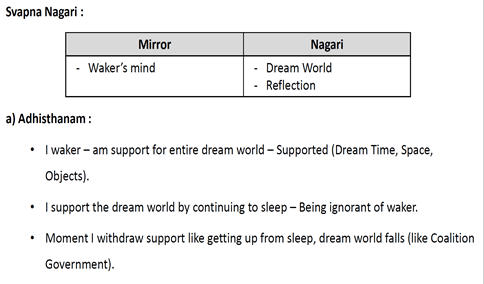
1. Here I-the-waker, am the adhiṣṭānam, support, the basis for the entire dream world. The dream time; the dream space; As long as I support through sleep, the dream world continues, the moment the I the waker withdraws the support, the dream word collapses.
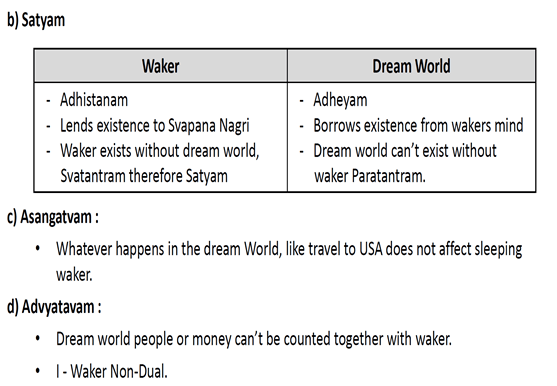
2. I-the waker, lend existence to svapna nagari, which means without me, dream world cannot exist, whereas without the dream world, I can, Thank God, I happily exist.
3. Whatever events happen in the dream world, has nothing to do with waker. In this particular dream case, the waker that is me, did not have a work permit, a visa and even a passport. I reached the airport in no time, flew to London in no time, everything was done with no time and space constraints at all.. In short, I the waker is asaṃgah, the dream event does not touch me at all.
4. The dream object and people; how many? OR whatever be their number, none of them can be counted, the only countable one is waker, and therefore, the people in dream are as good as non-existent. The Queen, the HMS Authorities, the Staff everyone are all non existent and therefore I am advayaha, I-the waker.
Here is a pictorial representation of the dream’s features
Waking up from a dream:
Let us take an example to understand the process of waking up from a dream. In a dark room, a rope is (wrongly) perceived as snake. Reacting to this snake, either one is afraid of it and tries to run away from it or one tries to catch it to earn something out of it. The game (reaction) of ‘run-and-chase’ continues as long as snake is perceived. The reason for this behaviour is our ignorance i.e. absence of the knowledge of truth. When we switch on the light, snake simply disappears and rope manifests itself without any effort on our part. Snake simply vanishes leaving no trace of itself. Snake was superimposed on Rope. Wrong perception made it look real. Snake ‘veiled’ the rope. Snake was real only until darkness prevailed. Now let us get back to the dream!
The dream world is inside me and it is unreal (mithya) but the dream world appears to be outside me, and real, when I am asleep (nidrāḥ). In other words, sleep (nidrāḥ) makes the inside-dream-world, outside and not only that,it makes the unreal-dream-world look as though real. To put it in a technical manner, my sleep state is not aware of my Waker nature which essentially means that Waker-ignorance is sleep (nidrāḥ). More technically, waker is adhiṣṭānam and therefore adhiṣṭāna-ignorance is nidrāḥ. Or still more technically, Waker-aadhiṣṭāna ajnānam eva nidra iti ucyate. When I am asleep, when I have adhiṣṭāna-ajnanam, the inside-dream appears outside and false-dream appears real.
When sleep (nidrāḥ) goes away i.e., at prabodha samaya (prabhoda is waking, samaya means at that time) I am aware of my waker status. So waking up is nothing but waker-knowledge. Prabhodha is nothing but adhiṣṭāna jnānam. And when I am aware of myself as the waker, when I have adhiṣṭāna jnānam, the outside dream is no more outside, and, the real dream is no more real; it is falsified.
In the same way, this world is experienced as separate object due to veiling power of māyā. Once this veil, the root cause of ignorance is removed, Self, the Brahman, shines by itself. This world is true only until the truth is veiled. The world talked here is better understood if we take it as ‘mental world’ or ‘Jīva shṛṣṭi’.
With the two examples of Mirror & Dream in these two introductory blogs,let us digest these learnings and proceed to the Sloka in the next blog.
It has been a month since I commenced my journey in search of myself by trying to understand Dakshinamurthy Stothram. Someone told me en route, “If you are searching yourselves, then why don’t you look at the mirror ? simple; why do you undertake arduous journeys?” Very valid question. Infact, this is what all of us do daily either in our dressing room or in the bathroom.
Well, that is exactly what I have been doing so long and so foolishly. Every time I see myself in the mirror, I think that I am the smartest guy around, trying to be one of the specially initiated in the field of Vedanta. Hardly did I realise that all I do is nothing but dreaming and I am the one who wanders in the region of the many and variable.
Mirror and its features: Talking about Mirrors, look at this building, the Museum of Contemporary Arts at Cleveland, Ohio, USA.
MOCA, Cleveland, Ohio
What an impressive architecture! I can see the whole street, the traffic, the buildings etc in the mirror – in other words, the “दर्पण नगरि Darpana Nagari” (Darpana – Mirror; Nagari – City/Street) as we call in Sanskrit. Let us keep looking at it a bit more and contemplate as to what we see. We could see four distinct features. They are
1. The Mirror is the base and supports (अधिष्टानं adhiṣṭānam) the reflected street. The relationship between the mirror and the reflected street is one of supporter-supported relationship (अधिष्टान आदेय स्म्बन्धः adhiṣṭāna-ādeya-sambandhaḥ).
2. Then the second feature is that the reflected street does not have an existence of its own, even though it is experienced by me. I experience the street, the cars that move, the buildings and everything . But all of them are surreal. They all are borrowed from the mirror. And therefore the reflected street has borrowed existence; whereas the mirror has got its own existence (i.e., whether the reflection is there or not, mirror exists), the reflection cannot exist without the mirror. Therefore, the mirror is having independent existence (सत्यम् sathyam) , whereas reflection is having dependent existence (मित्यम् mithyam).
3. Whatever events that happen in the reflected street, will not affect the mirror. If there is a car accident that is reflected, it does not crack the mirror. If it is a water spill on the road that is reflected, it does not wet the mirror. Therefore mirror is असंगत्त्वम् asaṃgattvam. This “unaffectedness” of the mirror is the third feature of the mirror.
4. Since the reflected objects are having dependent existence (mithya) i.e., having no existence of their own, they are as good as non-existent. This means they cannot be counted along with the mirror; they are uncountable and therefore what is countable is only one; even though there are hundreds of reflected objects, thousand reflected objects; none of them can add up to the mirror. And therefore this non-duality अद्वैयत्वं (advaiyatvam) is the fourth feature.of the mirror.
Here are the pictorial representations of the features of the Mirror.
Never ever in my life so far (until I started studying the Dakshinamurthy Sthothram), did I bother to focus on the philosophical features of a mirror and it is a new learning.
Talking about this new learning, never did I realize too, that these four features are very much applicable to my dreams too. Let us see the “Dreaming” process in this perspective in my next blog which will be a week later.
It is an oft-quoted saying that philosophy begins in wonder. The mystery of the Universe with all its changes strikes the reflective temper of human beings. Through this reflective temper, human beings constantly question their experiences. The Vedic philosophy grew out of a demand for the explanation of actual experiences of an individual.
One of the fundamental laws of Vedanta is “ I am different from whatever I experience”. In general, this whole world that I experience therefore, comes under the Category – “The experienced” or in other words “The object” and I come under the category “The experiencer” or “The subject”.
Now, start the reflective temper by dismissing the object and the subject only remains. In this world I interact with persons and I clearly say that “I am not like this person; I am not like these group of persons; I am not this animal; I am not this; I am not that, I won’t be like that, I am different etc.”….and the list goes on. This way you go on dismissing everything that you experience as an object different from you and finally dismissing the world itself as an object. This is the first level of reflection. The next level is to look at yourselves, since you ruled out the world.
I am not the world that I experience ; but then who am I ? To my limited knowledge, there cannot be any other question other than this simple question which evoked such a vast, deep and wide analysis of the individual experiences by the Saints & Philosophers of Hinduism/Sanatana Dharma. One lifetime to understand the material available may not be adequate. Yet from this ocean of information and knowledge I will venture out and reproduce what is quoted in the basic source book on Vedanta “Tattva Bodha”.
‘I’ (addressed as Atma) am the one who is distinctly different from the gross, subtle and causal bodies; who is beyond the five layers (kośas); who abides as the self-evident witness to the three states of experience (of the nature of existence/awake-awareness/dream-fullness/deep sleep).
Vedanta identifies the features of a human body-mind-intellect complex with three types of bodies, 5 types of sheaths/layers, 5 sense organs 5 action organs , the mind the intellect and the three states of the consciousness (viz, wake, dream and deep sleep). This means that the “Atma (“I”) ” is beyond all these 21 seamlessly integrated features of body-mind-intellect complex.
“I” am not the world; “I” am not the body, “I” am not the mind/intellect. If “I” am different from all these three; then “I” must be a conscious principle, because I am experiencing them.
Thus the entire object or anātmā consists of three factors, the world, the body and the mind; and “I”, the ātmā, the observer consists of the consciousness principle called chaitanyam. This is the fundamental concept that we are trying to grapple with in Vedanta
At this stage I am again reminded of this excellent poem “Master Piece” by “Author Anonymous” which I posted in my blog on June 12, 2020 (Masterpiece – Prabhu’s Ponder (prabhusponder.com)). It simply moved me – what deep understanding of the subject and what an expression! The author wanted to remain Anonymous and clearly stated that “spirituality decreases when it is attributed to a person. I was but a scribe.”
This master piece is what “I” am and can only be experienced rather than be defined.
Now in the first Sloka, the subject matter is: What is the relationship between I, the consciousness principle, and the entire universe; the inert matter. What is the relationship between I the ātmā, the consciousness principle, and the world, the inert principle called anātmā.
So अत्म–अनात्मसम्भन्दः atma-anātma sambhandaḥ “ஆன்மாவும்அண்டமும்” “Jivatma and the Jagat” is the subject matter of the first verse; and Sankaracharya beautifully explains this with the help of two examples of mirror and dream, about which we will see in the coming blogs.
CAUTION 1:
Throughout the blogs, you will see fair mix of words in Sanskrit and Tamil. Wherever possible, I will try to use the transliterated/ words with verbatim letters in English for easy understanding based on my elementary knowledge.
CAUTION 2
As each Sloka brings out the essence of Vedanta, it is necessary that some basic concepts of the Vedanta is discussed first before dwelling into the Sloka. As such there will be introductory blogs which will cover the concepts before taking up the Sloka and its meaning. With my limited understanding I will try and make these conceptual blogs simple through day to day examples. If you find them too elementary, please bear with my ignorance. It will turn out that we may need a minimum of 4-5 blogs to cover each Sloka. Get ready for a long haul.
The Panchakshara (पञ्चाक्षर) literally means “five letters” in Sanskrit and refers to the five holy letters Na, Ma, Śi, Vā and Ya. This is prayer to Lord Siva and is associated with Siva’s Mantra , OM Namah Sivaya of which is also called the Panchakshari Mantra.
Here is a translation in Tamil of the epic Sthothram by Adi Sankaracharya
Today is the first day of the New Year for Tamils who follow the solar calendar. Festival means plenty of food to eat and enjoy apart from prayers and rituals. Vegetarians in India have no issues. What about our clans in the Western World ?
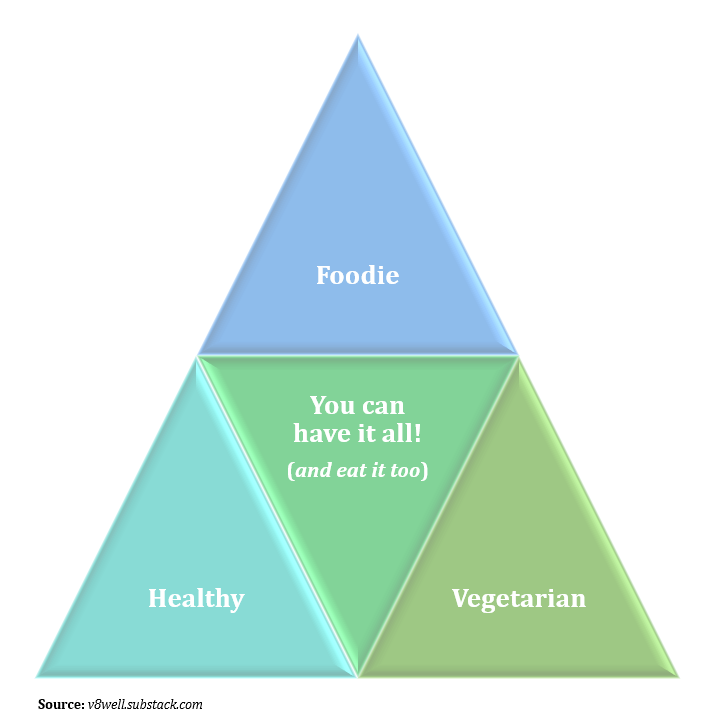
Veggies face the culinary trilemma of being vegetarian, trying to eat healthy and being a foodie.
Some common modern-day myths
Being a vegetarian makes you healthy. Yes, we are practically immortal at this point!
A vegetarian cannot be a foodie. Given we are limited to tofu and eggplant parmesan.
A foodie by definition, cannot eat healthy. See above.
This Substack is an attempt to conquer the impossible trinity of vegetarianism. Please do visit for receipes.
As I wrote last week, I have commenced my journey in understanding myself. Nothing works without a prayer and I am a strong believer in that life style. So, I will start with a prayer on who else except the one and only Lord Arunachala at Thiruvannamalai who through Bhagwan Ramana Maharishi kindled the enquiry “WHO AM I?” in millions of people in the Universe, me being the latest ignorant one , the “jada jana”. This will be a composition by Sri Muthuswamy Dikshithar. The blog will appear under Carnatic Musing in the Menu on 9th April 2021
An introduction to Dakshinamurthy will be presented in the blog that follows on 16th April. I am deeply obliged to Mr. Sreenivasa Rao for kindly permitting me to use his blogs where he has covered the subject in it’s entirety
This will be followed by a blog on the Dhyana Slokas (துதிப்பாடல்கள்) that will be published on 24th April 2021 coinciding with the Divine Wedding of Goddess Meenakshi with Lord Sundareshwarar at the Meenakshi Temple at Madurai, Tamil Nadu.
After that I plan to take time for each of the Slokas as I am a learner. These blogs will be longer than usual, as these will include apart from the translation in Tamil, excerpts from the various commentaries that I tried to read for my understanding. The first Sloka is planned in the month of May
The essence of Spring time rising viewed from the 25th floor of Upper East of Manhattan with iPhoneX accompanied by the soft music by my grandchildren. What else do one need to brighten up the day?
As a kid nearly 60 years back, Visalakshi Ammman Kovil (Temple is more than 300 years old ) in Batlagundu (Vattlagundu), situated in Nilkottai Taluk of in Dindigul District in Tamilnadu, on the bank of HARIDHRA RIVER (MANJALARU – no idea if the river exists today!) was the only place which I used to go regularly for prayers, not because I understood what a prayer is and the need for one; but that used to be the mandate those days for boys at the “Agraharam (an ungated community!)” from the family. Visalakshi Amman & Lord Visvesvarar are the principal deities and the temple included several Deities such as Ganesha, Subramanya, Chandikeshwarar, Dakṣiṇāmurty etc. For each of the Gods, we used to recite a specific Sloka and when it came to Dakṣiṇāmurty, we used to recite as a routine. Here is a short video of the temple (Photo Courtesy – My friend Muthunarayanan alias Muthappa)
I did not know anything about either God or the Sloka except that I had to recite it at that particular spot where Lord Dakṣiṇāmurty was situated. All I knew was that He was a form of Siva. Never in my life subsequent to that period and even in my dreams did I imagine once, that one day I will be writing about the Sthothram on Lord Dakṣiṇāmurty by Adi Śankarācārya. Blessed I am indeed to even think of consolidating what is written and explained by legends and doyens of Spirituality and Vedāntaḥ.
But strange is the nature and power of “the Ultimate Reality”. Study of Vedāntaḥ and listening to Spirituality oriented Discourses is the most familiar route for spending time after retirement for most of us and I am no exception to this. One such lecture by Prof. Mahadevan of IIM, Bangalore was the spark I needed to dive into the Ocean of Vedāntaḥ Concepts brought out in Dakṣiṇāmurty Stotram. Realizing that I am getting old and spending time on spirituality, my son presented me with a book titled “The Upanishads” by Sri. Eknath Easwaran. This added fuel to the fire. As I was exploring these two topics, I learnt that I can’t do either if I don’t know Tattva Bodha. Now this is the third dimension to my time management. My preoccupation with these three books and commentaries by Swami Paramarthananda, Swami Omkaranada and Swami Sravapriyananda drove my grandchildren (my daughter’s young boys) to the conclusion that their “Thatha” (grandfather) who used to spend lot of time playing cricket and organizing/fixing the place rendered as a “mess” by them is not doing it anymore and is lost. They even declared my room as “Thatha’s Corner “– The lost and found room. The fact is that as a “Thatha” I am lost; but I am trying to find out as to who I am instead of where I am.
How can I find out the answer to the question “Who am I”? The legendary Tamil Saint Thirumoolar comes to my rescue in his epic Thirumandiram
“நரருஞ் சுரரும் பசுபாசம் நண்ணிக்
கருமங்க ளாலே கழித்தலிற் கண்டு
குருஎன் பவன்ஞானி கோதில னானால்
பரமென்ற லன்றிப் பகர்வொன்று மின்றே”.
மனிதர்களும்,தேவர்களும் பாசத்தில் அகப்பட்டு பல்வேறு வினைகளைச் செய்து அதனால் அழிந்து போகின்றனர். இதைக் கண்ட பின்பு ஒருவன் செய்ய வேண்டியது என்ன? ஒரு குற்றமற்ற ஞானியைத் தன் குருவாகப் பற்றிக் கொண்டாலே போதும். “பரத்துடன் கூடி நீயும் பரம் ஆவாய்” என்று உபதேசம் செய்வதன்றி அந்த குரு செய்ய வேண்டியது எதுவும் இல்லை.
As mortals like me, get trapped by “attachment” and perform actions which lead us nowhere, one has to look for a Guru who will make him understand that “You are That”. Fine; I need a Guru. How do I look for Guru at this Old age? Thirumoolar gives a response to my query.
“ஆட்கொண்ட வர்தனி நாயகன் அன்புற
மேற்கொண்ட வர்வினை போயற நாடொறும்
நிற்கின்ற செஞ்சடை நீளன் உருவத்தின்
மேற்கொண்ட வாறலை வீவித் துளானே”.
ஒரு குருவாக வந்து மாணவனை ஆட்கொள்பவர் ஒப்பற்ற ஈசனே ஆவார். அவர் தன் மாணவனின் வினைகள் அழியும் வண்ணம் நாள்தோறும் உபதேசிக்கிறார். அவர் நீர்மலிந்த நீள் சடையை உடைய சிவனே அன்றி வேறு எவரும் அல்ல. சிவனே மனம் இரங்கியும் கீழே இறங்கியும் வந்து மாணவனின் வருத்துகின்ற வல்வினைகளை அழித்து விடுகின்றார்.
Thirumoolar further states Lord Siva Himself comes in the form of a Guru to help us understand ourselves. It is with this confidence, that I am undertaking this journey, with Lord Dakṣiṇāmurty as my Guru and Adi Śankarācārya’ Stotramon on the Lord as the first leg of my journey.
To be honest, nothing that I will be writing in the months to come is mine, except the attempt to focus my understanding and in that process try to express the Sanskrit Slokas in my mother tongue – Tamil; it is only my limited understanding of the vast literature available in public domain. The purpose of documenting my understanding is with the hope that someday someone as ignorant as me (hopefully not when they become “the lost Thatha”), will take baby steps as a novice like me, into this delightful field of spirituality holding this piece of document as the helping hand. If that happens, that will be the biggest gift that I would be automatically passing on (without holding back) to all the people in the public domain whose works I have used extensively. There is no commercial interest whatsoever.
A word of caution here – Millions of pages have been written over centuries by “Subject” – “Matter” – Specialists to provide commentaries for the Slokas in these books. Summing them up into few lines is absolutely immature and childish; yet as a child I have started my baby steps on Vedāntaḥ. Pardon me for that. But Children have the right to enquire and ask questions. The child I am, I am asking questions to myself with the fond hope that someday I will find answers as to who I am.
Seeking your Blessings and wishes as I commence my journey. You are most welcome to join me in my journey. Looking forward to your wonderful and valued company. A broad based schedule for April & May will be posted in the next blog.