PRELUDE TO NIRVANA SHATAKAM

Before we start exploring Nirvana Shatakam and look at the answers to the vital question of “ Who am I?”, it is essential for us to understand what am I made of, what do I do and what is beyond me. To my limited knowledge, there cannot be a more deeper analysis to these questions than by the Saints & Philosophers of Hindu Religion. One needs a lifetime to understand the material available in the religion. I will definitely restate again and again that I am a novice in this field of philosophy (“Vedanta”) and can only skim at the surface without any deep understanding. Yet from this ocean of information and knowledge I will venture out and reproduce one approach advocated by the legendary Swami Chinmayananda (http://www.chinmayamission.com) which helps me in the process of understanding myself.

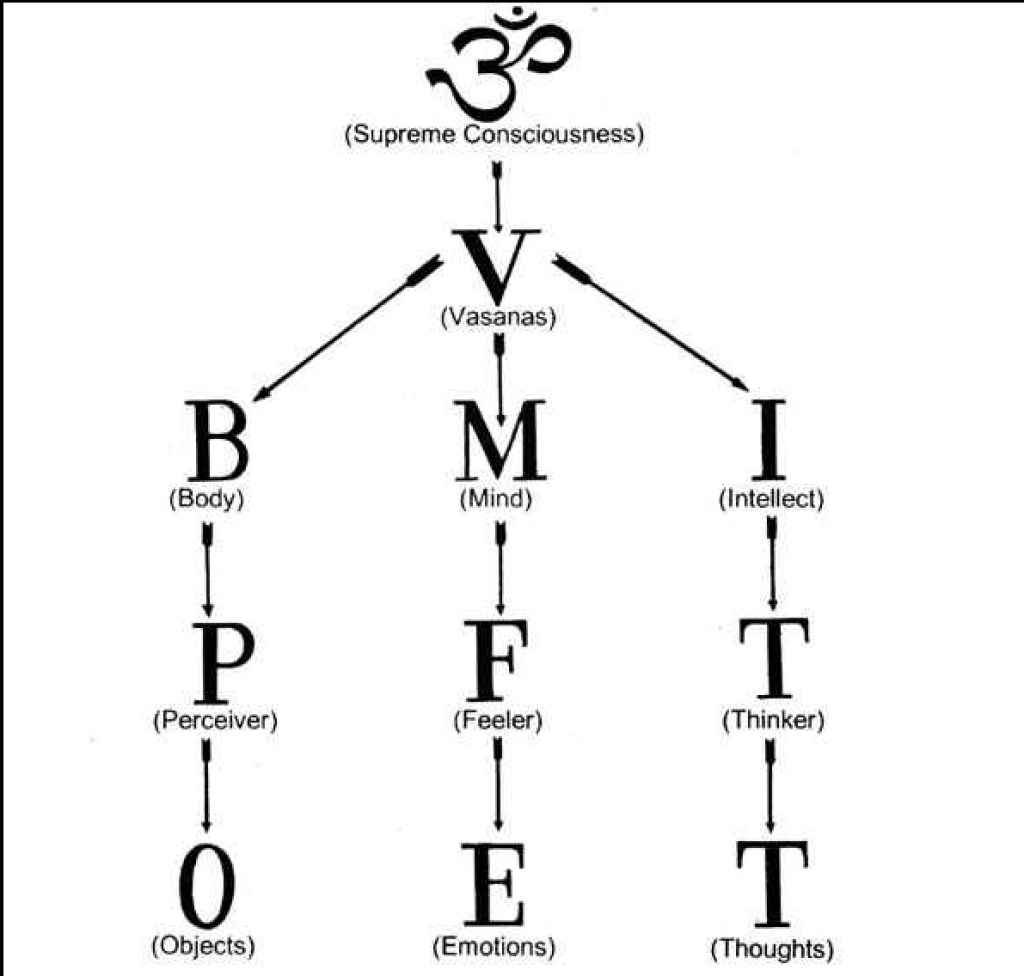
BMI Chart

Interpretation of Symbols :

The Symbol of Truth

Om 

viewed through the veil of

Vasanas 

Expresses through the instruments of:

the Body (B), Mind (M), Intellect (I)

As the individual entity or ego:

the Perceiver (P), Feeler (F), Thinker (T) 

In the world of:

Objects (O), Emotions (E), and Thoughts (T). 

I – The person

Here is how the Swamiji helps us in Understanding Ourselves (Our Personality). When we say “experience” we are looking at three fundamental factors:

1. the experiencer (the subject)

2. the object of experience (the object)

3. the relationship between the two, the experiencing (the act)

The Individual as an experiencer (PFT) is the subject who gains experiences of the world (OET) through the instruments of experiencing (BMI). Through the body, the person experiences the world of objects; through the mind, one experiences the world of emotions, and through the intellect, the world of ideas.

When the subject identifies with the intellect, he becomes the thinker, experiencing the world of thoughts and ideas; when identified with the mind he becomes the feeler, experiencing the world of emotions and feelings; and when identified with the body, he becomes the perceiver, experiencing the world of objects.

Therefore each individual acts out the various roles of a perceiver, feeler, and thinker as he seeks his happiness in the world of objects, emotions, and thoughts.

In every experience in life, man contacts the world through the media of four constituent entities in him. They are his body, mind, intellect, and the Consciousness, symbolized by the symbol Om, which is the Life Principle in him. 

Now let us have an idea of what these elements are as explained by the Swamiji.

Body, Mind, Intellect:

“ The physical body (பிண்டம்) is solid matter, the densest aspect of the human personality. It contains five organs of perception (ஞானேந்திரியம்) and the five organs of action (கர்மேந்திரியம்). The size and shape of the body differ from individual to individual, but the essential ingredients and the functions of the organs are common to all.

The variable factor in man is the mind and intellect equipment. The mind is the seat of impulses and feelings, and it is common to all living creatures. Animals also possess a mind. It all boils down to how one applies the mind.

Human being alone has the capacity to discriminate and analyze his/her feelings as and when they arise. He/She alone can allow his/her actions to be guided and directed by his/her power of discrimination instead of being driven and carried away by momentary impulses and feelings. This faculty of discrimination, this power of judgment, this capacity to discern what is to be done and what is to be avoided, is the function of the intellect.

Vasanas:

The quality and textures of the mind and intellect equipment differ from one individual to another, depending upon one’s inherent and innate tendencies or inclinations, which are called vasanas.

Vasanas create desires in the intellect; desires produce thoughts in the mind, and thoughts manifest in the form of actions at the level of the physical body. Desires, thoughts and actions are, therefore, only manifestation of vasanas in the respective individual. Each one of us thus becomes a helpless statement of our past though this impulse of vasanas.

(Note: How did we get these Vasanas in oneself? This is a separate subject by itself. For this particular blog I would just compare Vasanas to the Residual Magnetism in a material.)

Om, the Symbol of Truth:

In the ultimate analysis, the whole aim of living for a human being is to condition the body, mind and intellect to ensure that the vasanas are transcended in order for us to regain our true nature. At this individual level, when the vasanas are completely transcended, the Self manifests of its own accord. Only then does man know his true birthright. At the Individual level, this Self is called an Atman and at the level of the cosmic totality, this Divine Self called Om, the Life Principle, is called the Brahman.

The Ground Reality:

Due to our vasanas and the consequent desires, agitations, and actions, we are ignorant of this Divine Self. Therefore, we identify with our body, mind, and intellect and their limitations. An individual is the Self as though contaminated by this ignorance. The only method for regaining one’s true nature is to vigilantly and ceaselessly divert one’s mind and intellect away from preoccupation with objects, emotions, and thoughts and direct it to an awareness of the divine Self”. (Material Courtesy – Chinmaya Mission).

How do I proceed?

This is the essence of Spirituality. The paths that we take to get rid of this ignorance are the path of knowledge (Gnana) , the path of devotion (Bhakthi) and the path of action (Karma). These three paths are not independent and are seamlessly integrated. At this point I will quote the blog I wrote on May 17, 2019, about Knowledge and Devotion as part of my attempt to write in Tamil, Adi Sankara’s Sivananda Lahari. In that blog I quoted the eminent Indian Scholar C. Rajagopalachari. He brings out the integration of the three yogas beautifully by saying “ When intelligence matures and lodges securely in the mind, it becomes wisdom. When wisdom is integrated with life and issues out in action, it becomes bhakti. Knowledge, when it becomes fully mature, is bhakti. If it does not get transformed into bhakti, such knowledge is useless tinsel. To believe that gnyaana and bhakti, knowledge and devotion, are different from each other, is ignorance”.

Nearly a year later I am fortunate to attempt to write in Tamil, the philosophical treatise in Vedhanta by Adi Sankara called Nirvana Shatakam. Understanding the simple concepts outlined by the Swamiji will help us unravel the truths brought out by Adi Sankara

Verses will start from the next blog.

WHO AM I ?

Remember the two vital questions which I missed while I was “role playing” during the Corana Virus! Who am “I”? What do I mean when I use the word “Happy”?

There are numerous ways by which one can explain “happiness” – the state of being happy. I was looking for an apt definition for happiness. Pop! Came the answer from Twitter. Here is the link

Here is my interpretation. Modern psychology brings out the science behind “happiness”. As an “experiencer”, I look at “being happy” in a different perspective. When I am in deep sleep without any application whatsoever of my mind and sense organs, I am in a state unaffected by anything – “It is a Bliss” – indicating how happy I am when I am sleeping without any miseries. That is what I mean by the word “happy”. That kind of happiness is what I want in every second of my life. Am I the only one desiring like that? The lady there in Anand Mahindra’s tweet brings out exactly what is happiness. It depends on oneself (attitude of myself decides what is happiness). So who is myself or who am I?

This question however is a complex one. The self inquiry in the question has one challenge. Am I splitting myself as inner and outer Self? Dr S Radhakrishnan, a great philosopher and the former President of India, says “To divide human being into outer desire and inner quality is to violate the integrity of human life. The two orders of Reality – the transcendental the empirical are closely related”. If I agree with this argument, then, who am I ?

I don’t have an answer ready made. The real answer cannot be provided either by a theory or by dialectic. These alone, as in themselves and without reference to personal experience cannot carry conviction. But I am still in the process of experiencing the answer (otherwise called as my life) and won’t be able to answer till my experiences (life) end.

Luckily, the experiences elucidated by legendary philosophers and thinkers are available for me. Their teachings are presented either as metaphysics or ethics. In the traditional Hindu system this is called “Brahmavidya” and “Yogashastra”. The universally acclaimed classic Indian treatise “Bhagwad Gita” is a combination of both – the science of Reality and the art of Union with Reality.

In India, there are two outstanding treatises, considered equivalent to The Divine Response available for the vital question “Who am I?”. The answer to my question was provided as early as in 8th Century by Adi Shankaracharya. He brought out the “Brahmavidya” to the question “Who am I?” through a hymn in Sanskrit comprising six verses – “Atma Shatakam or Nirvana Shatakam”. The word shatakam means six and the word nirvana means freedom or liberation. It is thus a hymn of six verses on liberation, each of which is like a jewel in the garland of Vedanta. It is also called as atma shatakam or six verses on the nature of the Self. The first three lines in each of the first five verses negate all that is not “I”(Atman), while the last line in each verse strongly affirms what “I”(Atman) is.

In the year 1902, in a town called Thiruvannamalai, Tamil Nadu, Bhagwan Shri Ramana Maharishi provided answers to one Sri M. Sivaprakasam Pillai, a graduate in Philosophy, who was at the time employed in the Revenue Department of the South Arcot Collectorate. This was published in 1923. The teachings of Bhagwan Shri Ramana Maharishi is published by SriRamanasramam in Thiruvannamalai as “Who am I”.

My next series of blogs will focus on Adi Shankaracharya’s Nirvana Shatakam/Atma Shatakam.

Ganesha Pancharathnamala – Verse 5

नितान्तकान्तदन्तकान्तिमन्तकान्तकात्मजं

अचिन्त्यरूपमन्तहीनमन्तरायकृन्तनम्

हृदन्तरे निरन्तरं वसन्तमेव योगिनां

तमेकदन्तमेव तं विचिन्तयामि सन्ततम् ॥५॥

Nitaanta-Kaanta-Danta-Kaantim-Antaka-Antaka-[A]atmajam

Acintya-Ruupam-Anta-Hiinam-Antaraaya-Krntanam |

Hrd-Antare Nirantaram Vasantam-Eva Yoginaam

Tam-Eka-Dantam-Eva Tam Vicintayaami Santatam ||5||

Meaning of the Sanskrit Words

नितान्तकान्तदन्तकान्तिमन्तकान्तकात्मजं (Nitaanta-Kaanta-Danta-Kaantim-Antaka-Antaka-Aatmajam): Who is Very Dear to Devotees as Beautiful Ekadanta and Who is the Son of One Who Restrained Yama

नितान्त (Nitaanta) = Extraordinary, Excessive, Considerable, Very Much

कान्त (Kaanta) = Desired, Loved, Dear

दन्त (Danta) = signifying Ekadanta [another name of Sri Ganesha]

कान्ति (Kaanti) = Loveliness, Beauty, Splendour

अन्तक (Antaka) = Yama

अन्तक (Antaka) = Putting an End, Causing Death

आत्मज (Aatmaja) = Born from, a Son, self-originated

अचिन्त्यरूपमन्तहीनमन्तरायकृन्तनम् (Acintya-Ruupam-Antahiinam-Antaraaya-Krntanam): Whose Form is Inconceivable and without any Limit and which Cuts through the Obstacles [of Devotees]

अचिन्त्य (Acintya) = Inconceivable, Surpassing thought

रूप (Ruupa) = Form, Appearance

अन्त (Anta) = End, Limit, Boundary

हीन (Hiina) = Left, Abandoned, Bereft or Deprived of, Low, Vile

अन्तराय (Antaraaya) = Intervention, Obstacle

कृन्तन (Krntana) = Cutting of, Dividing

हृदन्तरे (Hrd-Antare): Within the Cave of the Heart

हृद् (Hrd) = Heart

अन्तर (Antara) = Interior of anything

निरन्तरं (Nirantaram): Having no Interval, Uninterrupted, Perpetual, Continually

वसन्तमेव (Vasantam-Eva): Abides in this manner

वस (Vasa) = Dwelling, Residence

एव (Eva) = Exactly so, in this Manner, Indeed, Truly

योगिनां (Yoginaam): Yogis

योगिन् (Yogin) = Yogi, Ascetic, contemplative Saint

तमेकदन्तमेव (Tam-Eka-Dantam-Eva): [I Reflect upon] Him, the Ekadanta

तम् (Tam) = His

एक (Eka) = One

दन्त (Danta) = an Elephant’s Tusk, Ivory

एव (Eva) = Exactly so, in this Manner, Indeed, Truly

विचिन्तयामि (Vicintayaami): I Reflect upon

विचिन्त् (Vicint) = to Think of, Reflect upon, to Perceive, Discern, Observe

सन्ततम् (Santatam): Stretch or Extended along, Woven together, Continuous, Uninterrupted

Meaning of the Verse

5.1: (Salutations to Sri Vinayaka) Whose Beautiful Form of Ekadanta is very much Dear to His Devotees, and Who is the Son of the One (referring to Lord Shiva) Who Put an End to (i.e. restrained) Antaka (i.e. Yama).

5.2: Whose essential Form is Inconceivable and without any Limit, and which Cuts through the Obstacles of His Devotees,

5.3: Who Continually Abides in the Cave of the Heart of the Yogis.

5.4: I Continually Reflect upon Him, the Ekadanta (another name of Sri Vinayaka).

Meaning in Tamil

ஒற்றைத்தந்த அழகுடனே அடியோரின் மன நிறையோனே

காலனவன் அடிபணியும் இறையோனின் முதற்புதல்வோனே

கருதுதற்கியலா வடிவுடனே எல்லையில்லா நிறைவோனே

அடியோரின் இடரதனை அடியோடு களைத்திடுவோனே

ஞானியரின் இதயச்சுரங்கமதில் நிலையாக உறைவோனே

ஒற்றைத்தந்த உருவமதை இடையின்றி நினைத்திடுவேனே

Ganesha Pancharathnamala – Verse 4

अकिंचनार्तिमार्जनं चिरन्तनोक्तिभाजनं

पुरारिपूर्वनन्दनं सुरारिगर्वचर्वणम्

प्रपञ्चनाशभीषणं धनंजयादिभूषणम्

कपोलदानवारणं भजे पुराणवारणम् ॥४॥

Akincana-[A]arti-Maarjanam Cirantano[a-U]kti-Bhaajanam

Pura-Ari-Puurva-Nandanam Sura-Ari-Garva-Carvannam |

Prapan.ca-Naasha-Bhiissannam Dhananjaya-[A]adi-Bhuussannam

Kapola-Daana-Vaarannam Bhaje Puraanna-Vaarannam ||4||

Meaning of the Sanskrit Words

अकिंचनार्तिमार्जनं (Akincana-Aarti-Maarjanam): Who Wipes out the Sufferings of the Destitutes

अकिञ्चन (Akin.cana) = Without Anything, Utterly Destitute, Disinterested, Worth Nothing

आर्ति (Aarti) = Pain, Injury, Mischief, Sickness

मार्जन (Maarjana) = Wiping away, Cleaning, Broom, Brush

चिरन्तनोक्तिभाजनं (Cirantana-Ukti-Bhaajanam): Who is the Receptacle of the Words of Praise of Ancients

चिरन्तन (Cirantana) = Existing from Ancient Times

उक्ति (Ukti) = Speech, Proclamation, Word, Expression

भाजन (Bhaajana) = Sharing, Participating in, Entitled to, a Recipient, Receptacle, a Vessel, Pot

पुरारिपूर्वनन्दनं (Pura-Ari-Puurva-Nandanam): Who is the Former Son of the Enemy of the Tripurasuras

पुर (Pura) = a Fortress, Castle, City, House, Tripurasura

अरि (Ari) = an Enemy, a Devoted or Pious Man

पुर्व (Purva) = Former, Before, Prior, Preceding

नन्दन (Nandana) = a Son, Gladdening, Rejoicing

सुरारिगर्वचर्वणम् (Sura-Ari-Garva-Carvannam): Who Chews down the Pride and Arrogance of the Enemies of the Devas

सुर (Sura) = Deva, God, Divinity

अरि (Ari) = an Enemy, a Devoted or Pious Man

गर्व (Garva) = Pride, Arrogance

चर्वण (Carvanna) = Chewing, Tasting, Solid Food

प्रपञ्चनाशभीषणं (Prapan.ca-Naasha-Bhiissannam): Who assumes Terrible Form to Destroy the Delusion of the World

प्रपञ्च (Prapan.ca) = Expansion, Manifoldness, Diversity, Expansion of the Universe, the Visible World

नाश (Naasha) = Destruction, Annihilation

भीषण (Bhiissanna) = Terrifying, Frightening, Formidable

धनंजयादिभूषणम् (Dhananjaya-Aadi-Bhuussannam): Who Himself is Adorned with Poers like that of Fire etc

धनंजय (Dhanamjaya) = Fire

आदि (Aadi) = Beginning with, Etc, and so on, and Others

भूषण (Bhuussanna) = Adorned, Decorated

कपोलदानवारणं (Kapola-Daana-Vaarannam): From Whose Cheeks flow down the Juice of Grace

कपोल (Kapola) = Cheek

दान (Daana) = act of Giving, Gift, Donation, Rut-Fluid

वारुणी (Vaarunnii) = any Spirituous Liquor, of a River

भजे (Bhaje):

भज् (Bhaj) = To Revere, Adore

पुराणवारणम् (Puraanna-Vaarannam): Juice of Praise form the Puranic Scriptures

पुराण (Puraanna) = Ancient, Old, the Puranic Scriptures

वारुणी (Vaarunnii) = any Spirituous Liquor, of a River

Meaning of the Verse

4.1: (Salutations to Sri Vinayaka) Who Wipes out the Sufferings of the Destitutes who take His Refuge; Who is the Receptacle of the Words of Praises of the Ancients,

4.2: Who is the Former Son (the latter being Kartikeya) of the Enemy of Tripurasuras (i.e. Lord Shiva), and Who Chews down the Pride and Arrogance of the Enemies of the Devas,

4.3: Who wields Terrible Power to Destroy the delusion of the Five Elements constituting the World (from the mind of His Devotees); Who Himself is Adorned with the Powers (behind the Five Elements) like Fire etc,

4.4: From Whose Cheeks flow down the Juice of Grace; Salutations to Him Whose Praise similarly flows down like Juice from the Puranas.

Meaning in Tamil

என்றும் எளியோரின் துயர் துடைப்போனே

தொன்று தொட்டு புவியோர் உனைப் புகழ்வோரே

முப்புரமெரி அச்சிவனவனின் முழுமுதல் பாலனே

அசுரர்தம் அகந்தைதனை மென்றழித்தோனே

அச்சுறுத்தும் வலிமையுடன் மாயைதனை அழிப்போனே

அழலுடனே இதர இயற்கைதனின் ஆற்றல்தமை அணிந்தோனே

கருணை பொழிச்சாறு கன்னமதில் கசிந்துவரும் மதமொப்பதன்றோ

மறைகள் அமுதமெனப் பொழிந்திடும் உன் புகழதனை அடிபணிவேனே

Ganesha Pancharathnamala – Verse 3

समस्तलोकशंकरं निरस्तदैत्यकुञ्जरं

दरेतरोदरं वरं वरेभवक्त्रमक्षरम्

कृपाकरं क्षमाकरं मुदाकरं यशस्करं

मनस्करं नमस्कृतां नमस्करोमि भास्वरम् ॥३॥

Samasta-Loka-Shamkaram Nirasta-Daitya-Kun.jaram

Dare[a-I]taro[a-U]daram Varam Varebha-Vaktram-Akssaram |

Krpaa-Karam Kssamaa-Karam Mudaa-Karam Yashas-Karam

Manas-Karam Namas-Krtaam Namas-Karomi Bhaasvaram ||3||

Meaning of the Sanskrit Words

समस्तलोकशंकरं (Samasta-Loka-Shamkaram): Who is the Auspicious Power behind All the Worlds

समस्त (Samasta) = All, Whole, Put Together, Combined, United

लोक (Loka) = World, Men

भाजन (Bhaajana) = Sharing, Participating in, Entitled to, a Recipient, Receptacle, a Vessel, Pot

निरस्तदैत्यकुञ्जरं (Nirasta-Daitya-Kun.jaram): Who Removes the Mighty [inner] Demons

निरस्त (Nirasta) = Cast out, Expelled, Removed, Destroyed

दैत्य (Daitya) = Son of Diti, Demon

कुञ्जर (Kun.jara) = Elephant, anything Pre-eminent, of a Mountain, of a Locality

दरेतरोदरं (Dara-Itara-Udaram): Huge Belly

दर (Dara) = Cleaving, Breaking, the Navel

इतर (Itara) = Expresses contrary idea of preceding word, Low, Vile, Expelled, Rejected

उदर (Udara) = Belly, Stomach, Cavity, Interior of anything

वरं (Varam): Boon, Gift, Valuable, Precious, Most Excellent

वरेभवक्त्रमक्षरम् (Varebha-Vaktram-Akssaram): Whose Most Excellent Face reflects His Imperishable Nature

वर (Vara) = Boon, Gift, Valuable, Precious, Most Excellent

वक्त्र (Vaktra) = the Mouth, Face

अक्षर (Akssara) = Imperishable, Unalterable

कृपाकरं (Krpaa-Karam): Who Showers Grace

कृपा (Krpaa) = Pity, Tenderness, Compassion

कर (Kara) = a Doer, the Hand

क्षमाकरं (Kssamaa-Karam): Who Showers Forgiveness

क्षमा (Kssamaa) = Patience, Forbearance

कर (Kara) = a Doer, the Hand

मुदाकरं (Mudaa-Karam): Who Showers Joy

मुद् (Mud) = To be Merry or Glad or Happy, to Rejoice, to Mix, Blend, Unite

कर (Kara) = a Doer, the Hand

यशस्करं (Yashas-Karam): Who Showers Glory

यशस् (Yashas) = Beauty, Splendour, Honour, Glory, Fame, Renown

कर (Kara) = a Doer, the Hand

मनस्करं (Manas-Karam): Who Bestows Intelligence and Wisdom

मनस् (Manas) = Mind, Intellect, Understanding

कर (Kara) = a Doer, the Hand

नमस्कृतां (Namas-Krtaam): to those who Salute Him

नमस् (Namas) = Bow, Obeisance, Reverential Salutation

कृत (Krta) = Made, Done, Performed

नमस्करोमि (Namas-Karomi): I Salute

नमस् (Namas) = Bow, Obeisance, Reverential Salutation

कर (Kara) = a Doer, the Hand

भास्वरम् (Bhaasvaram): Shining, Brilliant, Bright, Resplendent, the Sun

Meaning of the Verse

3.1: (Salutations to Sri Vinayaka) Who is the Auspicious Power behind All the Worlds and Who Removes the Mighty (inner) Demons,

3.2: Whose Huge Body signifies Prosperity and Boon-Giving and Whose Most Excellent Face reflects His Imperishable Nature.

3.3: Who Showers Grace (Kripakara), Who Showers Forgiveness (Kshamakara), Who Showers Joy (Mudakara) and who Showers Glory (Yashaskara) to His Devotees,

3.4: Who Bestows Intelligence and Wisdom (Manaskara) to those Who Salute Him with Reverence; I Salute His Shining Form.

Meaning in Tamil

உலகெலாம் உய்விக்கும் மங்களம் நிறை சக்தி வடிவோனே

உளமுறை மாசெனும் அரக்கனை அழித்திடும் ஆனைமுகத்தோனே

வெளிவரும் உந்தியுடை வளம்நிறை வயிறுடன் வரம்தருவோனே

மேலான அழகுநிறை முகம் காட்டும் அழிவிலா இயல்போனே

கருணையுடன் பிழை பொறுப்போனே

மகிழ்வுடனே புகழ் அளிக்கும பெரியோனே

துதிப்போர்க்கு கூர்மதி மெய்யறிவு அளியோனே

அடிபணிந்தேன் ஆதவனின் ஒளிபடைத்த உன் வடிவினை

Ganesha Pancharathnamala – Verse 2

नतेतरातिभीकरं नवोदितार्कभास्वरं

नमत्सुरारिनिर्जरं नताधिकापदुद्धरम्

सुरेश्वरं निधीश्वरं गजेश्वरं गणेश्वरं

महेश्वरं तमाश्रये परात्परं निरन्तरम् ॥२॥

Nate[a-I]tara-Ati-Bhiikaram Navo[a-U]dita-Arka-Bhaasvaram

Namat-Sura-Ari-Nir-Jaram Nata-Adhika-Apad-Uddharam |

Sure[a-Ii]shvaram Nidhi-[I]ishvaram Gaje[a-Ii]shvaram Ganne[a-Ii]shvaram

Mahe[a-Ii]shvaram Tama-Ashraye Paraatparam Nir-Antaram ||2||

Meaning of the Sanskrit Words

नतेतरातिभीकरं (Nata-Itara-Ati-Bhiikaram): To those who do not Bow down, He takes a Frightening Form

नत (Nata) = Bent, Bowed, Bowing to, Saluting

इतर (Itara) = Expresses contrary idea of preceding word, Low, Vile, Expelled, Rejected

अति (Ati) = Exceedingly, Very, Passing, Going, Beyond

भीकर (Bhiikara) = Causing Fear

नवोदितार्कभास्वरं (Nava-Udita-Arka-Bhaasvaram): His Form is Shining Fresh like a Newly-Risen Sun

नव (Nava) = New, Fresh, Young

उदित (Udita) = Risen, Ascended, Born, High, Tall, Lofty

अर्क (Arka) = the Sun, a Ray

भास्वर (Bhaasvara) = Shining, Brilliant, Bright, Resplendent, the Sun

नमत्सुरारिनिर्जरं (Namat-Sura-Ari-Nir-Jaram): Who is without Decay and is Saluted by Devas and Devoted Persons

नमस् (Namas) = Bow, Obeisance, Reverential Salutation

सुर (Sura) = Deva, God, Divinity

अरि (Ari) = an Enemy, a Devoted or Pious Man

निस् (Nis) = Free from

जर (Jara) = Becoming Old, Wearing, Wasting

नताधिकापदुद्धरम् (Nata-Adhika-Apad-Uddharam): To those Who Surrender, He Extricates them from Difficult Calamities

नत (Nata) = Bent, Bowed, Bowing to, Saluting

अधिक (Adhika) = Additional, Surpassing, Abundant, Surplus

आपद् (Aapad) = Misfortune, Calamity, Distress

उद्धरण (Uddharanna) = Drawing out, Extricating, Rescuing, Delivering

सुरेश्वरं (Sura-Iishvaram): Who is the God of the Devas

सुर (Sura) = Deva, God, Divinity

ईश्वर (Iishvara) = Master, Lord, the Supreme

निधीश्वरं (Nidhi-Iishvaram): Who is the God of Prosperity

निधि (Nidhi) = a Place for Deposits, Store, Treasure, Sea, Setting down or Serving up

ईश्वर (Iishvara) = Master, Lord, the Supreme

गजेश्वरं (Gaja-Iishvaram): Who is the God with Elephant Face

गज (Gaja) = Elephant, Gajasura

ईश्वर (Iishvara) = Master, Lord, the Supreme

गणेश्वरं (Ganna-Iishvaram): Who is the God of the Ganas [celestial attendants]

गण (Ganna) = a Flock, Troop, Multitude, body of Followers or Attendants

ईश्वर (Iishvara) = Master, Lord, the Supreme

महेश्वरं (Maha-Iishvaram): Who is the Great God

महा (Mahaa) = Great, Large, Extensive, Abundant, Numerous, Considerable

ईश्वर (Iishvara) = Master, Lord, the Supreme

तमाश्रये (Tama-Aashraye): To His Refuge

तम् (Tam) = His

आश्रय (Aashraya) = Refuge, Shelter, Dwelling, Protecting, Assistance

परात्परं (Paraatparam): Superior to the Best

निरन्तरम् (Nirantaram): Having no Interval, Uninterrupted, Perpetual, Continually

Meaning of the Verse

2.1: (Salutations to Sri Vinayaka) To those who do not Bow down to God out of arrogance, He takes a Frightening form; His benign however form is like a Newly-Risen Sun,

2.2: Who is always Fresh without any Decay, and is Saluted Reverentially by the Devas and the Devoted Persons; Who Extricates those who Surrender to Him from Difficult Calamities,

2.3: Who is the God of the Devas (Sureshvara), Who is the God of Prosperity (Nidhishvara), Who is the God with an Elephant Face (Gajeshvara) and Who is the God of the Ganas (celestial attendants) (Ganeshvara),

2.4: Who is the Great God (Maheshvara); To His Refuge, Who is Superior than the Best, I Continually place myself in devotional surrender.

Meaning in Tamil

இறுமாப்புடை கொடியோர்க்கு அச்சமிகு உருவோனே

புதுப்பொலிவுடை இளஞ்சூரிய அருளுடை வடிவோனே

விண்ணவரும் திடப்பற்றோரும் தொழுதிடும் அழிவிலானே

உனதடி பற்றும் பக்தர்தம் பெரும் இடர் களைவோனே

விண்ணவர் தலையோனே பொன்வளமைக்கு வித்தோனே

வேழமுகத்தோனேவிண்சூழ்வாழ்இனத்தோரின் கோமானே

இறையோனின் பெருமகனே தலையோருள் தலையானே

நிலைபேறென தஞ்சமென்றடைந்தேன் சித்தி விநாயகனே

Ganesha Pancharathnamala – Verse 1

मुदाकरात्तमोदकं सदा विमुक्तिसाधकं

कलाधरावतंसकं विलासिलोकरक्षकम्

अनायकैकनायकं विनाशितेभदैत्यकं

नताशुभाशुनाशकं नमामि तं विनायकम् ॥१॥

Mudaa-Karaatta-Modakam Sadaa Vimukti-Saadhakam

Kalaa-Dhara-Avatamsakam Vilaasi-Loka-Rakssakam |

Anaayakai[a-E]ka-Naayakam Vinaashitebha-Daityakam

Nata-Ashubha-Ashu-Naashakam Namaami Vinaayakam ||1||

Meaning of the Sanskrit Words

मुदाकरात्तमोदकं (Mudaa-Karaatta-Modakam): Who Holds the Divine Joy in His Hand as Modaka

मुद् (Mud) = To be Merry or Glad or Happy, to Rejoice

कर (Kara) = a Doer, the Hand

मोदक (Modaka) = a small round Sweetmeat, any Sweetmeat, Gladdening, Exhilarating

सदा (Sadaa): Always

विमुक्तिसाधकं (Vimukti-Saadhakam): Who Always strives to Accomplish the Liberation of His Devotees towards that Divine Joy

विमुक्ति (Vimukti) = Release, Deliverance, Liberation

साधक (Saadhaka) = Accomplishment, Fulfilling, Effective, Productive of

कलाधरावतंसकं (Kalaa-Dhara-Avatamsakam): Who Holds the Digit of the Moon as His Ornament

कला (Kalaa) = A small part of anything, part of Moon, a division of Time, Art

धर (Dhara) = Holding, Bearing ஞ

अवतंस (Avatamsa) = a Garland, Ring-shaped Ornament, Ear-Ring, Crest

विलासिलोकरक्षकम् (Vilaasi-Loka-Rakssakam): Who Protects the World in a Joyful Spirit

विलास (Vilaasa) = Sport, Play, Shining forth, Appearance, Manifestation

लोक (Loka) = World, Men

रक्ष (Rakssa) = Guarding, Protecting

अनायकैकनायकं (Anaayaka-Eka-Naayakam): Who is Without any Master but is Himself the Only Master for His Devotees

अनायक (Anaayaka) = having no Leader or Ruler

एक (Eka) = One

नायक (Naayaka) = a Guide, Leader, Chief, Lord, Principal

विनाशितेभदैत्यकं (Vinaashitebha-Daityakam): Who Destroys the [inner] Demons

विनाश (Vinaasha) = Destruction, Annihilation

दैत्य (Daitya) = Son of Diti, Demon

नताशुभाशुनाशकं (Nata-Ashubha-Ashu-Naashakam): To those Who Surrender to Him, He Destroys their Inauspicious tendencies Quickly

नत (Nata) = Bent, Bowed, Bowing to, Saluting

अशुभ (Ashubha) = Inauspicious, Bad, Vicious, Misfortune

आशु (Aashu) = Fast, Quick, Quickly, Immediately, Directly

नाश (Naasha) = Destruction, Annihilation

नमामि (Namaami): I Salute

नमस् (Namas) = Bow, Obeisance, Reverential Salutation

तं (Tam): Him

विनायकम् (Vinaayakam): Sri Vinayaka

Meaning of the Verse

1.1: (Salutations to Sri Vinayaka) Who Holds the Divine Joy in His Hand as Modaka (a sweetmeat) and Who Always strives to Accomplish the Liberation of His Devotees towards that Divine Joy,

1.2: Who Holds the Digit of the Moon as His Ornament and with a Joyful Spirit Protects the World,

1.3: Who is without any Master but is Himself the only Master for His Devotees, and Protects them by Destroying the (inner) Demons,

1.4: To those who Surrender to Him, He Destroys the Inauspicious tendencies Quickly; I Salute Sri Vinayaka and surrender to Him.

Meaning in Tamil

கைத்தலம்நிறை பேரின்பப் பண்டம்

பக்தர்தம் கரையேற்றம் எப்பொழுதும்

மிளிர் நிலவு ஆபரண அணிகலம்

மகிழ்வுடனே புவி காத்தருளும்

தலையிலா தன்னிகரற்ற தலையாகும்

அன்பருள்ளுறை அரக்கனெனும் மாசறுக்கும்

அடிசரண் அன்பர் வினை ஒழித்தழிக்கும்

அவ்விநாயகனை அடிபணிவோம் என்றும்

Aditya Hridayam Verses 16-21

Starting from the end of Verse 15, Sage Agasthya brings out the salutory tone (nama:) and continues until the 21st verse, showering the Lord Sun (sUryA) with more positive epithets (அடைமொழி) such as victory (jaya), happiness (Bhadra) etc

Verse 16

नमः पूर्वाय गिरये पश्चिमायाद्रये नमः

ज्योतिर्गणानां पतये दिनाधिपतये नमः ॥१६॥

nama: pUrvAya girayE pashcimAyAdrayEnnama:

jyOtirgaNAnAm patayE dinAdipatayE nama:

Meaning of the Sanskrit Words

nama: = salutations

pUrva = eastern

giri: = mountain

pashcima = western

adri: = mountain

jyOti: = light

gaNa: = collection, group

jyOtirgaNa: = collection of stellar bodies

pati: = ruler, leader

dina = day

adhipati: = ruler, Lord

Meaning of the Verse

Salutations be to the eastern and western mountains, to

the Lord of the celestial bodies, to the Lord of the day

Meaning in Tamil

காலையில் உதிக்கும் கீழ்மலையே போற்றி

மாலையில் சாயும் மேல்மலையே போற்றி

ஜோதியுள் விண்மண்டல வேந்தனே போற்றி

பகலுக்குத் தலையான பரமனே போற்றி

——————————————————————

Verse 17

जयाय जयभद्राय हर्यश्वाय नमो नमः

नमो नमस्सहस्रांशो आदित्याय नमो नमः ॥१७॥

jayAya jayabhadrAya haryashvAya namO nama:

namO nama: sahasrAmsha AdityAya namO nama:

Meaning of the Sanskrit Words

jaya: = victory; epithet for sun

bhadra = happy; auspicious

jayabhadra: = happiness from victory

hari = green; greenish-yellow

ashva: = horse

nama: = salutation

sahasra = thousand; large number

amsha: = part, portion [amshu: = ray]

Aditya: = son of Aditi

Meaning of the Verse

Salutations be to the victor (sun), the happiness from

victory, the one with the green horses, the one with a

thousand parts/rays, the son of Aditi.

Meaning in Tamil

வெற்றியின் வடிவே போற்றி

பெற்றிடும் மகிழ்வே போற்றி

பசுமைப்பரி பூணுடையோனே போற்றி

ஆயிரம் கரமுடையோனே போற்றி

வான்அன்னை அதிதியின் மகனே போற்றி

—————————————————————-

Verse 18

नम उग्राय वीराय सारङ्गाय नमो नमः

नमः पद्मप्रबोधाय मार्तण्डाय नमो नमः ॥१८॥

nama ugrAya vIrAya sAra.NgAya namOnnama:

nama: padmaprabOdhAya mArtaNDAya namOnnama:

Meaning of the Sanskrit Words

nama: = salutations

ugra: = ferocious, powerful; intensely hot;

(also a name of Shiva)

vIra: = powerful one; hero

sAra.Nga: = has ~30 meanings; here, it is “light”;

(primarily used to refer to “spotted deer”)

padmaprabOdha: = awakening of the lotus, stimulating

the expansion, blooming of a lotus

mArtaNDa: = sun

Meaning of the Verse

Salutations be to the fearful, powerful sun, who is

the awakener of the lotus.

Meaning in Tamil

அச்சம்தரும் ஆதவனே போற்றி

அனைத்தும் வெல்லும் அதிவீரனே போற்றி

வண்ண ஒளியோனே போற்றி

ஆம்பல் மலர அருள்புரிவோனே போற்றி

ஆதவ அய்யனே போற்றி போற்றி

———————————————————————-

Verse 19

ब्रह्मेशानाच्युतेशाय सूर्यादित्यवर्चसे

भास्वते सर्वभक्षाय रौद्राय वपुषे नमः ॥१९॥

brahmEshAnAcyutEshAya sUryAyAditya varcasE

bhAsvatE sarva bhakshAya rOudrAya vapuShE nama:

Meaning of the Sanskrit Words

brahma: = Brahma

IshAna: = Shiva; ruler, lord

acyuta: = Vishnu

Isha: = ruler; Shiva

sUrya: = sun

Aditya: = sun, son of Aditi

varca: = brilliance, vigor, splendor

bhAsvat = luminous, resplendent

sarva = all

bhaksha: = consumer, devourer

rOudra: = like Rudra; worshipper of Rudra; fierce one

vapuSh = body; handsome

Meaning of the Verse

Salutations be to the ruler of Brahma, Shiva and Vishnu,

the Sun, the brilliance in Him, the devourer of all, and

the one appearing to take the form of Rudra

Meaning in Tamil

அயனாகி அனந்தனாகி ஆதியோகியாகி

அதிதியின் புதல்வனாகி ஆற்றல் நிறையோனாகி

சுடரொளி வீசீ அனைத்தும் நுகர்வோனாகி

அஞ்சுவரு தோற்றமுடை அழகோனே போற்றி

—————————————————————————

Verse 20

तमोघ्नाय हिमघ्नाय शत्रुघ्नायामितात्मने

कृतघ्नघ्नाय देवाय ज्योतिषां पतये नमः ॥२०॥

tamOghnAya himaghnAya shatrughnAyAmitAtmanE

kRtaghnahanAya dEvAya jyOtiShAm patayEnnama:

(Also kRtaghnaghnAya…)

Meaning of the Sanskrit Words

tama: = darkness

ghna = killing, removing; curing

himam = coldness, frost

shatrughna: = destroyer of enemies

amitAtman = immeasurable form

krutaghna = ungrateful

hana: = destroy

[ghna is also “to destroy”, so “kRtaghna-ghnAya” and

“kRtaghna-hanAya” mean the same]

dEva: = Deva

jyOtis = heavenly body

jyOtiShAm = of heavenly bodies

pati: = ruler, Lord

nama: = salutations

Meaning of the Verse

Salutations be to He who is the dispeller of darkness,

destroyer of cold and enemies, who has an immeasurable

form, is a destroyer of the ingratiates, the Deva who

is the ruler of the heavenly bodies

Meaning in Tamil

காரிருள் கடுங்குளிர் கொடும்பகை ஒழி அளவிலா ஆதவனே

நன்றிக்கேடழி தேவனே விண்ணோர் தலையனே போற்றி

———————————————————————————-

Verse 21

तप्तचामीकराभाय वह्नये विश्वकर्मणे

नमस्तमोऽभिनिघ्नाय रुचये लोकसाक्षिणे ॥२१॥

taptacAmIkarAbhAya harayE vahnaye vishva karmaNE

namastamO$bhinighnAya rucayE lOkasAkshiNE

Meaning of the Sanskrit Words

tapta = heated, burnt; melting

cAmIkaram = gold

AbhAs = lustre, splendor

taptacAmIkarAbha: = one with lustre of refined gold

vahnaye – fire

hari: = captivating; Vishnu; destroying

vishva karmaN = creator of the universe

nama: = salutations

tama: = darkness

abhinighna: = destroyer

ruci: = light, brightness; taste; appearance

lOka = world; cosmos

sAkshin = witness

Meaning of the Verse

Salutations be to He who shines like molten gold, who is

captivating and the architect of the universe, who removes

darkness, is the essense of lustre and is the cosmic witness

Meaning in Tamil

உருக்கிய பொன்மிளிர் ஒளியோனே

உன்னழலால் இவ்வுலகம் வடிப்போனே

உலகிருள் களைவோனே அழகொளிக்கதிரோனேஇவ்

இயலுலக வாழ்வின் சான்றுரையோனே போற்றி

—————————————————————————

Aditya Hridayam Verse 11-15

Verse 11

हरिदश्वस्सहस्रार्चिस्सप्तसप्तिर्मरीचिमान् ।
तिमिरोन्मथनश्शम्भुस्त्वष्टा मार्ताण्ड अंशुमान् ॥११॥


Harid-Ashvas-Sahasra-Arcis-Sapta-Saptir-Mariicimaan |
Timiro[a-U]nmathanash-Shambhus-Tvassttaa Maartaanndda Amshumaan ||11||

Meaning of Sanskrit Words

harita = of green color

ashva: = horse

(haridashva: = He who has green horses)

sahasra = thousand (also to mean ‘large numbers’)

arci: = ray of the sun

(sahasrArci: = having massive number of rays)

sapta = seven

sapti: = horse

marIci: = ray of the sun

marIcimAn = one who is filled with rays

timira: = darkness

unmathana: = tearing/shaking off

(timirOnmathana: = remover of darkness)

shambhu: = auspiciousness

tvaShTA = (literally) to peel, make thin, remove

(here, decrease of sufferings)

aNda: = egg (here, primordial egg)

mArtaNda: = mArta aNda: = egg infused with mortality/life

anshu: = ray

anshumAn = one with rays

Meaning of the Verse

He is omnipresent who pervades all with His thousands of rays (that symbolize his hands).

He rides a chariot with seven green horses (symbolizing the sense organs). He is the dispeller of darkness (ignorance). He is the incarnation of auspiciousness and mitigator of ills, and is

the source of life in the form of a mundane cosmic egg

Meaning in Tamil

பசுமைநிறை புரவிஏழுபூண் ரதமேறி

ஆயிரம் கரங்கள் நீட்டி துயர் நீக்கி

உலகிருள் நீக்கி மங்கள திருஉருவாகி

உயிர்மூலமெனும் இம்மை அண்டமாகி

உலகாள்வான் எங்கும் நிறை ஆதவன்

Here is the link to the incident in Mahabharat where Lord Karna offers prayers to the Sun God before removing his Kavach (inborn Protective Armor). The lyrics & picturisation of this song exactly describes this para in Tamil

https://youtu.be/sGLw1FRIStQ

—————————————————————

Verse 12

हिरण्यगर्भश्शिशिरस्तपनो भास्करो रविः

अग्निगर्भोऽदितेः पुत्रः शङ्खश्शिशिरनाशनः ॥१२॥

hiraNyagarbha: shishirastapanO bhAskarO ravi:

agnigarbhO aditE: putra: sha.Nkha shishiranAshana:

Meaning of the Sanskrit Words

hiraNyam = gold

garbha: = born from

shishira: = cold

tapana: = heat; sun

bhAs = light, brightness; bhAskara: = the one causing it; sun

ravi: = sun

agnigarbha: = pregnant with fire

aditi: = free, boundless; here, refers to Aditi, the mother of

the devAs; hence the sun is also called Adityaa

putra: = son

sha.Nkha: = conch; drum; here, precious?

shishiranAshana: = remover of cold

Meaning of the Verse

The Sun is the one born from the golden egg, the remover of darkness, bearer of fire, son of Aditi, and the destroyer of cold.

Meaning in Tamil

பொன் அண்டப்பிறப்போன் பனித்திவலைவிலக்கி வெப்பஒளிக்கதிராவான்

அழற்பிழம்போன் அதிதிபுதல்வன் சங்கமுழங்கி குளிரதனை விரட்டிடுவான்

———————————————————————

Verse 13

व्योमनाथस्तमोभेदी ऋग्यजुस्सामपारगः

घनवृष्टिरपां मित्रो विन्ध्यवीथीप्लवङ्गमः ॥१३॥

vyOmanAtha: tama: bhEdI ruk yaju: sAmapAraga:

ghanavruShTirapAm mitrO vindhya vIthI plavangama:

Meaning of the Sanskrit Words

vyOma: = sky, atmosphere

nAtha: = ruler

tama: = darkness

bhEdI = destruction, annihilation [bhEdiram = thunderbolt]

rugyajussAmapAraga: = master of Rig, Yajur and Sama Vedas

ghana = dense, firm, heavy

vruShTi: = rain [vruShTibhU: = frog]

apAm = water

vindhya = Vindhya mountains (deccan)

vIthI = road, way (vIthi: also)

plava = swimming, floating, jumping

plava.Ngama: = coarsing, movement [also means a monkey, frog]

Meaning of the Verse

He is the ruler of the skies, remover of darkness, master of the three Vedas (Rig, Yajur and Sama), from whom come heavy showers of water, and who coarses in his way across the Vindhya mountains

Meaning in Tamil

இருளகற்றும் வானாளோன் மும்மறை வித்தகன் கனமழை

நீர்பொழியக் காரணமாவான் விந்தியமலைவீதி உலாவோன்

—————————————————————

Verse 14

आतपी मण्डली मृत्युः पिङ्गलस्सर्वतापनः

कविर्विश्वो महातेजाः रक्तस्सर्वभवोद्भवः ॥१४॥

AtapI maNDalI mrutyu: pi.Ngala: sarvatApana:

kavirvishvO mahAtEjA raktassarvabhavOdbhava:

Meaning of the Sanskrit Words

AtapI = heating; causing pain

maNDalI = round, circular

mrutyu: = death

pi.Ngala: = yellowish, brownish “tawny” color

sarvatApana: = burning/distressing everything

kavi: = wise man, sage; poet

vishva: = universal; soul

mahAtEjA = great lustre, brilliance

rakta: = red

sarvabhava: = everything that exists

udbhava: = creator

Meaning of the Verse

He is heat-causing, circular, death, tawny, and all destroying. He is the all-knowing, extremely shining, red colored, creator of everything that exists.

Meaning in Tamil

மாள் விளை வெப்பமிகு கோள்வீதியுடை பழு

மஞ்சள் நிற அனைத்தெரிக்கும் ஆற்றலுடையான்

உலகாளும் மெய்யறியோன் மாகதிரொளிச்சிவந்தோன்

உளயாவும் உயிரினங்களனைத்தும் படைவினையான்

————————————————————

Verse 15

नक्षत्रग्रहताराणामधिपो विश्वभावनः

तेजसामपि तेजस्वी द्वादशात्मन्नमोऽस्तु ते ॥१५॥

nakshatra grahatArANAm adhipO vishvabhAvana:

tejasAm api tejasvI dvAdashAtmannamOstutE

Meaning of the Sanskrit Words

nakshatram = star; constellation

graha: = planet (as understood in those times); seize, grab

tArA = star

…tArANAm = Among the stars, planets and constellations

adhipa: = ruler, king [= adhipati:]

vishva: = soul; universal [vishvam = world; Vishnu]

bhAvana: = creator

tEjas = brilliance; sharpness; prowess

dvAdasha = twelve (dvi adika dasha)

Atman = inner form

nama: = salutations

astu = let it be

tE = to you (“tubhyam” is also valid)

Meaning of the Verse

He is the controller of stars, constellations and planets,
the creator of everything that exists, most brilliant among
everything splendid. Oh God, who appears in twelveforms (the months of the yr), all my salutations be to you.

In other words, He is the presiding Deity of Constellations (Nakshatras), Planets(Graha) and Stars (Tara), and conceives the whole Universe in his mind (i.e. his scope of influence is universal). He has more Energy of Splendour (Tejas) than even the most Energetic; Salutations to You who has twelve Atmans (i.e. 12 Adityas – Varuna, Mitra, Aryama, Bhaga, Amshuman, Dhata, Parjamya, Tvashtha, Vishnu, Pushya, Vivasvan),

Meaning in Tamil

விண்மண்டலம் கோள் விண்மீன் அனைத்திற்கும் முதல்வோன்

அவன் விளைசெயலன்றோ புவிவிண் அடங்கும் இப்பிரபஞ்சம்

ஒளிமயத்துஒளிமயமாய் பன்னிரு இறைவடிவாய் பரஞ்ஜோதியாய்

படர்ந்திருக்கும் பரம்பொருளான பகலவனடி யான் பணிந்தேன்

——————————————————————-

Aditya Hridayam Verse 7-10

Verse 7

सर्वदेवात्मको ह्येषः तेजस्वी रश्मिभावनः

एष देवासुरगणान् लोकान् पाति गभस्तिभिः ॥७॥

sarvadevAtmakO hyESha tEjasvI rashmibhAvana:

ESha devAsuragaNAn lokAn pAti gabhastibhi:

Meaning of the Sanskrit words

sarva deva Atmaka: = all the devAs’ embodiment/real nature/form

hi ESha: = indeed, this [sUryA]

tEjasvI = bright, sharp

rashmi bhAvana: = creator/cause of His rays

ESha: = this [AdityA]

devA asura = devAs and asurAs

gaNa: = group/collection [gaNA: = plural; gaNAn = used in object sense]

lokAn = all the worlds [used in an object form here]

pAti = sustains/takes care [pAti: = master, husband; pAlanam = take care

comes from this root]

gabhasti: = rays/beams of light [gabhastibhi: = by His rays]

Meaning of the Verse

Indeed, He is the real form (embodiment) of all devAs, bright, and creator of His rays.

He sustains the groups of devAs and asurAs and their worlds by His rays.

Meaning in Tamil

கருத்துருவமன்றோ ஆதவன் அனைத்து தேவரினத்தின்

கதிரொளி படைத்துக்காப்பான் தேவ அசுர கணங்களை

——————————————————————-

Verse 8

एष ब्रह्मा विष्णुश्च शिवः स्कन्दः प्रजापतिः

माहेन्द्रो धनदः कालो यमस्सोमो ह्यपां पतिः ॥८॥

ESha: brahmA ca vishnushca shiva: skanda: prajApati:

mahEndrO dhanada: kAlO yama: sOmO hyapAm pati:

Meaning of the Sanskrit words

ESha: = He

brahmA ca vishnu: ca shiva: ca = the trinity

skanda: = shivA’s son

prajApati: = Lord of all creatures

mahA indra: = great Indra (Lord of Celestial Beings)

dhanada: = Kubera (Lord of Wealth)

kAla: = Lord of Time

yama: = Lord of Death

soma: = moon, nourisher (Moon God)

hi = indeed

apAm pati: = Varuna (Lord of Waters)

Meaning of the Verse

He is indeed Brahma, Vishnu, Shiva, Skanda, Prajaapati, Indra, Kubera,

Kaala, Yamaa, Soma, and Varuna.

Meaning in Tamil

அயனும் மாயவனும் அழழேந்தியும் அவனே

அறுமுகனும் ஆக்குபவனும் அவனே

காலமும் காலனும் அவனே

இந்திரனும் சந்திரனும் அவனே

பொன்னரசனும் பொழிமழையரசனும் அவனே

(அறிந்திடுவாய் இராமா)

—————————————————————

Verse 9

पितरो वसवस्साध्याः ह्यश्विनौ मरुतो मनुः

वायुर्वह्निः प्रजाप्राणा ऋतुकर्ता प्रभाकरः ॥९॥

pitarO vasava: sAdhyA hi ashvinOu marutO manu:

vAyu: vahni: prajAprANa R^itukartA prabhAkara:

Meaning of the Sanskrit words

pitara: = revered spirit of dead/manes

vasava: = (8) gods who attend to indrA [vasu: – singular] 8 Vasus

sAdhyA: = (12) yogIs

hi = indeed

ashvinOu = (2) physicians in devaloka: ( Ashwini kumaras)

maruta: = (49) more gods

manu: = another god

vAyu: = wind god

vahni: = agni, fire-god

prajAprANa = air that sustains life

R^itukartA = creator of seasons

prabhAkara: = producer of light

Meaning of the Verse

Indeed He is the Pitrs, Vasus, Sadhyas, Ashwins,

Maruts, Manu, Vayu, Agni, life-breath, source of

seasons and light in the universe.

Meaning in Tamil

முன்னோரும் முனியோரும் இறையோரும் இறையோரின்

மருத்துவரும் இயற்கையின் ஐம்புலன்களும் அவனே

பருவ காலங்களும் பகலொளி படைப்போனும் அவனே

————————————————————

Verse 10

आदित्यः सविता सूर्यः खगः पूषा गभस्तिमान्

सुवर्णसदृशो भानुर्हिरण्यरेतो दिवाकरः ॥१०॥

Aditya: savitA sUrya: khaga: pUShA gabhastimAn

suvarNasadrushO bhAnur hirenyaretaa divAkara:

Meaning of the Sanskrit words

Aditya: = son of aditi [srimad bhAgavatam has great

details on lineages]

savitA = creator/generator/inspirer (of senses)

sUrya: = sun

khaga: = moving/flying in the air; here it is the sun;

it is also used to mean “bird”

pUShA = nourisher [pUSh dhAtu has the meanings of

nourish, to grow, increase; pOShanam is a noun

form]

gabhastimAn = owner of rays of light

suvarNasadrusha: = like (sadrusha:) pearls (suvarNa:)

[golden, sparkling]

bhAnu: = brilliant

Hirenyareta = fertility seed (rEtA) of the world (vishva)

divAkara: = maker (-Akara:) of days (diva:)

Meaning of the Verse

He is the son of Aditi, the inspirer/creator of senses, the sun,

the traveller in the heavens, sustainer, possessor of

rays, golden, brilliant, and the cause of the universe

and creator of day.

Meaning in Tamil

புலன் ஐந்தும் ஊக்குவிப்போன் அதிதிஅன்னையின் புதல்வன் அவன்

வான் உலவிப்பேணி உலகூட்டமளித் திகழொளிக்கதிரவன் அவன்

பொன் ஒளியினால் இயலுலகுக்கு கருவான வித்தவன் பகலவன் அவன்