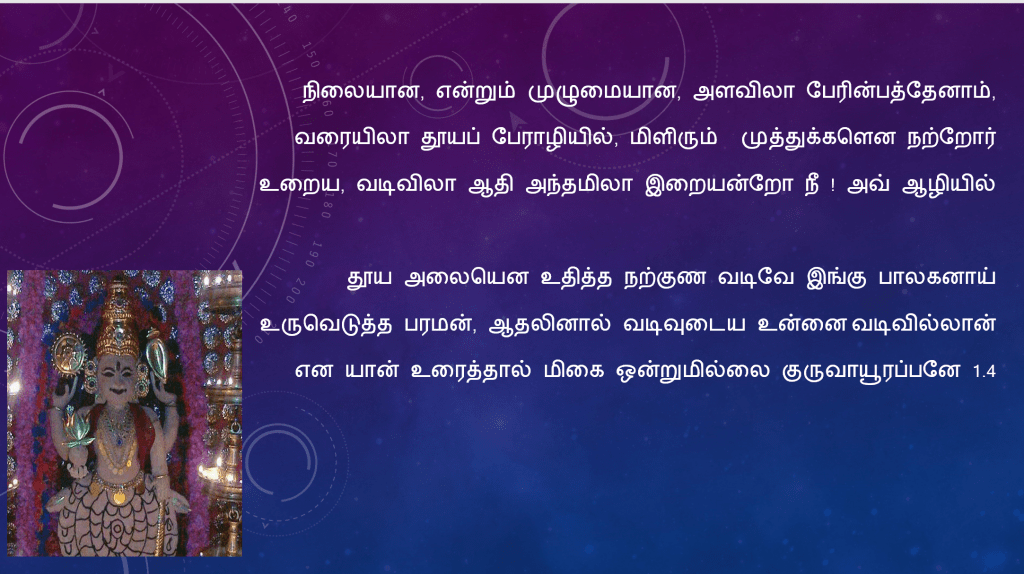
Narayaneeyam – Dasakam 1 – Verse 10

Sanskrit Verse

ऐश्वर्यं शङ्करादीश्वरविनियमनं विश्वतेजोहराणां
तेजस्संहारि वीर्यं विमलमपि यशो निस्पृहैश्चोपगीतम्।
अङ्गासङ्गा सदा श्रीरखिलविदसि क्वापि ते सङ्गवार्ता
तद्वातागारवासिन् मुरहर भगवच्छब्दमुख्याश्रयोऽसि॥१०॥

Audio Link

https://www.dropbox.com/s/of5xqux33phzhbx/Sloka%2010.mp3?dl=0 – chanting by Sri. Sankararama Sharma

Meaning in Tamil

Dasakam 1 – Verse 10

Meaning in English

O Lord of Guruvaayur! Thy lordliness consists in being the controller of all gods from Lord Shankara onwards.Thy prowess overcomes that of those who excel the whole world in prowess. Thy pure fame is sung by even the most desireless sages. Laxmi Devi always resides in Thy bosom. Thou are omniscient and there is not the slightest trace of attachment in Thee. Therefore, the term ‘Bhagavan’ is applicable to Thee alone

English Transliteration

AishvaryaM shankaraadiishvaraviniyamanaM vishvatejOharaaNaaM

tejassanhaari viiryaM vimalamapi yashO nispRaihaishchOpagiitam .

angaasangaa sadaa shriirakhilavidasi na kvaapi tee sangavaartaa

tadvaataagaaravaasin murahara bhagavachChabdamukhyaashrayO(a)si .. 10

Meaning of the Sanskrit Words

ऐश्वर्यं – state of being a mighty lord (Lordliness)

शङ्करादीश्वरविनियमनं = [शङ्कर + आदी + ईश्वर + विनियमनं = Sankara + beginning + Lord/God + control/limit/restrict = ] controls all gods beginning with Sankara

विश्वतेजोहराणां = [विश् + तेजस् + हर = universe, powers, destroy = ] of those (powerful beings) who are the destroyers (हर) of the powers (तेजस्) of the universe (विश्व)

तेजस्संहारि = [तेज: + संहारि = powers, destroyer ] = is the destroyer (संहारिन्) of the powers (तेजस्)

वीर्यं = prowess

विमलमपि = विमलं + अपि = stain less/pure/untainted

यशो = fame/honour

निस्पृहैश्चोपगीतम् = [निस्पृहै: + च + उपगीतं] = free from desire,and, sing/sung

अङ्गासङ्गा = अङ्ग + सङ्ग = part of the body (implies heart):, union

सदा – always (resides in your bosom)

श्रीरखिलविदसि = श्री + अखिलविदसि = Lakshmi, omnipresent

न क्वापि ते सङ्गवार्ता = no, anywhere, the, attachment (you are beyond any attachment)

तद्वातागारवासिन् = तत + वातगार + वासिन् = hence, air(vayu), house (guruvayur)

मुरहर = Mura the demon, victor (Murari, Krishna):

भगवच्छब्दमुख्याश्रयोऽसि = भगवत् + शब्द+ द्मुख्य + आश्रय: + असि = Bhagwan , the sound, main, base, you are (You are the main base for the name Bhagwan). The author says that only You deserve to be called Bhagavaan since You possess the six qualities of ऐश्वर्यं (sovereignty), वीर्यं (virility), यशः (fame), श्रीः (wealth), ज्ञानं (knowledge), वैराग्यम् (detachment).

Narayaneeyam – Dasakam 1 – Verse 9

Sanskrit Verse

कारुण्यात्काममन्यं ददति खलु परे स्वात्मदस्त्वं विशेषा
दैश्वर्यादीशतेऽन्ये जगति परजने स्वात्मनोऽपीश्वरस्त्वम्।
त्वय्युच्चैरारमन्ति प्रतिपदमधुरे चेतना: स्फीतभाग्या
स्त्वं चात्माराम एवेत्यतुलगुणगणाधार शौरे नमस्ते॥९॥

Audio Link

https://www.dropbox.com/s/2k4ty4w5dd8bys6/Sloka%209.mp3?dl=0 – chanting by Sri. Sankararama Sharma

Meaning in Tamil

Dasakam 1 – Verse 9

Meaning in English

O Lord Shri Krishna! while other gods out of compassion, fulfill the desires of their devotees, Thou out of Thy unique compassion, offer Thyself (liberation) to Thy devotees. While other gods rule over the world with the powers invested in them, Thou are the very inner controller of all and rule over all beings and other gods as well as Thyself. Hence all fortunate jeevas [souls] take immense delight in the bliss that Thou are. As for Thee, Thou are ever satisfied in Thyself and are the abode of incomparable attributes. O Lord! prostrations to Thee.

English Transliteration

kaaruNyaatkaamamanyaM dadati khalu pare svaatmadastvaM visheShaa-

daishvaryaadiishate(a)nye jagati parajane svaatmanO(a)piishvarastvam .

tvaiyyuchchairaaramanti pratipadamadhure chetanaaH sphiitabhaagyaa-

stvaM chaatmaaraama evetyatulaguNagaNaadhaara shaure namaste .. 9

Meaning of the Sanskrit Words

कारुण्यात्काममन्यं = कारुण्यात्-कामम्-अन्यं = compassion, desired objects, other

ददति – given

खलु – indeed

परे – other (other gods)

स्वात्मदस्त्वं = स्वात्मन् + असि + त्वं = swatman, asi, tvam = own self, give, your [You give your own self (i.e., give liberation)]

विशेषाद्- special
ऐश्वर्यादीशतेऽन्ये = ऐश्वर्यात् + ईस्ते + अन्ये = aishwaryath, ISTe, anye = by the power, rule, other (others rule by the power )

जगति – in the world

परजने – other people

स्वात्मनोऽपीश्वरस्त्वम्। = स्व-आत्मन: + अपि-ईश्वर: + त्वं = own self , even, lord, yourself
त्वय्युच्चैरारमन्ति= त्वयि-उच्चै:+ आरमन्ति = in you, higher (deeply), revel,

प्रतिपदमधुरे = प्रतिपद + मधुरे = every step, sweet

चेतना: – souls

स्फीतभाग्या = स्फीत + भाग्य = exceedingly, fortunate
स्त्वं चात्माराम एवेत्यतुलगुणगणाधार = त्वं + च + आत्माराम: + एव + इति + अतुल + गुण + गण+ आधार = you, also, reveling in ones own self + the one+ thus + immense + qualities + abode

शौरे – oh Sauri

नमस्ते – ते नमः. – to you, salutations

Narayaneeyam – Dasakam 1 – Verse 8

Sanskrit Verse

नम्राणां सन्निधत्ते सततमपि पुरस्तैरनभ्यर्थितान
प्यर्थान् कामानजस्रं वितरति परमानन्दसान्द्रां गतिं च।
इत्थं निश्शेषलभ्यो निरवधिकफल: पारिजातो हरे त्वं
क्षुद्रं तं शक्रवाटीद्रुममभिलषति व्यर्थमर्थिव्रजोऽयम्॥८॥

Audio Link

https://www.dropbox.com/s/otvgfqct3zmta4q/Sloka%208.mp3?dl=0 – chanting by Sri. Sankararama Sharma

Meaning in Tamil

Dasakam 1 – Verse 8

Meaning in English

O Lord Vishnu! for the devotees who surrender to Thee, Thou always confer, unasked for, not only wealth and other desires, but also liberation.Thus being accessible to every one and bestower of unlimited boons, Thou are the unique Paarijaata tree [parijaata: a heavenly flower]. Alas, the desire prompted hoards of people, in vain, long for trivial blessings from the Kalpaka tree of the garden of Indra. [Kalpaka: a wish fulfilling tree]

English Transliteration

namraaNaaM sannidhatte satatamapi purastairanabhyarthitaana-

pyarthaan kaamaanajasraM vitarati paramaanandasaandraaM gatiM cha .

itthaM nishsheShalabhyO niravadhikaphalaH paarijaatO hare tvaM

kshudraM taM shakravaaTiidrumamabhilaShati vyarthamarthivrajO(a)yam .. 8

Meaning of the Sanskrit Words

नम्राणां – (to) those who worship The

सन्निधत्ते – you appear

सततम् अपि = always also

पुरः = in front

तैः = by them

अनभ्यर्थितान् अपि = अनभ्य (anabhya) अर्थितान् (arthitaan) अपि (api)- even those that have not been requested

अर्थान् कामान् = arthaan, kamaan, wealth and desired objects ( the two types of purushaarth)

अजस्रम् = ajasram -perpetually

वितरति – virarati – give away

परमानन्दसान्द्राम् =parama, ananda, saandra – which is completely filled (सान्द्र) with the Supreme (परम) Happiness (आनन्द)

गतिं च = gatim, ca – and the state

इत्थं = In this way,

निश्शेषलभ्यः = accessible to all without leaving anyone

निरवधिकफलः = the bestower of boundless (निरवधिक) fruits (फल)

पारिजातो हरे त्वं – Parijata Tree, Oh Hari, you

क्षुद्रं तं – ittham tam – inferior, that

शक्रवाटी- शक्, वाटी – shakra, vaaTi, Indra, Garden

द्रुम- druma, – tree

अभिलषति = abhilaShati, – wish/desire

व्यर्थमर्थिव्रजोऽयम् = व्यर्थम् (vyartham) unnecessarily/useless/futile + अर्थि (arthin) one who desires anything, + व्रज (vraja) several/multitude + अयम् (ayam) this

The Fairy “I” can’t fathom – She, the Big M

“It is an oft-quoted saying that philosophy begins in wonder. The mystery of the world with all its changes strikes the reflective temper. The Vedic philosophy grew out of a demand for the explanation of actual experience. Philosophy bade men seek beneath all change, which is the law of life, unity and persistency. All things are passing; what remains? Anything or nothing? The Vedic age raised the problem of philosophy and offered a solution. It was then that attempts to reflect upon the world of experience were made for the first time. When we reflect upon the world of experience, the word illusion (“Maya”) comes to the foreground.

The doctrine of Maya is consideredby many thinkers,to be an integral part of the Vedanta philosophy. The Vedanta system is supposed to be an acosmic pantheism, holding that the Absolute called Brahman alone is real and the finite manifestations are illusory. There is one absolute undifferentiated reality, the nature of which is constitutedby knowledge. The entire empirical world, with its distinction of finite minds and the objects of their thought,is an illusion. Subjects and objects are like the fleeting images which encompass the dreaming soul and melt away into nothingness at the momentof waking.

The term Maya signifies the illusory character of the finite world.” ( Dr. S. Radhakrishnan, Eminent Indian Philosopher)

Wait a minute; does this statement strike a chord in us – in today’s COVID-19 environment?

It looks like it happened “just recently”. A year and a quarter has passed since the virus silently spread across the world. Millions of lives lost. Inter and intra relationships & transactions among and within individuals and society have been completely turned around leaving one to wonder whether it is all a dream and whether we all are waking up to a new state after a deep sleep. Yes, all the three basic states of our Consciousness (awake, dream and deep sleep) have come to play in this crucial time in each one of us thanks to Maya (She, The Big M,I call it).

Well, to me it appears like that; so I woke up after my second vaccination, with a new found determination to explore Maya and her origin, the Vedanta. True to its nature, the Big M treated me like a kid (which I am) and presented me with an exclusive giant Mall with infinite toy stores. No wonder I am lost. Not to disappoint me, the Big M presented me with three books titled Tattva Bodha, Isavasya Upanishad and Dakshinamurthy Stothram.

The last 2 weeks have been fairly severe in terms of the weather; temperatures dropping to single digits (deg F) and snow storms lashing cities forcing kids like me to seek the comfort of our cozy home – that means the Big M has given me an opportunity to deep dive into the books that I got from Her. Each Sloka (Verse) and each word in the three books, is sending me into “space walks” in search of the Self . Holding each Sloka as my life line, I venture into the space of contemplation. Whenever I return back to my home base, I stare through the window at the vast white carpet of snow all around and tried to relate my space walk with the “ground reality”.

In one such “stare” in the early morning after I went on my 18th space walk (corresponding to the 18th Sloka of the Isavasya Upanishad) , the day after the snow storm I did have a direct response from the principal character of that Sloka. Here is that Sloka, its meaning in English and Tamil and the response of the character .

A word of caution here – Millions of pages have been written over centuries by “Subject” – “Matter” – Specialists to provide commentaries for the Slokas in these books. Summing them up into few lines is absolutely immature and childish; yet as a child I have started by scribblings on Vedanta. Pardon me for that.

But Children have the right to enquire and ask questions. The child I am, I am asking questions to myself with the fond hope that someday I will find answers.

The Sloka

अग्ने नय सुपथा राये अस्मान्विश्वानि देव वयुनानि विद्वान् ।

युयोध्यस्मज्जुहुराणमेनो भूयिष्ठां ते नम उक्तिं विधेम ॥ १८ ॥

English Transliteration

agne naya supathā rāye asmānviśvāni deva vayunāni vidvān |

yuyodhyasmajjuhurāṇameno bhūyiṣṭhāṃ te nama uktiṃ vidhema || 18 ||

Meaning in Tamil

அழல் தெய்வமே ! புரிவினை யாவுமறிந்திட்டுயாம்

நல்வினைப் பயனை துய்த்திட நல்வழியே நடத்திடு

உள் உறை தீவினை வஞ்சம்தனை விடுத்திடு

அளித்திட்டேன் பக்தியுடன் எம் வணங்குதலை

Meaning in English

O god of fire, lead us by the good path

To eternal joy. You know all our deeds.

Deliver us from evil, we who bow

And pray again and again.

(From The Upanishads by Eknath Easwaran)

The response

Music Courtesy: Jagruthi an awakening by Music India. (No commercial interests for me).

Narayaneeyam – Dasakam 1 – Verse 7

Sanskrit Verse

कष्टा ते सृष्टिचेष्टा बहुतरभवखेदावहा जीवभाजा
मित्येवं पूर्वमालोचितमजित मया नैवमद्याभिजाने।
नोचेज्जीवा: कथं वा मधुरतरमिदं त्वद्वपुश्चिद्रसार्द्रं
नेत्रै: श्रोत्रैश्च पीत्वा परमरससुधाम्भोधिपूरे रमेरन्॥७॥

Audio Link

Please listen to the chanting by Sri. Sankararama Sharma – https://www.dropbox.com/s/z2qwoa943eh0cz5/Sloka%207.mp3?dl=0

Meaning in Tamil

Dasakam 1 – Verse 7

Meaning in English

O Invincible Lord! Thy activity of creation is indeed a tragic sport, as it causes a lot of sufferings to the living beings. This is what I used to think, but now I do not think so. For if there were no creation, how could human beings enjoy the beauty and sweetness of Thy form which is so delightful to hear and ecstatic to behold, and thus revel in the ocean of Supreme-Bliss-Consciousness.

English Transliteration

kaShTaa te sR^iShTicheShTaa bahutarabhavakhedaavahaa jiivabhaajaa-

mityevaM puurvamaalOchitamajita mayaa naivamadyaabhijaane .

nOchejjiivaaH kathaM vaa madhurataramidaM tvadvapushchidrasaardraM

netraiH shrOtraishcha piitvaa paramarasasudhaambhOdhipuure rameran .. 7

Meaning of the Sanskrit Words

• पूर्वम् = Earlier

• मया आलोचितम् = it was thought by me that

• ते सृष्टिचेष्टा = your activity of creation is

• कष्टा = one that is tormenting

• बहुतरभवखेदावहा = and one that brings forth many sorrows

• जीवभाजाम् = for all the living beings

• अजित = O, Invincible one

• अद्य एवं न अभिजाने = Now I do not think so.

• नो चेत् = If not

• कथं वा = how will

• जीवाः = the humans

• नेत्रैः श्रोत्रैः च पीत्वा = having drunk with eyes and ears (seen and heard)

• इदं त्वद्वपुः = this form of yours

• मधुरतरम् = that is extremely delightful

• चिद्रसार्द्रम् = and that is soaked (आर्द्र) in consciousness (चित्) and bliss (रस)

• रमेरन् = revel

• परमरससुधाम्भोधिपूरे = in the fullness (पूर) of the ocean (आम्भोधि) of absolute (परम) nectarian (सुधा) bliss (रस)

Narayaneeyam – Dasakam 1 – Verse 6

Sanskrit Verse

तत्ते प्रत्यग्रधाराधरललितकलायावलीकेलिकारं
लावण्यस्यैकसारं सुकृतिजनदृशां पूर्णपुण्यावतारम्।
लक्ष्मीनिश्शङ्कलीलानिलयनममृतस्यन्दसन्दोहमन्त:
सिञ्चत् सञ्चिन्तकानां वपुरनुकलये मारुतागारनाथ ॥६॥

Audio Link

https://www.dropbox.com/s/h27ueo0086egh4b/Sloka%206.mp3?dl=0

Meaning in Tamil

Meaning in English

Your form is like the beauty of the fresh rain bearing clouds, and of a beautiful bunch of blue lotuses. Your form is an embodiment of beauty, in the eyes of the people who have done meritorious deeds, and is a complete incarnation of all their good deeds. You are the abode where Goddess Laxmi delights without inhibition. You are the source of a torrential flow of nectarine Bliss, soaking the hearts of people who meditate. On that form of Yours I continuously meditate, O Lord of Guruvayur!

English Transliteration

Tatte pratyagradhaaraadhara lalita kalaayaavalii kelikaaraM

laavaNyasyaikasaaraM sukRaitijanadRaishaaM puurNa puNyaavataaram .

lakshmii nishshanka liilaa nilayanamamRsitasyanda sandOhamantaH

si~nchat sa~nchintakaanaaM vapuranukalaye maarutaagaaranaatha…6

Meaning of the Sanskrit Words

• (हे) मारुतागारनाथ = O Lord of Guruvaayur

• (अहम्) अनुकलये = I meditate upon

• तत् ते वपुः = that body of yours

• प्रत्यग्रधाराधरललितकलायावलीकेलिकारम् = which ridicules (केलिकार) the fresh (प्रत्यग्र) rain-bearing (धारा-धर) clouds (धाराधर) and the bunch (आवली) of lovely (ललित) dark-colored kalaaya (कलाय) flowers, due to its superior dark-colored beauty

• लावण्यस्य एकसारम् = which is the ultimate (एक) essence (सार) of beauty (लावण्य)

• सुकृतिजनदृशां पूर्णपुण्यावतारम् = which is the full (पूर्ण) manifestation (अवतार) of the virtues (पुण्य) in front of the eyes (दृश्) of virtuous (सुकृति) people (जन)

• लक्ष्मीनिश्शङ्कलीलानिलयनम् = which is the location for Lakshmi to play without any worry

• सिञ्चत् = which is raining

• सञ्चिन्तकानाम् अन्तः = in the minds of those who are meditating

• अमृतस्यन्दसन्दोहम् = the combined flow of emerging nectar

Narayaneeyam – Dasakam 1 – Verse 5

Sanskrit Verse

निर्व्यापारोऽपि निष्कारणमज भजसे यत्क्रियामीक्षणाख्यां
तेनैवोदेति लीना प्रकृतिरसतिकल्पाऽपि कल्पादिकाले।
तस्या: संशुद्धमंशं कमपि तमतिरोधायकं सत्त्वरूपं
त्वं धृत्वा दधासि स्वमहिमविभवाकुण्ठ वैकुण्ठ रूपं॥५॥

Audio Link

(Courtesy Shri. Sankararama Sharma – Ref https://www.sanskritfromhome.in/shankararama-sharma/)

https://www.dropbox.com/s/9ag98doaj19icdk/Sloka%205.mp3?dl=0

Meaning in Tamil

English Transliteration

Nir vyaapaarO (a)pi niShkaaraNam aja bhajase

yatkriyaam iikshaNa akhyaaM

tena ivO deti liinaa prakR^itir asati kalpa a(a)pi kalpaadi kaale .

tasyaaH samshuddhamam shaMkam api tam ati rOdhaayakaM satvaruupaM

sa tvaM dhR^itvaa dadhaasi sva mahima vibhava akuNTha vaikuNTha ruupam .. 5

Meaning in English

Oh Birthless Lord! Even though You are not bound by any activities, and You are without any motive, You do resort to that activity known as ‘eekshanaa’ – the will to create. Because of that only. Nature (‘Prakriti’) manifests itself. This Prakriti, is latent in You, as if non existent in the beginning of a new cycle of creation. Then, from the pure Saatvik portion of ‘Prakriti’ (Maya) (which does not in any way obstruct Your Brahmic effulgence), Oh Lord of Vaikunth, You manifest Yourself, in full glory, with a Divine form here in Guruvayur.

Meaning of the Sanskrit Words

निर्व्यापार: – अपि – jobless/free from any occupation, even (though not bound by any activities)

निष्कारणम् – without any reason/motive,

अज भजसे – unborn, choose (thou resort to),

यत्-क्रियाम्-ईक्षणा-आख्यां – that, action/performance/doing, sight/look/care for, inform/tell/make it known (that activity known as ‘eekshanaa’ (the will to create)

तेन-एव-उदेति लीना प्रकृति:-because of that, only, came to manifest, the latent, Nature or ‘Prakriti’

असति-कल्पा-अपि कल्पादि-काले -.असत् non existent/unreal, period, and, beginning of the period, timely/seasonable

(which abides in Thee) as if non existent in the beginning of a new cycle of creation

तस्या: संशुद्धम्-अंशं – that, purified of sin, part

of that (Prakriti) an absolutely pure part

कमपि तम्-अति रोधायकं सत्वरूपं – which does not stop/obstruct (Thy glory of) the Saatvic form

स त्वं धृत्वा दधासि -that Thou did take and assume

स्व-महिम-विभव-अकुण्ठ वैकुण्ठ रूपं – O Lord of Vaikuntha! a majestic form which does not obstruct Thy glories

…….majestic, omnipresence/rich/wealthy, eternal, vaikuntam, form

Carnatic Musing 36 – Sankari SaMkuru Chandramukhi – Raga Saveri

Composer

Shyama Sastry . There is an excellent treatise on Shyama Sastry by Mr. Sreenivasa Rao in his 11 blogs . Pl visit https://sreenivasaraos.com

Audio Link

Whenever I talk about Carnatic Music Performance by siblings, the first one that comes to my mind cannot be anyone else except that of the legends DK Pattammal & DK Jayaraman. Here is their ageless rendition of Ragam Saveri. Pl listen and enjoy.

https://www.dropbox.com/s/zf6wt5jrqkhk7nj/DK%20Pattammal%20%26%20DK%20Jayaraman%20-%20shankari%20shamkuru%20candramukhi%20-%20sAvEri%20-%20syAmA%20sAstri-7PaWa3JVRhw.mp3?dl=0

Sanskrit Verses

पल्लवि

शङ्करी  शङ्कुरु  चन्द्रमुखी अखिलाण्डेश्वरी (श्री)

शाम्भवी सरसिज भव वन्दिते गौरी (अम्ब)

अनुपल्लवि

सङ्कट  हारिणी रिपु विदारिणी कल्याणी

सदा नत फल दायिके (alt: दायकी ) हर नायिके  (alt: नायकी) जगत् जननी

चरणम् 1

जम्बुपति विलासिनी जगदवनोल्लसिनी

कम्बु  कन्धरे भवानी कपाल धारिणी शूलिनी

चरणम् 2

अङ्गज  रिपु तोशिनी अखिल  भुवन पोशिनी

मङ्गल  प्रदे मृदानी मराल संनिभ गमनी

चरणम् 3

श्याम कृष्ण सोदरी श्यामळे शातोदरी

सामगान  लोले बाले सदार्ति भञ्जन  शीले

English Transliteration

In the kRti ‘Sankari SaMkuru’ – rAga sAvEri (tALa Adi), SrI SyAmA Sastry prays to Mother akhilANDESvari at tiruvAnaikkoil (jambukESvaraM).

pallavi

Sankari SaM-kuru candra mukhi 1akhil(A)ND(E)Svari

SAmbhavi sarasija bhava vanditE 2gauri amba

anupallavi

sankaTa hAriNi ripu vidAriNi kalyANi

sadA nata 3phala dAyikE hara nAyikE jagaj-janani (Sankari)

caraNam 1

jambu pati vilAsini jagad-avan(O)llAsini

kambu kandharE bhavAni 4kapAla dhAriNi SUlini (Sankari)

caraNam 2

angaja ripu tOshiNi akhila bhuvana pOshiNi

mangaLa pradE 5mRDAni 6marALa sannibha gamani (Sankari)

caraNam 3

SyAma kRshNa sOdari SyAmaLE 7SAt(O)dari

sAma gAna lOlE 8bAlE sad(A)rti bhanjana-SIlE (Sankari)

Meaning in Tamil

பல்லவி

சங்கரி தந்திடு மன அமைதி,

அகிலாண்டேஸ்வரி,

சாம்பவி, நாபிக்கமலம் உதய அயன் துதி கௌரி, அன்னையே

அனுபல்லவி

இடர்களை பகையழி கல்யாணி

துதிஉரை அடியார்க்கு அருள் அளிஇப்

புவிஈன்ற அன்னையே அரன் நாயகியேசங்கரி

சரணம் 1

ஜம்புநாதனின் துணைவியே,புவி காத்து மகிழும்

சங்குமிடறு கொள் கபாலசூலம் அணி பவானியே

சரணம் 2

காமாரிதனை மகிழ்வூட்டும் அண்டம் பேணும்

மங்களம் வழங்கும் அன்னநடை பயிலும் அகிலாண்டேஸவரி….சங்கரி

சரணம் 3

நீல வண்ணனின் சகோதரி உமையே கொடி இடையாளே

சாமவேத கீதமகிழ் வினைதீர்க்குணமுடை நங்கையே….சங்கரி

Meaning in English

O Consort of Shankara/Shiva! Please create tranquility ! O Moon faced one ! O Goddess of the whole universe ! O ShambhavI! One worshipped by Brahma, the one born in a lotus ! O Mother Gauri !

One who removes/destroys danger/crises ! One who crushes enemies ! O Auspicious one ! One who gives reward to those who always bow to her. O Consort of Shiva ! O Mother of the world !

One who sports with Shiva , (from Jambukeshwara Temple of Tiruvanaikaval, where the Goddess is called Akhilandeshwari. This is one of the Pancha Bhoota Sthalams, representing water). One who takes joy in protecting the world ! One whose neck is like a conch ! O Bhavani ! One who carries a skull ! One who weilds a spear !

One who pleases the enemy of the God of Love ! One who nourishes the entire world ! One who provides good fortune/welfare/happiness ! O Consort of Shiva ! One who walks like a swan !

O Sister of the dark skinned Krishna (also signature of the composer)! O Shyamala ! One with a slender belly/waist ! One who takes pleasure in the chanting of Sama Veda! O Young one ! One whose nature is to always dispel grief !

Meaning of the Sanskrit Words

पल्लवि

शङ्करी  – Shankari

शङ्कुरु  – शम कुरु – tranquility do – give peace

चन्द्रमुखी – moon like face

अखिलाण्डेश्वरी – अखिल अण्ड ईश्वरि – Whole-universe-goddess – goddess of the whole universe

श्री – auspicious

शाम्भवी – Shambhavi – Siva’ wife

सरसिज – lotus

भव – produced

वन्दिते – pray

गौरी – Gauri

अम्ब – mother

अनुपल्लवि

सङ्कट  – crisis/danger

हारिणी – remove / dispel

रिपु – enemy

विदारिणी – breaking / crush/ destroy

कल्याणी – Kalyani (prosperous)

सदा – airways

नत – bowing to

फल – fruit / reward

दायिके (alt: दायकी ) – provider / bestowed

हर नायिके  (alt: नायकी) – consort of Lord Siva

जगत् – world

जननी – Mother

चरणं १

जम्बुपति – Lord Jambukeshwara of Thiruvanaikaval

विलासिनी – wife

जगदवनोल्लसिनी –

जगत् – universe

अवन – protect

उल्लासिनि – take joy or delight

कम्बु  – conch

कन्धरे – necked

भवानी – Bhavaani

कपाल – skull

धारिणी – carries/wearing

शूलिनी – trident holding

चरणं २

अङ्गज  – Manmathan – Lord of Cupid

रिपु – enemy

तोशिनी – pleases/delights

अखिल  – entire

भुवन – universe

पोशिनी – nourishes

मङ्गल  – auspicious/happy/welfare

प्रदे – provides / gives

मृदानी – Wife of Lord Siva (मृदा)

मराल – swan

संनिभ – similar to

गमनी – walk

चरणं ३

श्याम – dark colored कृष्ण – Lord Krishna (pen name of the author)

सोदरी – sister

श्यामळे – Ok Shyamala (Parvati)

शातोदरी- शात-उदरि – slender – waist

सामगान  – सम गान – Sama Veda – Music/chant

लोले – pleasure

बाले – oh girl

सदार्ति – सदा अर्ति – always grief

भञ्जन  – relieve

शीले – nature

Notes –

Variations –

2 – gauri amba – gauri.

3 – phala dAyikE – phala dAyaki.

References

1 – akhilANDESvari – name of Mother at tiruvAnaikka (tiruvAnaikkoil) – Consort of ‘jambukESvara’ (jambu pati). Please refer to tiruvAnaikkA – 1; tiruvAnaikkA – 2 (Tamil website)

4 – kapAla dhAriNi – According to above website, akhilANDESvari was a ‘ugra dEvatA’ who was pacified by Adi Sankara by installing SrI cakra in Her ears.

5 – mRDAni – Wife of mRDa – Siva. Please refer to lalitA sahasra nAma (564) – ‘mRDAnI’.

6 – marALa sannibha gamani – swan-like gaited. Please also refer to lalitA sahasra nAma (47) – ‘marALI manda gamanA’. Also refer to – discourse of kAnci mahAsvAmi on ‘saundarya lahari’ (91).

7 – SAtOdari – Slender waited. It also means ‘daughter of himavAn’ who is called ‘SatOdara’ (having hundreds of caves). Please refer to lalitA sahasra nAma (130) – ‘SAtOdarI’.

8 – bAlE – Mother tripura sundari is called ‘bAlA’ – please refer to lalitA sahasra nAma (965). A 9-year girl is called ‘bAlA’.

Narayaneeyam – Dasakam 1 – Verse 4

Sanskrit Verse

निष्कम्पे नित्यपूर्णे निरवधिपरमानन्दपीयूषरूपे
निर्लीनानेकमुक्तावलिसुभगतमे निर्मलब्रह्मसिन्धौ
कल्लोलोल्लासतुल्यं खलु विमलतरं सत्त्वमाहुस्तदात्मा
कस्मान्नो निष्कलस्त्वं सकल इति वचस्त्वत्कलास्वेव भूमन्

Audio Link

(Courtesy Shri. Sankararama Sharma – Ref

https://www.dropbox.com/s/nvk97yq7sqt87g4/Sloka%204.mp3?dl=0

Meaning in Tamil

Meaning in English

Brahman is akin to the mighty ocean, changeless, ever full with the nature of unlimited nectarine bliss. Like many pearls in the ocean, innumerable liberated souls are absorbed in this Brahmic bliss and hence it is extremely resplendent. Just like the waves rise in the ocean, it is said that Shuddha Satwa form has risen from the Brahman. You, here in Guruvayur is that Satwa form. Hence it is appropriate to call Lord Guruvayurappan as Poorna Avataar (Nishkalaa) even though some may argue that if You have a form then you are Ansha Avataar (Sakalaa).

English Transliteration

NiShkampe nityapuurNe niravadhiparamaanandapiiyuuSharuupe

nirliinaanekamuktaavalisubhagatame nirmalabrahmasindhau .

kallOlOllaasatulyaM khalu vimalataraM sattvamaahustadaatmaa

kasmaannOniShkalastvaM sakala iti vachastvatkalaasveva bhuuman..4

Meaning of the Sanskrit Words

निष्कम्पे – (in the) vibrationless (changeless)/motionless

नित्यपूर्णे – नित्य पूर्ण – (and in the) ever full

निरवधिपरमानन्दपीयूषरूपे – निरवधि परमानन्द पीयूष रूपे – unlimited, bliss, nectarine, personified (form)

निर्लीन-अनेक-मुक्तावलि-सुभगतमे -liberated/unaffected, several, pearl necklace/ string of pearls, prosperity/loveliness

(in which) many liberated ones having merged and hence is extremely resplendent (or resplendent because of many pearls in the ocean)

निर्मल-ब्रह्म-सिन्धौ – in the pure ocean of Brahman

कल्लोल-उल्लास-तुल्यं- waves, happiness/joy, like (like waves rising)

खलु विमलतरं सत्त्वम्-आहु: – so then, pure (state of being stainless), satwam, invoke

[(so) indeed (Thy form) of extremely pure Shuddha Satwa it is said (to have risen from Brahman)]

तत्-आत्मा – that form of Thine

कस्मात्-न निष्कल: – त्वं – why not it be called Nishkala (undivided /seedless/without any parts (or without any kalaa or Purn-avataara

सकल इति वच: – total, this, word/term

त्वत्-कलासु-एव – you, time defined, only

[(is for Thy (other) part incarnations only)]

भूमन् – abundance (oh infinite one)

The day after vaccination

The dark days of COVID-19 combined with the cold winter could force anyone to be tugged under the comforter and lie down on the bed even when awake particularly on a Sunday. Well, I have a different story to tell.

Sunday 24th January 2021 – It was the day after I got “moderna-ized”. Wondering about the new English word coined here ! Yes, the previous day I got the first doze of the much anticipated COVID vaccine from Moderna, making me feel that sometimes getting old is helpful (Got the appointment because I was more than 65 years old – physically).

As typical of an old timer, I got up at 0600 hrs on a cold and frigid Sunday morning with temperature smoothly gliding down to 12 deg F (Remember that I am guy who spent all his life at around 32 deg C. !). I had a choice to make – a choice about how I feel.

In my life, whenever I had to make choices, I had the luck of having someone close to me to lean my shoulders on and pause before making the choice. This Sunday is no exception. As my “close someone” unfolded himself to me, I made my choice.

THERE IS HOPE; THERE IS A BRIGHTER SIDE TO LIFE. LOOK AT THAT AND START THE DAY.

I did. Here is what I looked at from my windows.