Carnatic Musing 36 – Sankari SaMkuru Chandramukhi – Raga Saveri

Composer

Shyama Sastry . There is an excellent treatise on Shyama Sastry by Mr. Sreenivasa Rao in his 11 blogs . Pl visit https://sreenivasaraos.com

Audio Link

Whenever I talk about Carnatic Music Performance by siblings, the first one that comes to my mind cannot be anyone else except that of the legends DK Pattammal & DK Jayaraman. Here is their ageless rendition of Ragam Saveri. Pl listen and enjoy.

https://www.dropbox.com/s/zf6wt5jrqkhk7nj/DK%20Pattammal%20%26%20DK%20Jayaraman%20-%20shankari%20shamkuru%20candramukhi%20-%20sAvEri%20-%20syAmA%20sAstri-7PaWa3JVRhw.mp3?dl=0

Sanskrit Verses

पल्लवि

शङ्करी  शङ्कुरु  चन्द्रमुखी अखिलाण्डेश्वरी (श्री)

शाम्भवी सरसिज भव वन्दिते गौरी (अम्ब)

अनुपल्लवि

सङ्कट  हारिणी रिपु विदारिणी कल्याणी

सदा नत फल दायिके (alt: दायकी ) हर नायिके  (alt: नायकी) जगत् जननी

चरणम् 1

जम्बुपति विलासिनी जगदवनोल्लसिनी

कम्बु  कन्धरे भवानी कपाल धारिणी शूलिनी

चरणम् 2

अङ्गज  रिपु तोशिनी अखिल  भुवन पोशिनी

मङ्गल  प्रदे मृदानी मराल संनिभ गमनी

चरणम् 3

श्याम कृष्ण सोदरी श्यामळे शातोदरी

सामगान  लोले बाले सदार्ति भञ्जन  शीले

English Transliteration

In the kRti ‘Sankari SaMkuru’ – rAga sAvEri (tALa Adi), SrI SyAmA Sastry prays to Mother akhilANDESvari at tiruvAnaikkoil (jambukESvaraM).

pallavi

Sankari SaM-kuru candra mukhi 1akhil(A)ND(E)Svari

SAmbhavi sarasija bhava vanditE 2gauri amba

anupallavi

sankaTa hAriNi ripu vidAriNi kalyANi

sadA nata 3phala dAyikE hara nAyikE jagaj-janani (Sankari)

caraNam 1

jambu pati vilAsini jagad-avan(O)llAsini

kambu kandharE bhavAni 4kapAla dhAriNi SUlini (Sankari)

caraNam 2

angaja ripu tOshiNi akhila bhuvana pOshiNi

mangaLa pradE 5mRDAni 6marALa sannibha gamani (Sankari)

caraNam 3

SyAma kRshNa sOdari SyAmaLE 7SAt(O)dari

sAma gAna lOlE 8bAlE sad(A)rti bhanjana-SIlE (Sankari)

Meaning in Tamil

பல்லவி

சங்கரி தந்திடு மன அமைதி,

அகிலாண்டேஸ்வரி,

சாம்பவி, நாபிக்கமலம் உதய அயன் துதி கௌரி, அன்னையே

அனுபல்லவி

இடர்களை பகையழி கல்யாணி

துதிஉரை அடியார்க்கு அருள் அளிஇப்

புவிஈன்ற அன்னையே அரன் நாயகியேசங்கரி

சரணம் 1

ஜம்புநாதனின் துணைவியே,புவி காத்து மகிழும்

சங்குமிடறு கொள் கபாலசூலம் அணி பவானியே

சரணம் 2

காமாரிதனை மகிழ்வூட்டும் அண்டம் பேணும்

மங்களம் வழங்கும் அன்னநடை பயிலும் அகிலாண்டேஸவரி….சங்கரி

சரணம் 3

நீல வண்ணனின் சகோதரி உமையே கொடி இடையாளே

சாமவேத கீதமகிழ் வினைதீர்க்குணமுடை நங்கையே….சங்கரி

Meaning in English

O Consort of Shankara/Shiva! Please create tranquility ! O Moon faced one ! O Goddess of the whole universe ! O ShambhavI! One worshipped by Brahma, the one born in a lotus ! O Mother Gauri !

One who removes/destroys danger/crises ! One who crushes enemies ! O Auspicious one ! One who gives reward to those who always bow to her. O Consort of Shiva ! O Mother of the world !

One who sports with Shiva , (from Jambukeshwara Temple of Tiruvanaikaval, where the Goddess is called Akhilandeshwari. This is one of the Pancha Bhoota Sthalams, representing water). One who takes joy in protecting the world ! One whose neck is like a conch ! O Bhavani ! One who carries a skull ! One who weilds a spear !

One who pleases the enemy of the God of Love ! One who nourishes the entire world ! One who provides good fortune/welfare/happiness ! O Consort of Shiva ! One who walks like a swan !

O Sister of the dark skinned Krishna (also signature of the composer)! O Shyamala ! One with a slender belly/waist ! One who takes pleasure in the chanting of Sama Veda! O Young one ! One whose nature is to always dispel grief !

Meaning of the Sanskrit Words

पल्लवि

शङ्करी  – Shankari

शङ्कुरु  – शम कुरु – tranquility do – give peace

चन्द्रमुखी – moon like face

अखिलाण्डेश्वरी – अखिल अण्ड ईश्वरि – Whole-universe-goddess – goddess of the whole universe

श्री – auspicious

शाम्भवी – Shambhavi – Siva’ wife

सरसिज – lotus

भव – produced

वन्दिते – pray

गौरी – Gauri

अम्ब – mother

अनुपल्लवि

सङ्कट  – crisis/danger

हारिणी – remove / dispel

रिपु – enemy

विदारिणी – breaking / crush/ destroy

कल्याणी – Kalyani (prosperous)

सदा – airways

नत – bowing to

फल – fruit / reward

दायिके (alt: दायकी ) – provider / bestowed

हर नायिके  (alt: नायकी) – consort of Lord Siva

जगत् – world

जननी – Mother

चरणं १

जम्बुपति – Lord Jambukeshwara of Thiruvanaikaval

विलासिनी – wife

जगदवनोल्लसिनी –

जगत् – universe

अवन – protect

उल्लासिनि – take joy or delight

कम्बु  – conch

कन्धरे – necked

भवानी – Bhavaani

कपाल – skull

धारिणी – carries/wearing

शूलिनी – trident holding

चरणं २

अङ्गज  – Manmathan – Lord of Cupid

रिपु – enemy

तोशिनी – pleases/delights

अखिल  – entire

भुवन – universe

पोशिनी – nourishes

मङ्गल  – auspicious/happy/welfare

प्रदे – provides / gives

मृदानी – Wife of Lord Siva (मृदा)

मराल – swan

संनिभ – similar to

गमनी – walk

चरणं ३

श्याम – dark colored कृष्ण – Lord Krishna (pen name of the author)

सोदरी – sister

श्यामळे – Ok Shyamala (Parvati)

शातोदरी- शात-उदरि – slender – waist

सामगान  – सम गान – Sama Veda – Music/chant

लोले – pleasure

बाले – oh girl

सदार्ति – सदा अर्ति – always grief

भञ्जन  – relieve

शीले – nature

Notes –

Variations –

2 – gauri amba – gauri.

3 – phala dAyikE – phala dAyaki.

References

1 – akhilANDESvari – name of Mother at tiruvAnaikka (tiruvAnaikkoil) – Consort of ‘jambukESvara’ (jambu pati). Please refer to tiruvAnaikkA – 1; tiruvAnaikkA – 2 (Tamil website)

4 – kapAla dhAriNi – According to above website, akhilANDESvari was a ‘ugra dEvatA’ who was pacified by Adi Sankara by installing SrI cakra in Her ears.

5 – mRDAni – Wife of mRDa – Siva. Please refer to lalitA sahasra nAma (564) – ‘mRDAnI’.

6 – marALa sannibha gamani – swan-like gaited. Please also refer to lalitA sahasra nAma (47) – ‘marALI manda gamanA’. Also refer to – discourse of kAnci mahAsvAmi on ‘saundarya lahari’ (91).

7 – SAtOdari – Slender waited. It also means ‘daughter of himavAn’ who is called ‘SatOdara’ (having hundreds of caves). Please refer to lalitA sahasra nAma (130) – ‘SAtOdarI’.

8 – bAlE – Mother tripura sundari is called ‘bAlA’ – please refer to lalitA sahasra nAma (965). A 9-year girl is called ‘bAlA’.
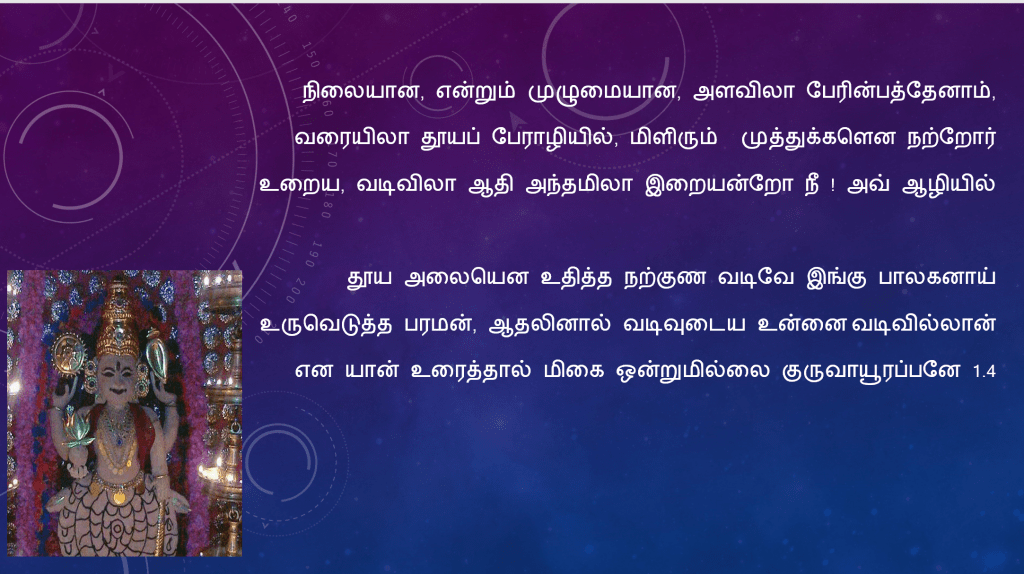
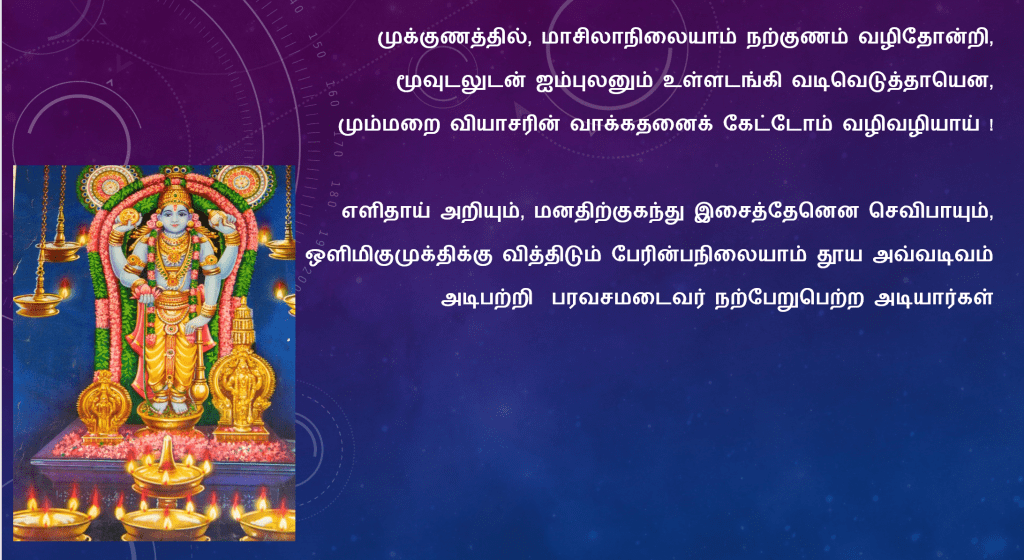
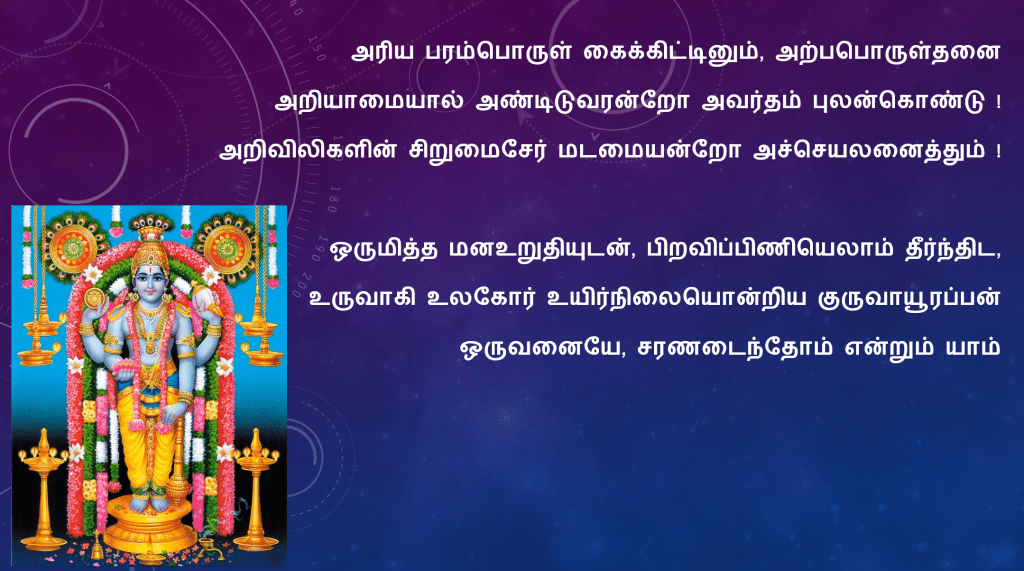
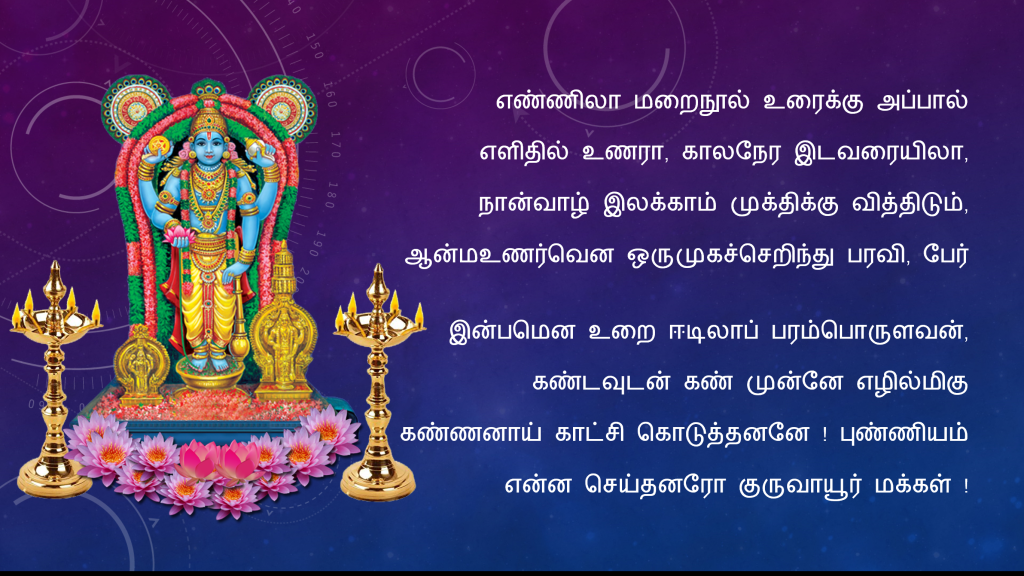
Narayaneeyam – Dasakam 1 – Verse 4

Sanskrit Verse

निष्कम्पे नित्यपूर्णे निरवधिपरमानन्दपीयूषरूपे
निर्लीनानेकमुक्तावलिसुभगतमे निर्मलब्रह्मसिन्धौ
कल्लोलोल्लासतुल्यं खलु विमलतरं सत्त्वमाहुस्तदात्मा
कस्मान्नो निष्कलस्त्वं सकल इति वचस्त्वत्कलास्वेव भूमन्

Audio Link

(Courtesy Shri. Sankararama Sharma – Ref

https://www.dropbox.com/s/nvk97yq7sqt87g4/Sloka%204.mp3?dl=0

Meaning in Tamil

Meaning in English

Brahman is akin to the mighty ocean, changeless, ever full with the nature of unlimited nectarine bliss. Like many pearls in the ocean, innumerable liberated souls are absorbed in this Brahmic bliss and hence it is extremely resplendent. Just like the waves rise in the ocean, it is said that Shuddha Satwa form has risen from the Brahman. You, here in Guruvayur is that Satwa form. Hence it is appropriate to call Lord Guruvayurappan as Poorna Avataar (Nishkalaa) even though some may argue that if You have a form then you are Ansha Avataar (Sakalaa).

English Transliteration

NiShkampe nityapuurNe niravadhiparamaanandapiiyuuSharuupe

nirliinaanekamuktaavalisubhagatame nirmalabrahmasindhau .

kallOlOllaasatulyaM khalu vimalataraM sattvamaahustadaatmaa

kasmaannOniShkalastvaM sakala iti vachastvatkalaasveva bhuuman..4

Meaning of the Sanskrit Words

निष्कम्पे – (in the) vibrationless (changeless)/motionless

नित्यपूर्णे – नित्य पूर्ण – (and in the) ever full

निरवधिपरमानन्दपीयूषरूपे – निरवधि परमानन्द पीयूष रूपे – unlimited, bliss, nectarine, personified (form)

निर्लीन-अनेक-मुक्तावलि-सुभगतमे -liberated/unaffected, several, pearl necklace/ string of pearls, prosperity/loveliness

(in which) many liberated ones having merged and hence is extremely resplendent (or resplendent because of many pearls in the ocean)

निर्मल-ब्रह्म-सिन्धौ – in the pure ocean of Brahman

कल्लोल-उल्लास-तुल्यं- waves, happiness/joy, like (like waves rising)

खलु विमलतरं सत्त्वम्-आहु: – so then, pure (state of being stainless), satwam, invoke

[(so) indeed (Thy form) of extremely pure Shuddha Satwa it is said (to have risen from Brahman)]

तत्-आत्मा – that form of Thine

कस्मात्-न निष्कल: – त्वं – why not it be called Nishkala (undivided /seedless/without any parts (or without any kalaa or Purn-avataara

सकल इति वच: – total, this, word/term

त्वत्-कलासु-एव – you, time defined, only

[(is for Thy (other) part incarnations only)]

भूमन् – abundance (oh infinite one)

Narayaneeyam – Dasakam 1 – Verse 3

Sanskrit Verse

सत्त्वं यत्तत् पराभ्यामपरिकलनतो निर्मलं तेन तावत्
भूतैर्भूतेन्द्रियैस्ते वपुरिति बहुश: श्रूयते व्यासवाक्यम्।
तत् स्वच्छ्त्वाद्यदाच्छादितपरसुखचिद्गर्भनिर्भासरूपं
तस्मिन् धन्या रमन्ते श्रुतिमतिमधुरे सुग्रहे विग्रहे ते

Audio Link

(Courtesy Shri. Sankararama Sharma – Ref https://www.sanskritfromhome.in/shankararama-sharma/)

https://www.dropbox.com/s/c1kc3ixizuzwskp/Sloka%203.mp3?dl=0

Meaning in Tamil

Meaning in English

Sage Vyaasa have stated again and again in many scriptures that You are born from the form of Satva Guna. That Satva Guna, which compared to the other two Gunas (Rajas and Tamas) is absolutely pure and not tainted by them. That form is constituted of subtle elements and organs of senses and actions. Your form, because of such purity, totally reveals the Supreme Bliss and Consciousness within (which is the resplendent Brahman) without any obstruction. In that form, the fortunate ones (who have good deeds to their credit) revel. That form is delightful to the mind and ears, which the devotees can easily grasp in Your image.

English Transliteration

sattvaM yattat paraabhyaamaparikalanatO nirmalaM tena taavat

bhuutairbhuutendriyaiste vapuriti bahushaH shruuyate vyaasavaakyam .

tat svachChatvaadyadachChaadita parasukhachidgarbhanirbhaasaruupaM

tasmin dhanyaa ramante shrutimatimadhure sugrahe vigrahe te .. 3

Meaning of the Sanskrit Words

सत्त्वं यत्- तत् – that pure Satwa guna which पराभ्याम् – compared with the other two (Rajas and Tamas) अपरिकलनत: being not mixed (and so)निर्मलंabsolutely pureतेन तावत् भूतै: -from it (shuddha satva) was bornभूतेन्द्रियै: – ते वपु: -Thy form constituted of the subtle elements and organs of sense and actionइति बहुश: श्रूयते thus is repeatedly heardव्यासवाक्यंfrom the words of (sage) Vyasaतत् स्वच्छ्त्वात्-that (form) because of its purityयत्-आच्छादित-परसुखचित्-गर्भ-निर्भासरूपंwhich, because of unobstructed supreme bliss and consciousness within, is supremely resplendent (Brahman)तस्मिन् धन्या रमन्तेin that form the fortunate ones (who have good deeds to their credit) revelश्रुति-मति-मधुरे which is delightful to the ears and the mindसुग्रहे विग्रहे ते(devotees can) easily attain (grasp) in Thy image.

Narayaneeyam – Dasakam 1 – Verse 2

Sanskrit Verse

एवंदुर्लभ्यवस्तुन्यपि सुलभतया हस्तलब्धे यदन्यत्
तन्वा वाचा धिया वा भजति बत जन: क्षुद्रतैव स्फुटेयम्
एते तावद्वयं तु स्थिरतरमनसा विश्वपीड़ापहत्यै
निश्शेषात्मानमेनं गुरुपवनपुराधीशमेवाश्रयाम:

Audio Link

(Courtesy Shri. Sankararama Sharma – Ref https://www.sanskritfromhome.in/shankararama-sharma/)

https://www.dropbox.com/s/he4wumnzonyve81/Sloka%202.mp3?dl=0

Meaning in Tamil

Meaning in English

In this manner, such rare things are so easily accessible to all. Alas, people, pursue other worldly things with their body speech and mind. This, is pitiable indeed. However, we Thy devotees, surrender , to Thee, O Lord of Guruvaayur who is the embodiment of the entire soul of all beings of the universe, with fully resolved minds for the eradication of all worldly sufferings.

English Transliteration

evaM durlabhyavastunyapi sulabhatayaa hastalabdhe yadanyat

tanvaa vaachaa dhiyaa vaa bhajati bata janaH kshudrataiva sphuTeyam .

ete taavadvayaM tu sthirataramanasaa vishvapiiDaapahatyai

nishsheShaatmaanamenaM gurupavanapuraadhiishamevaashrayaamaH .. 2

Meaning of the Sanskrit Words

एवं – thus. दुर्लभ्य-वस्तुनि अपिvery – rare things too (are). सुलभतया – so easily. हस्त-लब्धे – is accessible (to all) यत्-अन्यत्yet – other things (worldly pleasures). तन्वा वाचा धिया वा – (with their) body speech and mind. भजति बत जन: – alas people pursue क्षुद्रता-एव स्फुट-इयं -/this is clearly pitiable एते तावत्-वयं तु – but we here (Thy devotees) however स्थिर-तर-मनसा – with mind fully resolved विश्व-पीड़ा-अपहत्यै – for the total eradication of all (our) sufferings. निश्शेष-आत्मानम्-एनं – Lord, who is the soul of all beings in the universe. गुरुपवनपुराधीशम् – to that Lord of Guruvaayur. एव-आश्रयाम:- alone we surrender

Narayaneeyam – Dasakam 1 – Verse 1

Sanskrit Verse

सान्द्रानन्दावबोधात्मकमनुपमितं कालदेशावधिभ्यां
निर्मुक्तं नित्यमुक्तं निगमशतसहस्रेण निर्भास्यमानम्
अस्पष्टं दृष्टमात्रे पुनरुरुपुरुषार्थात्मकं ब्रह्म तत्वं
तत्तावद्भाति साक्षाद् गुरुपवनपुरे हन्त भाग्यं जनानाम्

Audio Link

(Courtesy Shri. Sankararama Sharma – Ref https://www.sanskritfromhome.in/shankararama-sharma/)

https://www.dropbox.com/s/y4rq6tcsgc757ul/Sloka%201.mp3?dl=0

Meaning in Tamil

Meaning in English

The Supreme Reality-The Brahma Tatwa ,which is dense concentrated Bliss, which is of the nature of the Pure Consciousness, which is without parallel or comparison, and is totally free of time and space limitations, and is always free (of Maya) which hundreds and thousands of the Upanishadic statements seek to explain, and yet, is not clear. This Brahma Tatwa which is not easy to grasp in the beginning, but the realisation of which, is the highest purusharth (i.e. liberation), that (very Reality) shines right in front (in concrete form), (as an Image of Shri Krishna) in the Guruvaayur temple. Oh (wonderful indeed) is the good fortune of the people (who seek Thy Grace).

English Transliteration

SaandraanandaavabOdhaatmakamanupamitaM kaaladeshaavadhibhyaaM

nirmuktaM nityamuktaM nigamashatasahasreNa nirbhaasyamaanam .

aspaShTaM dR^iShTamaatre punarurupuruShaarthaatmakaM brahma tatvaM

tattaavadbhaati saakshaadgurupavanapure hanta bhaagyaM janaanaam .. १

Meaning of the Sanskrit Words

Please refer http://narayaneeyam-firststep.org/dashaka1

सान्द्र-आनन्द-अवबोधात्मकं Which is of the nature of intense Bliss and Supreme Consciousness अनुपमितं without comparison काल-देश-अवधिभ्यां निर्मुक्तं totally free from the limitations of time and space नित्यमुक्तंever free (from the control of Maya-the unmanifest Prakriti) निगम-शतसहस्रेण (whose nature) innumerable scriptural texts निर्भास्यमानंtry to reveal अस्पष्टं (and yet) is not easy to grasp (in the beginning) दृष्टमात्रे पुन:but then immediately on realisation उरु-पुरुषार्थात्मकं becomes the highest purushartha (i.e. moksha, liberation) ब्रह्म तत्वं Brahman, the Reality तत् तावत् that very (Reality), then भाति साक्षात् गुरुपवनपुरे shines right in front (in concrete form) at Guruvayur हन्त भाग्यं जनानाम् Oh! What good fortune for the people

* நான் வாழ் இலக்கு என்பது அறம், பொருள், அவா, முக்தி எனும நான்கு இலக்குகளைக் குறிக்கும். It basically refers to the four objectives of life in his /her ascent to self realization. It is called “Purushaarthaa” .

Narayaneeyam

Deep down inside me, there has always been a desire to study Narayaneeyam. Along with this desire, comes the fear of the unknown – 1000 plus verses in Sanskrit, my poor/no knowledge of Sanskrit and my abysmal and amateurish level of spirituality. So I keep dithering and didn’t do anything towards this during the pandemic year.

My experiments with my blogs in 2020 has now given me the courage to venture. I am browsing the topic and collecting reference materials. I have joined classes at Vyoma’s sanskritfromhome.in and have words of encouragement from my teacher/Guru Sri. Sankararama Sharma. I am listening to the discourses by learned scholars.

We have a saying in Tamil “தை பிறந்தால் வழி பிறக்கும்” ( we will find a way when we enter the Tamil month of Thai – when the Sun starts its northern journey).

So here I am diving into the ocean of bliss without knowing swimming, having confidence that the Lord will help me and show the way in my long and deep journey.

While the verse by verse work will commence beginning this Friday, the full first Dasakam in AV format will be posted on Mahara Sankaranthi day in my YouTube channel “prabhu53”. The work on the rest of the 99 Dasakams will be later on as per the dictations of Lord Guruvayurappan.

Please feel free to let me know the errors (hopefully not blunders) that I may have committed.

ஆறு மனமே ஆறு – The six tenets of Sankara

Atma Shatakam known as Nirvana Shatakam written by Adi Sankaracharya is the core of the Advaita (Non duality) philosophy. My earlier blogs on this, provided the meanjng of the Sanskrit words and the translations in Tamil. Here is a consolidation of the same in a video form.

November Dedications

In the Tamil calendar (Solar based) of Kartigai (around mid November – mid December), the full moon day is divinely important. Two important events – the arrival of Lord Katikeya (Subramanya/Arumugam) and the manifestation of Lord Siva as an endless flame of light (even Lord Vishnu and Lord Brahma couldn’t find the start and the end of it in the three worlds). The lighting of the famous Deepam at the famous Hill at Thiruvannamalai happens on this day.

Today being that day, I decided to refine and rededicate two of my earlier blogs through an audio visual in the social media. Here are the links to the two videos.

அம்புலி கங்கை அணிந்த

அடிமுடி காணா இறைவனை,

அன்பர் மனங்கவர் அண்ணாமலையோனை,

அன்றே கண்டு ஆனந்தமதனை

அலை அலையாய்ப் பெற்ற,

ஆதி சங்கரனின் சிவ

ஆனந்த லகரி எனும் அருள் மறையும்,

ஆர்க்கும் அலைகள் ஆழ்கடல் தோன்றி அழிவதொப்ப,

அன்பரின் மாளா துயர் அழியும் அவனை அடைந்தால் என

அலைவாயிலில் ஆதி சங்கரன், அருளிய

சுற்றும் அரவு என பதம் அமைந்த சுபரமணிய புஜங்கம் தனையும்,

அடியேன் அறிய இயன்று, திருக்

கார்த்திகை தீப நன்நாளின்று,

ஒலி ஒளி வடிவாய் வளைதளத்தில்

ஓங்கார நாதன் திருவடியில்

உளமுருகி பணித்திட்டேன்

ஒன்றுமில்லை இவ்வுலகில்

உனையன்று வேறெதுவும்

சிரம் தாழ்த்தி வணங்கிடுவேன்

திருவண்ணாமலை அருணனே

திருச்செந்தூர் குமரனே

திருக்கார்த்திகை தீப நாள் வாழ்த்துக்கள்

Carnatic Musing 32 – Vijayadasami – The closing day of Navarathri

Composer

Harikeshanallur Muthaiah Bhagawathar– Please refer Please refer https://karnatik.com/co1024.shtml for biography and compositions.

Audio Link

MLVhttps://www.dropbox.com/s/anth9dmg5kjigma/VijayAmbike%20vimalAmbike%20-%20vijayanAgari%20-%20%20%20Mutthayya%20bhAgavathar%20-%20ML%20Vasanthakumari-65D9mSi2THc.mp3?dl=0

Dr Nagavalli Nagarajhttps://www.dropbox.com/s/vcbd6yl36ckrhtr/Dr.Nagavalli%20Nagaraj-Vijayambike-vijayanagari-Muttaiah%20Bhagavatar-2sLWmKXn7vM.mp3?dl=0

Meaning in English

Oh Victorious mother, divinely pure mother, the goddess worshipped by Brahma and praised by the king of devas. Oh goddess who does good to devotees and is the essence of the Vedas. Oh goddess decorated by sound, note, method and modulation of music, Oh Goddess who is personification of music originating from notes and filled with nectar like tunes, Oh Gowri protect me, Oh Goddess who makes the mind of Harikesa joyous.

Meaning in Tamil

பல்லவி

விஜய அம்பிகையே விமல அம்பிகையே

அனுபல்லவி

ஆதவன் போற்றும் அமரன் வணங்கும்

அடியார்க்கு அருளும் ஆகம சாரமே….விஜய அம்பிகையே

சரணம்

சுருதி ஸ்வரமுடன் லய தாள ராக நாதமெனும் வடிவமே

சங்கரியே காப்பாய் எமை ஹரிகேசன் மனம் மகிழும் .. விஜய அம்பிகையே

Sanskrit Verses

पल्लवि

विजयाबिकॆ विमलात्मिकॆ

अनुपल्ल्वि

अजवन्दितॆ अमरॆन्द्र्नुतॆ निज भक्तहितॆ नुगमान्दर्गथॆ

चरणम्

श्रुति स्वर ग्राम मूर्चनालन्कार नाद् ज्नुत राग रस भरित

सब्गीत रूपिणि गौरि पालिसौ मातॆ हरिकॆश मनमॊदिनि

English Transliteration

pallavi

vijayAmbikE vimalAtmikE

(vijayAmbikE)

anupallavi

ajavanditE amarEndranutE nija bhaktahitE nigamAndargathE

(vijayAmbikE)

caraNam

shruti svara grAma mUrcanAlankAra nAda janita rAga rasa bharita

sangIta rUpiNi gaurI pAlisau mAtE harikEsha manamOdini

(vijayAmbikE)

Meaning of the Sanskrit Words

पल्लवि

विजयाबिकॆ – विजय अम्बिकॆ – victorious, mother

विमलात्मिकॆ – विमल आत्म्जॆ – pure, mother

अनुपल्ल्वि

अजवन्दितॆ – अज वन्दितॆ – Sun, worshipped

अमरॆन्द्र्नुतॆ – अमरेन्द्र नुतॆ – Lord Indra, meditated

निज – ones own

भक्तहितॆ – भक्त हितॆ – devotees, favor/well disposed

नुगमान्दर्गथॆ – निगम अन्दर्गथॆ – The Veda, अन्तर् गत – inner meaning/secret

चरणम्

श्रुति – Sruti – pitch – அலகு

स्वर – swara – note – கோவை

ग्राम – gramas – a group of tones which form the basis of morcana/scale

मूर्चनालन्कार – मूर्चन अलन्कार – moorchanas, decoration/way of linking

मॊर्चन – scale – கட்டை

अलन्कार – swara pattern – கோவை

नाद् – a combination of all the above (tune)

जनित – born /produced

राग रस – tune, feel

भरित – nourished /filled with

सब्गीत – music

रूपिणि – form / embodiment

गौरि – parvati

पालिसौ – protect

मातॆ – mother

हरिकॆश – harikeshanallur , pen name/mudra of the composer

मनमॊदिनि – मन मॊदिन् – mind, delight means

Carnatic Musing 31 – Navarathri – Day 9 – Composition on Goddess Saraswathi

Goddess Saraswathi

Note about this photo – This photo which is in the Puja Room of our house is nearing its Century. Yes ! it is nearly 100 years old. The work done on the image of Goddess Saraswathi. The silk embroidery with ornamental decorations were done by my mother when she was an young girl. We have made sure that this wonderful gift to me by my parents is carefully preserved.

Composer

Muthuswamy Dikshithar– Pl refer http://musicinfoguide.blogspot.com/2007/08/muthuswami-dikshitar-1775-1835.html for biography and http://guru-guha.blogspot.com for his compositions

Audio Link

Priya Sisters https://www.dropbox.com/s/2xqnqt25vyrcoil/Sri%20Saraswathi-WB7bembvlmg.mp3?dl=0

Meaning in English

Salutations to you, O Sarasvati! Giver of boons, Supreme goddess!, one praised by Vishnu, Shiva and Guruguha! Youthful wife of Brahma!

O one whose form is meditated upon by eminent Rishis who are devoid of the three Vasanas, one who is renowned for granting boons to all Devas headed by Indra, one with a lotus face (lit) with a gentle smile, one with lotus-feet of marvelous beauty, remover of the fear of Samsara, storehouse(literally cave) of all Mantras!

Meaning in Tamil

பல்லவி

அருள்மிகு சரஸ்வதியே அடிபணிந்தேன் எளியேனே

வரம்தரும் வாணியே செல்விநாதனும் உமாகாந்தனும்

குருகுகனும் போற்றும் கமலாலயனின் இளம் கலைமகளே

சமஷ்டி சரணம்

மூவாசனை தவிர் பெருமுனியோர் வணங்கும் வடிவம்,

முகில்வாகனனுடன் விண்ணோர்க்கும் வரம் பல தரும்,

முகமதனில் மலரும் புன்னகையும் எழில் கமலபாதமும்,

மும்மலம் நிறை பிறவிதரும் அச்சம் அகற்றிடும்,

மூவலகம் போற்றும் மறை ஞானக் கருவூலமாம்……அருள்மிகு

Sanskrit Verses

पल्लवि

श्री सरस्वति नमोऽस्तु ते

वरदे पर देवते

(मध्यम काल साहित्यम्)

श्री पति गौरी पति गुरु गुह विनुते

विधि युवते

समष्टि चरणम्

वासना त्रय विवर्जित

वर मुनि भावित मूर्ते

वासवाद्यखिल निर्जर

वर वितरण बहु कीर्ते दर

(मध्यम काल साहित्यम्)

हास युत मुखाम्बुरुहे

अद्भुत चरणाम्बुरुहे

संसार भीत्यापहे

सकल मन्त्राक्षर गुहे

English Transliteration

pallavi

SrI sarasvati namO(a)stu tE

varadE para dEvatE

(madhyama kAla sAhityam)

SrI pati gaurI pati guru guha vinutE

vidhi yuvatE

samashTi caraNam

vAsanA traya vivarjita –

vara muni bhAvita mUrtE

vAsavAdyakhila nirjara –

vara vitaraNa bahu kIrtE dara –

(madhyama kAla sAhityam)

hAsa yuta mukhAmburuhE

adbhuta caraNAmburuhE

saMsAra bhItyApahE

sakala mantrAkshara guhE

Meaning of the Sanskrit Words

पल्लवि

श्री सरस्वति – Sri Saraswathi

नमो-अस्तु ते – salutations, to you

वरदे – boon giver

पर देवते – supreme goddess

श्री पति – lakshmi’s husband Vishnu

गौरी पति – gauri’s husband – siva

गुरु गुह – pen name of the composer

विनुते – prayed

विधि – brahma’s

युवते- youthful woman

समष्टि चरणम्

वासना – त्रय – vasanaas, three – The three Vasanas (innate tendencies) that control us are : Loka Vasana, or the desire to win approval  from everyone, Deha  Vasana, or identification with the body and indulging its desires and lastly, Shastra  Vasana or being satisfied with the mere intellectual understanding of scriptures.

विवर्जित -avoid/abandon

वर – eminent

मुनि – saints/sages

भावित – worshipped

मूर्ते – form

वासव-आदि- Indra, Others,

अखिल निर्जर – all,immortal

वर – boon

वितरण – distribution

बहु कीर्ते – very renowned

दर -हास – posses smile

युत मुख- attached, face

अम्बु-रुहे – lotus, sprout

अद्भुत चरण-अम्बु-रुहे – wonderful, feet,lotus, sprout

संसार भीति-अपहे – samsara (life), fear (bheeti), cut off

सकल मन्त्र-अक्षर गुहे – all, mantras akshara, cave (store house)