After two years of launching my blogs in the field of Spirituality, I have just ventured into the field of consolidating the blogs and putting them in the form of a book.
The first set of books titled
“Under the Banyan Tree” – a comprehensive guide for understanding Adi Sankaracharya’s Dakshinamurthy Sthothram in English
“ஆலமரத்தடிஆசானின்அருள்வாக்கு” in Tamil
have just been released in Amazon.
The product details are given in the Snapshots attached (taken from Amazon’s Indian Market place; the same is available at Amazon’s other market places across the globe in US, UK, Australia etc).
The English book contains the Sanskrit Verses, transliterations and translations in English and Tamil, word by word meaning, understanding of the Sloka and the Vedantic (philosophical) concepts outlined in the Verses. The Tamil book is a condensed version containing the Sanskrit Verse, Meaning in English and Tamil.
The books are free for Kindle Unlimited users and is priced downloading/reading in Kindle.
I wanted to publish them as free; however, Amazon’s pricing policy for Ebooks demand a minimum price (perhaps to cover their hosting charges etc). I immediately decided to use the royalties received in the sale of these books towards charity. Coming from a family of teachers, I decided to use the monetary gains towards meeting the educational expenses of needy boys and girls, here in India.
May I request your indulgence in buying the book/these books in Amazon Kindle/Kindle Unlimited. Kindly forward this message to your friends and families who maybe interested in the field of Spirituality.
In all the Sanatana Dharma śāstrās, it is stated that God/Brahman/Ishwar/Paramatma known as the Ultimate Reality is the one and only cause of the universe. He is the Creator, the Maintainer and the Destroyer.
அகர முதல எழுத்தெல்லாம்
ஆதிபகவன் முதற்றே உலகு:
அவனின்றி ஓர் அணுவும் அசையாது.
Who is this Ultimate Reality? யார் அந்த “அவன் – ஆதி பகவன் ”?
Mundaka Upanishad defines this Ultimate Reality as
That which is invisible, inconceivable, without lineage, without any classifications (Varṇa), without eyes and ears, without hands and feet, and that which is eternal, all-pervasive, omnipresent, extremely subtle and undecaying” – that is what the wise behold as the source of all beings.
Adi Sankaracharya says: That omniscient and omnipotent source must be Brahman from which occur the birth, continuance and dissolution of this universe that is manifested through name and form, that is associated with diverse agents and experiences, that provides the support for actions and results, having well-regulated space, time and causation, and that deifies all thoughts about the real nature of its creation. (Brahma Sutra, I. 1 2)
Sanatana Dharma is perhaps the only one which gives such a clear perspective of this concept without calling any single individual as God.
The Basic requirements for Creation :
Let us try and understand some basic concepts in creation. The requirements for creation are as under:
1. The efficient cause (Nimitta Kaaran) whose activity makes something and whose inactivity does not make anything.
2. The material cause (Sadharan Kaaran) or the ‘raw material’ without which nothing can be made – Prakriti or Nature
3. The common cause (Upadan Kaaran) or the accessories helping in creation.
Efficient cause can be further divided into two:
a. Major efficient cause or the engineer or the master architect who creates, manages and destroys – Ishwar
b. Minor efficient cause or the user of the creation – Souls. Without it, the creation is purposeless.
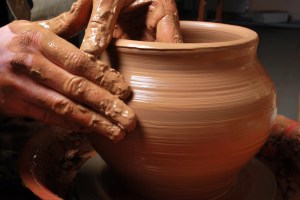
Material cause or Nature is inert non-living and hence incapable of being organized or disorganized itself in a planned manner. It needs an organizer or efficient cause for that.
Common cause includes the time and space.
This is true for any creation that happens in world – by Ishwar or by us.
Now, the next logical question that may arise in one’s mind is “How can this universe and physical beings come out from such an entity that is beyond physical attributes”?
The web that answers:
For this we should watch two interesting videos (one by Mr. David Attenborough).
We will see what these amazing videos convey w.r.t our subject – the creator in our next blog
Essentially the first Sloka of the Dakṣiṇāmūrti Sthothram deals with “atma svaroopam” which Adi Sankaracharya reveals with two day to day examples of “darpana nagari” and “svapna nagari”. The Atma is revealed as the base “adishtaanam” of the Universe, as the independent existence – truth “sathya”, as the one unaffected by the events and whatever happens “asamgaha” and finally as non dual “advayam”, the Brahman Himself.
In this first verse, from the experiential standpoint we discover that the world exists in our mind. The world exists because we experience it. Usually we think the other way around. The conventional perspective is world exists therefore we experience it. This is called srishti drishti vada . (Srushti means creation. Drishti means seeing. Vada means doctrine or teaching). It means, you see the world because it has been created. In the ongoing “Global Festival of Oneness 2021” conducted by Advaita Academy, there was an interesting presentation on this. This is how this debate on the two perspective was summed up pictorially by the speaker.
But the presentation by Sankara in this first verse is opposite to the conventional view. The creation exists because you see it. The world in the mind exists because you are there to experience it. If you are not there to witness the world, the world in your mind would not exist. What you directly experience is only the contents of your mind. So the vision conveyed by the first verse is drishti srishti vada. It is opposite to the conventional perspective.
ஆதி சங்கரரின் தக்ஷிணா மூர்தி ஸ்தோத்திரத்தின் முதல் பண்ணின் கருத்துக்கள் சைவ சித்தாந்தத்தில் வெளிப்படுகிறது. திருமூலர் திருமந்திரத்தில் சொல்கிறார்:
தன்னை அறியக் கிளம்பியவர்கள் தன்னுடைய மூலை முடுக்குகளிலெல்லாம் தன்னைத் தேடினார்கள்; மனம் எதிர்ப்பட்டது; அங்கும் தேடினார்கள்; அது ஒரு மாயப் பிம்பத்தை எழுப்பிக் காட்டியது. அடிமுடி தேடிய படலத்தில், முடி தேடிப் போன பிரம்மன், முடியைக் காணாமல் அன்னப் பறவையைக் கண்டு திரும்பிவிட்டதைப்போல, தன்னையே தேடிப் போனவர்கள், தன்னைக் காணாமல் ஏதோ ஒரு மாயப் பிம்பத்தைக் கண்டு அதுவே தான் என்று எண்ணித் திரும்பி விட்டார்கள். விளங்காதவர்கள்; விளக்கிச் சொன்னாலும் விளங்கிக் கொள்ளத் தெரியாதவர்கள். தலைவாயில் அடைத்திருப்பதாக எண்ணி ஏமாந்து பின்னால் சென்று புறக்கடை வாசலைத் தட்டிக்கொண்டு நிற்கிறார்கள். தன்னை அல்ல, தன்னுடைய நிழலைக்கூட இவர்களால் கண்டுகொள்ள முடியாது.
Brahman is in essence the indwelling Controller for all activity seen in any being whatsoever. That is why Bhagwan Ramana Maharishi says that stop unwanted discussions/arguments about the real or unreal world and objects. Start looking inwards in his “Ulladhu Naarpadhu” – உள்ளது நாற்பது.
உலகுமெய்பொய்த் தோற்ற முலகறிவா மன்றென்
றுலகுசுக மன்றென் றுரைத்தெ — னுலகுவிட்டுத்
தன்னையோர்ந் தொன்றிரண்டு தானற்று நானற்ற
வந்நிலையெல் லார்க்குமொப் பாம்.
What is the use of disputing: ‘The world is real’, ‘[No, it is] an unreal appearance’; ‘The world is sentient’, ‘It is not’; ‘The world is happiness’, ‘It is not’? Leaving [all thought about] the world and investigating [or knowing] oneself, [thereby] putting an end to [all disputes about] one and two [non-duality and duality], that state in which ‘I’ [ego] has [thereby] perished is agreeable to all. So instead of looking outward, start looking inward.
இதனையே திருமூலர் திருமந்திரம், 2956 பதியில்;
மனமாயை மாயை;இம் மாயை மயக்க;
மனமாயை தான்மாய, மற்றொன்றும் இல்லை;
பினைமாய்வது இல்லை; பிதற்றவும் வேண்டா;
தனைஆய்ந்து இருப்பது தத்துவம் தானே.
என தெளிவாக உரைக்கிறார். உங்களைப் பேதைமைப்படுத்துவதும் மயக்குவதும் நீங்களே உருவாக்கிச் செல்லங் கொஞ்சிப் பேணி வளர்த்து வைத்திருக்கிற மனம்தான். மனம் உங்களை மயக்குவதை நிறுத்துங்கள்; மனத்தை நீங்கள் மயக்குங்கள். மனம் என்கிற மாயை ஒழிந்துவிட்டால், பிறகு உங்களை மயக்கத்தக்கது வேறு ஒன்றும் இல்லை. ஒழித்துக்கட்ட வேண்டியதும் வேறு ஒன்றும் இல்லை. மனத்தின் தூண்டுதலுக்கு ஆட்பட்டுத் தாறுமாறாக நடந்துகொள்ளவும் தேவையில்லை. தன்னையே தான் ஆராய்ந்து, தானே தானாக இருப்பதுதான் யோகம்.
தன்னையே தான் ஆராய்தல் எப்படி? மாணிக்கவாசகர் சொல்கிறார்:
நான்ஆர்?என் உள்ளம்ஆர்? ஞானங்கள்
ஆர்? என்னை யார்அறிவார்?
வானோர் பிரான்என்னை
ஆண்டுஇலனேல் மதிமயங்கி
ஊனார் உடைதலையில்
உண்பலிதேர் அம்பலவன்
தேன்ஆர் கமலமே
சென்றுஊதாய் கோத்தும்பீ
(திருவாசகம், திருக்கோத்தும்பி, 2). நான் யார், என் உள்ளம் எது, ஞானங்கள் எவை என்று அறிய வேண்டும்; என்னை அறிகிறவர் யார் என்றும் பார்க்க வேண்டும். எல்லாமே வானோர் பிரானாகிய சிவன்தான் என்று தன்னை அறிவிக்கும் பொறுப்பையும் அறியும் பொறுப்பையும் இறைவனிடம் ஒப்படைக்கிறார் பக்தியின் வழிவந்த மாணிக்கவாசகர். யோகத்தின் வழிவந்த திருமூலரோ அந்தப் பொறுப்பைத் தன் வசமே வைத்துக்கொள்கிறார்.
So, how do we elevate ourselves to that enquiry Who am I? How can I look inward? In answer to this question, Sages have identified four areas
Study of Shastras and Shruti 2. The Kripa of the Guru 3. Yoga practice (Abhyasa) through meditation 4. God’s grace/Isvara Anugraha
When, by Shruti,, by the master’s favour, by practice of Yoga, and by the Grace of God, there arises a knowledge of one’s own Self, then, as a man regards the food he has eaten as one with himself, the Adept Yogin sees the universe as one with his Self, absorbed as the universe is in the Universal Ego which he has become.
References:
மேற்கோள் நூல்கள்
1. Dakṣiṇāmurty. Sthothram – Talks By Swami Paramarthananda; Transcribed by Sri P.S. Ramachandrn; Published by :Arsha Avinash
2. Dakshinamurti Stotra with Mānasollāsa of Sureśvarācārya translated by Alladi Mahadeva Sastri – from archives.org
3.சங்கரரின் தக்ஷிணாமூர்த்தி தோத்திரம்: சைவசித்தாந்த விளக்கம் – முனைவர்கோ.ந. முத்துக்குமாரசுவாமி – https://www.tamilhindu.com/
We saw in the last two blogs the Vedantic Concepts behind the Mirror and Dream. Let us now see how Bhagwadpaada Adi Sankara uses these two examples and teaches us further.
“To Him who by illusion of Ātman, as by sleep, sees the Universe existing within Himself – like a city seen to exist within a mirror – as though it were manifested without; to Him who beholds, when awake, His own very Self, the second less; to Him who is incarnate in the Teacher; to Him in the Effulgent form facing the South, to Him (Siva) be this bow!”
Vishvam Darpana-Drshyamaana-Nagarii-Tulyam – viśvam means this visible universe; the universe which we see in our waking state is comparable to darpaṇa dṛśyamāna nagari tulyam, comparable to the reflected city being seen in a huge mirror.
Nija-Antargatam – This visvam is within oneself only
Pashyann-Aātmani – This visvam (the world we are experiencing within ourselves only) is actually existing in me, ātmani pasyathi.
Mayayaa – because of the “aadhiṣṭāna ajnānam” i.e., avidya or maya (Ref the previous blogs)
bahiri udbhūtam – appears as though outside,
yathaa – like
nidrayaa – when we are asleep,
(the dream world which is really existing within ourselves appears as though outside, when we are asleep – implied meaning).
Iva – By using the word iva: as though outside, Sankaracharya conveyed that it is really not outside, everything is inside me only.
Yah: – In this context refers to the sleeping person “supta puruṣaḥ”; and this sleeping person was seeing the svapna viśvam outside; the sleeping person was seeing the dream world outside;
prabhodha samaya – but when the sleeping person wakes up, what is his experience; his outside dream world is resolved into himself. All elements of svapna viz. svpna deśa disappears into himself; svapna kālaḥ, svapna padārthaḥ, svapna jīvaḥ, they all dissolve effortlessly; since the entire dream world is resolved into himself, what remains? he the waker alone remains. Therefore, “supta puruṣaḥ, prabodha samaye,
advaiyam svatmānam sākṣātkurute” – meaning that on waking up, the sleeping person recognises himself as the secondless one; without any dream object. After waking up, I do not see the waker; I claim myself to be the waker. This claiming is called sākṣātkāraha. I should not use any other verb. If I say I see the waker, waker appears to be another person. If I say I experience the waker; it appears as though waker is different. Suppose I say I become the waker; even that word is not correct strictly because; there is no becoming involved; I was the waker before, I am the waker now, therefore, I do not even become the waker. I claim myself to be the waker; this claiming is called sākṣātkāraha.
Similarly, in self-knowledge, I do not experience the ātma/ In self-knowledge I do not see the ātma. In self-knowledge I do not become the ātma; In self-knowledge I claim I am the ātma. And this peculiar process of claiming is called sākṣātkāraha. So, it is not coming face to face. sākṣātkāraha, if it is translated as direct experience, we will have all kinds of misconception that when I wake up Brahman will be standing in front, smiling, giving darshanam. It is not like that, I am the waker. Therefore, prabhoda samaye, on waking up supta puruṣaḥ svātmaanam advyayam eva sākṣātkārute.
Last Line of the Sloka
तस्मै श्रीगुरुमूर्तये नम इदं श्रीदक्षिणामूर्तये Tasmai Shrii-Guru-Muurtaye Nama Idam Shrii-Dakssinnaamuurtaye
tasmai – means prabuddha puruṣāya; to that woken-up person, who is a jnāni; who is liberated; who knows I am jagatadhishtaanam, to that jnani my namaskaaram. So tasmai prabuddha puruṣāya, jnānine namaha. And who is that jnāni?
Shree gurumurthaye – who alone is a guru, who alone can serve as a guru and who is my guru, gurumoorthaye.
Namaha – my salutations.
Thus we can see that a complex concept in Philosophy is explained by Adi Sankara in just two lines using two simple day to day events in human life – the examples of viewing in a mirror and dreaming captures the essence of Vedanta. We will conclude the Sloka 1 in the next blog with a summary.
References:
மேற்கோள் நூல்கள்
1. Dakṣiṇāmurty. Sthothram – Talks By Swami Paramarthananda; Transcribed by Sri P.S. Ramachandrn; Published by :Arsha Avinash
2. Dakshinamurti Stotra with Mānasollāsa of Sureśvarācārya translated by Alladi Mahadeva Sastri
3.சங்கரரின் தக்ஷிணாமூர்த்தி தோத்திரம்: சைவசித்தாந்த விளக்கம் – முனைவர்கோ.ந. முத்துக்குமாரசுவாமிwww.tamilhindu.com/
In the process of my spiritual journey, I have been trying to understand the works of Adi Sankaracharya. The child in me ventured and tried to understand the following works of Adi Sankara so far.
Sivananda Lahari, Siva Panchaksharam, Subramanya Bhujangam, Nirvana Shatakam, Bhaja Govindam and Ganesha Pancharathnam. The current venture is into Dakshinamurthy Sthothram.
Last week during one of my Whatsapp messaging with my eldest brother (whose name is incidentally Gurumoorthy), I got the link of the MS Subbulakshmi’s song on Totakaashtakam. That was the trigger.
How childish I am and how immature I have been! True to the nature of a child (as would be described by Adi Sankara himself in one of the Slokas of Dakshinamurthy Stothram), it didn’t even occur to me that I should offer my prayers to Adi Sankara himself first, before venturing. How can anyone commence a journey without offering prayers to the காவல் தெய்வம் ? (The Protector) Sankara.
To me it became clear that The Guru, appeared as an innocuous message from my brother Gurumoorthy and triggered me to dive into Totakaashtakam and ensure that I don’t carry on the journey without offering my prayers to Adi Sankara – the Akhila Guru’s (Lord Sankara’s) avatar.
So, here is my humble understanding of the Ashtakam and my prayers to Adi Sankaracharya.
I dedicate this translation to the lotus feet of Maha Periavaa Sri Paramacharya of Kanchi. Here is a rare video clip of Maha Periavaa explaining Totakaashtakam.
I will resume Dakshinamurthy Stothram now in the next blog on 07th May 2021.
It is an oft-quoted saying that philosophy begins in wonder. The mystery of the Universe with all its changes strikes the reflective temper of human beings. Through this reflective temper, human beings constantly question their experiences. The Vedic philosophy grew out of a demand for the explanation of actual experiences of an individual.
One of the fundamental laws of Vedanta is “ I am different from whatever I experience”. In general, this whole world that I experience therefore, comes under the Category – “The experienced” or in other words “The object” and I come under the category “The experiencer” or “The subject”.
Now, start the reflective temper by dismissing the object and the subject only remains. In this world I interact with persons and I clearly say that “I am not like this person; I am not like these group of persons; I am not this animal; I am not this; I am not that, I won’t be like that, I am different etc.”….and the list goes on. This way you go on dismissing everything that you experience as an object different from you and finally dismissing the world itself as an object. This is the first level of reflection. The next level is to look at yourselves, since you ruled out the world.
I am not the world that I experience ; but then who am I ? To my limited knowledge, there cannot be any other question other than this simple question which evoked such a vast, deep and wide analysis of the individual experiences by the Saints & Philosophers of Hinduism/Sanatana Dharma. One lifetime to understand the material available may not be adequate. Yet from this ocean of information and knowledge I will venture out and reproduce what is quoted in the basic source book on Vedanta “Tattva Bodha”.
‘I’ (addressed as Atma) am the one who is distinctly different from the gross, subtle and causal bodies; who is beyond the five layers (kośas); who abides as the self-evident witness to the three states of experience (of the nature of existence/awake-awareness/dream-fullness/deep sleep).
Vedanta identifies the features of a human body-mind-intellect complex with three types of bodies, 5 types of sheaths/layers, 5 sense organs 5 action organs , the mind the intellect and the three states of the consciousness (viz, wake, dream and deep sleep). This means that the “Atma (“I”) ” is beyond all these 21 seamlessly integrated features of body-mind-intellect complex.
“I” am not the world; “I” am not the body, “I” am not the mind/intellect. If “I” am different from all these three; then “I” must be a conscious principle, because I am experiencing them.
Thus the entire object or anātmā consists of three factors, the world, the body and the mind; and “I”, the ātmā, the observer consists of the consciousness principle called chaitanyam. This is the fundamental concept that we are trying to grapple with in Vedanta
At this stage I am again reminded of this excellent poem “Master Piece” by “Author Anonymous” which I posted in my blog on June 12, 2020 (Masterpiece – Prabhu’s Ponder (prabhusponder.com)). It simply moved me – what deep understanding of the subject and what an expression! The author wanted to remain Anonymous and clearly stated that “spirituality decreases when it is attributed to a person. I was but a scribe.”
This master piece is what “I” am and can only be experienced rather than be defined.
Now in the first Sloka, the subject matter is: What is the relationship between I, the consciousness principle, and the entire universe; the inert matter. What is the relationship between I the ātmā, the consciousness principle, and the world, the inert principle called anātmā.
So अत्म–अनात्मसम्भन्दः atma-anātma sambhandaḥ “ஆன்மாவும்அண்டமும்” “Jivatma and the Jagat” is the subject matter of the first verse; and Sankaracharya beautifully explains this with the help of two examples of mirror and dream, about which we will see in the coming blogs.
CAUTION 1:
Throughout the blogs, you will see fair mix of words in Sanskrit and Tamil. Wherever possible, I will try to use the transliterated/ words with verbatim letters in English for easy understanding based on my elementary knowledge.
CAUTION 2
As each Sloka brings out the essence of Vedanta, it is necessary that some basic concepts of the Vedanta is discussed first before dwelling into the Sloka. As such there will be introductory blogs which will cover the concepts before taking up the Sloka and its meaning. With my limited understanding I will try and make these conceptual blogs simple through day to day examples. If you find them too elementary, please bear with my ignorance. It will turn out that we may need a minimum of 4-5 blogs to cover each Sloka. Get ready for a long haul.
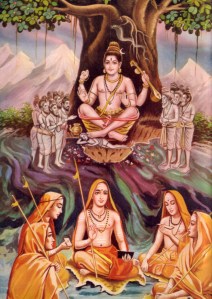
Salutations to Dakṣiṇāmurty whose exposition through profound silence is awakening the knowledge of the Supreme Brahman in the hearts of His disciples; who is Himself youthful but is sitting surrounded by old and great sages who are devoted to Brahman. The hands of the Supreme Spiritual Teacher form the Cin-Mudra. His appearance is still and blissful and who rejoices in His own Self which is reflected on his blissful face
Sitting on the ground near the banyan tree (Vata) were all Munis (Sages), who were (sitting) near to the bestower of knowledge. They were (sitting) near to the Guru of the three worlds, the Lord Himself, personified as Dakshinamurthy Deva; near to the one, expert in severing the sorrows resulting from the cycles of births and deaths; I bow to that Dakshinamurthy.
It is indeed a strange picture to behold; At the root (i.e. base) of a banyan tree (Vata) are seated old disciples (i.e. aged disciples) in front of an young Guru, The Guru is silent, and silence is His exposition (of the highest knowledge); and that (silence) is severing the doubts (automatically) from the minds of the disciples.
(Salutations to Sri Dakshinamurthy) who is a receptacle to all Knowledge, who is a Medicine to all the diseases of Worldly bondage, who is a Guru to all the Worlds; Salutations to Sri Dakshinamurthy
Sloka 5
ॐ नमः प्रणवार्थाय शुद्धज्ञानैकमूर्तये ।
निर्मलाय प्रशान्ताय दक्षिणामूर्तये नमः ॥५॥
Om Namah Prannava-Arthaaya Shuddha-Jnyaanai[a-E]ka-Muurtaye |
Salutations to the embodiment of Pranava (Om), Salutations to the personification of the pure, non-dual knowledge, Salutations to the pure and stainless, and Salutations to the tranquil; Salutations to Sri Dakshinamurthy.
(Salutations to Sri Dakshinamurthy) Salutations to the one who is (as if) Consciousness solidified, Salutations to the Mahesha (the Great God), Salutations to the one who dwell at the root (i.e. base) of the banyan tree (Vata), Salutations to the embodiment of Sacchidananda (Existence, Consciousness, Bliss); Salutations to Sri Dakshinamurthy.
“Ishwara – Guru – Atman”; (underlying) these different forms of (apparent) separation like a sky (i.e. spiritual sky or Chidakasha) who pervades, Salutations to that Dakshinamurthy.
Plan for the month of May 2021
Starting from April 30, 2021 we will try and understand the first Sloka of Dakshinamurthy Stothram through 5 blogs, each spaced at one week from the other.
Dakṣiṇāmurty is regarded as an aspect of Siva, as the universal teacher. He is the young and radiant Adi-Guru, Para-Guru, the Supreme Guru, imparting knowledge that liberates. He is the very personification of spiritual wisdom and eminence; and one who is immersed in Self. His teaching is through the subtlest form of speech- para vak – beyond the range of the physical ear, abiding in silence; the sort of silence that envelops within itself all other forms of expressions. It is the silence that underlines the limitations of rational knowledge, futilities of the blind alleys of metaphysical queries and the frailty hollowness of words. His teaching transcends speech and thought; it is experience. His listeners are learned and wise; ripe in intuitional understanding. The Guru’s language of silence dispels the doubts, the confusion and uncertainties in the minds of those around sitting in silence.
The Banyan Tree:
The banyan tree (vata vruksha) under which the Guru sits symbolizes creation as also the expanding universe, which regenerates itself. The tree known as Akshya vruksha with its unique growth pattern also represents the eternal principle, the Dharma. (Vata derived from the Sanskrit root “vat” means: to expand, to surround and to encompass). It is meant to suggest that Sri Dakṣiṇāmurty who sits under the vata tree presides over the cyclic processes of srishti (creation), sthiti (preservation), samhara (absorption or gathering up), tirobhava (suppression) and anugraha (revealing true knowledge).
The Iconography:
The iconographic descriptions of Sri Dakṣiṇāmurty are not uniform. In addition, there are several versions of his aspects and attributes. The following, in brief, is a summary position of Sri Dakṣiṇāmurty- iconography.
Sri Dakṣiṇāmurty is depicted as a young person with serene, tranquil and pleasing countenance; seated in a secluded spot in the Himalayas, under a banyan tree, upon a throne or a rock or an elevated platform covered with tiger-skin or deer-skin. Sri Dakṣiṇāmurty who is is always depicted singly.
He is usually depicted with four arms. In his upper right hand, he holds a rosary (aksha-maala) in kapittha-mudra, as if counting beads of japa-mala; or a snake (sarpa: symbol of tantric knowledge) or both. Sometimes, he is also shown holding a drum (damaru) with a snake coiling around it. The damaru, the srishti (creation) aspect of Shiva, represents the primeval sound and rhythm from which the universe emerges; and, into which it dissolves before re-emerging. The snake coiling around the damaru, symbolizes Kaala (time); it could either be the beginning or the end of time. In his upper-left-hand, he holds a flaming torch (Agni) symbolizing enlightenment or illumination, removing the darkness of ignorance. It also stands for his samhara (absorption or gathering back the created existence) aspect. His lower-left-hand resting on his left knee (the back of the hand touching the knee) gestures varada-mudra bestowing a boon (varadam vamahastam); and, it also holds a bunch of kusha grass or a palm-leaf manuscript symbolizing scriptural knowledge. The lower right-hand is depicted in a number of ways; and, the position of its palm, its fingers/gesture often defines the nature of a particular form of Sri Dakṣiṇāmurty. The lower-right-hand:
either gestures grace (his anugraha aspect) or assurance (abhaya-mudra); or
gestures jnana-mudra (thumb and middle/index finger meet each other and touch the heart (jnana mudram hrdi sthane); or
it faces inwards (abhyantara mukham karma) as in the temple at Ilambyankottur (conveying that knowledge comes from within); or
is held in chin-mudra (the index finger of his right hand is bent and touching the tip of his thumb – the other three fingers are stretched up) indicating identity of the Absolute and the individual; or
is held in Vykhyana-mudra (similar to chin-mudra)- but, facing the viewer as if imparting a teaching, while seated in a relaxed position; and so on
The Posture:
Sri Dakṣiṇāmurty is most usually depicted in a seated posture; and at times in standing, as in his Veena-dhara variation (holding a veena). But he is not depicted in reclining (shayana) postures. While seated in Virasana, his right leg is stretched down (lambaka padam); and, is stamping upon (samharaka) the dwarf (apasmara–puruṣaḥ : representing ignorance and delusion). This suppression (nirodha) of ignorance is described as the tirobhava aspect of Sri Dakshinamurti. And, his left foot bent at the knee is resting on his right knee or thigh (sayanam padakam or kunchita-paada). His sitting posture is relaxed; his body position and carriage is free from bends and rigidity. His general aspect is calm and meditative.
The Hair and Decorations:
His luxuriant hair of matted locks (jatabhara, jatabhandha, jatamandala or jatamakuta), said to represent his sthithi (preservation) aspect, is adorned and enriched with jewelry, the crescent moon, a snake and bunches of wild flowers such as durdhura (dhatura). The mass of the jatas is either disheveled or held together by a snake or a band (patta-bandha); and, is arranged in conical shapes to resemble a crown. In the middle of jatabhara, resides a small smiling face of the Ganga. Curly hair locks fall onto his shoulders and upper arms. On his forehead, he bears a vertical urna (third eye). It is said dhurdhura (dhatura – belonging to Solanaceae family) and other forest-flowers as well as the cobra must be positioned over the right of his head ; the skull and moon over the left ; and , Ganga in the middle. Sri Dakṣiṇāmurty is modestly adorned with rudraksha-mala; garlands of wild flowers; flowers above his ears (karna avathamsam). The yagnopavita (sacred cord) runs across his chest, which is adorned with sandal-paste, garlands and necklaces. He is ornamented with kati-bandha jewelled waist band; naga-bandha armlets; anklets with little bells; bracelets; kirti-mukha earring in his right ear and conch- shell earrings (shankha-patra) or an open circular earring (karnavali or vrutta-abharana) in his left earlobe.
The Complexion and the dress code
The nature of Sri Dakṣiṇāmurty is sattva, pure, blissful, bright and serene (shantha). His complexion is radiant like a clear crystal (shuddha spatikopama); or the pure silvery white pearl (spatika-rajatha-varna mauktikeem); or soothingly bright as the jasmine flower or the moon (kundendu dhavala prabha). He is also described as glowing like gold (hema prabha) or dark (shyamabha) . Some Tantric texts describe his complexion as white as milk (kshira-gaura) or snow-white (Kailasadri-nibha), absorbed in self (bhava shuddha). His countenance is free from even the slightest traces of disturbance (klesha vargitam). A soothing and gentle smile lights up his expression. His steady gaze is fixed upon the tip of his nose (nasagra drshti yuk) or on the tip of his toes (padagre drhsti patam). His eyes must be slightly open (kimchid unmiltair netraih), as in contemplation (yoga dhyana-anusarinam). He is dressed in white upper garments (sittottariya) and yajnopavita (sita-upavita). His lower garment is of tiger skin (vyagra charmambara) or silk (divyambara) , held in place by a serpent.
The Surroundings:
The great teacher-god is surrounded by many animals, particularly the deer and the Nandi bull. The Rishis eager to absorb the Guru’s teaching are at his feet. Their numbers and names are mentioned differently in different texts. For instance; Karanagama mentions four Rishis: Agasthya, Pulasthya, Vishwamitra and Angoras. The Kamikagama mentions seven Rishis : Kaushika, Kashyapa, Bharadwaja, Atri, Gautama and two others. And, the Amsumad-bhedagama mentions seven Rishis as Narada, Vashista, Jamadagni, Bhrighu, Bharadwaja, Sanaka, and Agasthya. The texts also mention that the number of sages depicted could either be one , two or even three (esham ekam dvayam vapi trayam vaparsvayor nyaseth). The aged sages must all be shown with matted hair coiled up (jata bhara); dressed in white; and, wearing rudraksha maala . Their height is prescribed not to reach above the chest of Sri Dakshinamurthi.
Significance of the name:
Let us now dwell on the name. Why is he called Dakṣiṇāmurty? It is mentioned repeatedly that he is called Dakṣiṇāmurty because he is facing south and also because the deity is placed in the southern quarter of the temple. Some say that the name of the deity may have been derived because of this practice. However, there are few other explanations too.
Yama, the Lord of Death, is in the southern direction. Usually this is considered inauspicious, for example, we are not advised to do Achamanam, japam or any mangala kaaryam facing south. Some people do not even sit facing south while eating. Since Yama, being the Lord of death is a dreaded one, Sri Dakṣiṇāmurty who liberates one from eternal death, saṃsāraḥ., is actually face-to-face with Death, challenging him. In other words, Jnana is the panacea for saṃsāraḥ., death. He who gains Jnana is never afraid of death. Death is kAla, and Shiva, Jnana, is kAla-kAla, or Shiva deals Death to that very Death. To signify this we have Sri Dakṣiṇāmurty facing south.
The south-orientation of Sri Dakṣiṇāmurty appears to be based on the notion that he is seated in the Himalayas looking towards the land-mass where the aspirants reside; that is towards south.
Another way of understanding it is; Suta –samhita describes the five faces or five aspects of Shiva which are turned towards four cardinal directions and the space above, as: on the West: Sadyojata (representing earth, and pervading ego); on the North: Vamadeva (water and manas); on the South: Aghora (fire and Buddhi); on the East: Tatpuruṣaḥ (air and maya); and above all: Isana (akasha and soul). The South face of Shiva is Aghora. Aghora the benevolent is predominantly of sattva nature with minimal of rajas and tamas. It is a state of pure being and energy. It is pure knowledge (para-vidya); and, Sri Dakṣiṇāmurty represents that knowledge. Sri Dakṣiṇāmurty who corresponds to Aghora the south aspect of Shiva is therefore represented facing south.
The great seer Sri Ramana Maharishi who perhaps is closest to Sri Dakṣiṇāmurty in his ideals and in his teaching methods, explained the term as Dakshina + Amurthy, meaning a formless entity, one which is capable but is without form. Dakshina refers to He, who is competent to create, sustain, and dissolve this Universe; and, who, however, in reality, in his Absolute state, is A-murthy i.e. formless.
He is called Dakṣiṇāmurty because of his boundless compassion (Dakshinya) towards all creation. Dakshina , it is said , also means favourable (anukula ) to the devotee. Dakshina is also interpreted as grace. Sri Dakṣiṇāmurty is regarded the very embodiment of grace. It is explained that ‘grace’ (anugraha) is an act of unbound compassion releasing the individual from the coils of saṃsāraḥ.. As Guru, he is the sublime ideal of spiritual wisdom adorned with grace towards all aspirants. And, only through his grace can one attain liberation.
The term ‘daksha’ denotes one who is capable, skilful or an expert. Daksha also signifies the intelligent or competent. Dakṣiṇāmurty is the Daksha, the Master in music, arts and in all that is accomplished artistically; an exponent, an authority on scriptural learning; an adept in Tantra-vidya; a supreme Yogi; and, a teacher beyond compare who teaches the true knowledge that liberates.
The Panchakshara (पञ्चाक्षर) literally means “five letters” in Sanskrit and refers to the five holy letters Na, Ma, Śi, Vā and Ya. This is prayer to Lord Siva and is associated with Siva’s Mantra , OM Namah Sivaya of which is also called the Panchakshari Mantra.
Here is a translation in Tamil of the epic Sthothram by Adi Sankaracharya
As I wrote last week, I have commenced my journey in understanding myself. Nothing works without a prayer and I am a strong believer in that life style. So, I will start with a prayer on who else except the one and only Lord Arunachala at Thiruvannamalai who through Bhagwan Ramana Maharishi kindled the enquiry “WHO AM I?” in millions of people in the Universe, me being the latest ignorant one , the “jada jana”. This will be a composition by Sri Muthuswamy Dikshithar. The blog will appear under Carnatic Musing in the Menu on 9th April 2021
An introduction to Dakshinamurthy will be presented in the blog that follows on 16th April. I am deeply obliged to Mr. Sreenivasa Rao for kindly permitting me to use his blogs where he has covered the subject in it’s entirety
This will be followed by a blog on the Dhyana Slokas (துதிப்பாடல்கள்) that will be published on 24th April 2021 coinciding with the Divine Wedding of Goddess Meenakshi with Lord Sundareshwarar at the Meenakshi Temple at Madurai, Tamil Nadu.
After that I plan to take time for each of the Slokas as I am a learner. These blogs will be longer than usual, as these will include apart from the translation in Tamil, excerpts from the various commentaries that I tried to read for my understanding. The first Sloka is planned in the month of May






 Prabhu's Ponder